As the crypto asset market has evolved, leveraged trading has gradually become a key way to improve capital efficiency. Traditionally, this has relied on perpetual contracts or futures, tools that are powerful but require users to actively manage margin, monitor exposure, and handle liquidation risks.
As the user base expanded beyond professional traders, demand grew for simpler leveraged products. In response, leveraged tokens began to emerge, packaging complex leverage mechanics into assets that can be traded directly.
Gate ETF is one such implementation. It automatically manages underlying positions, allowing users to gain leveraged exposure without interacting with derivatives directly. Within the crypto trading ecosystem, it sits between spot trading and contract trading, combining elements of both.
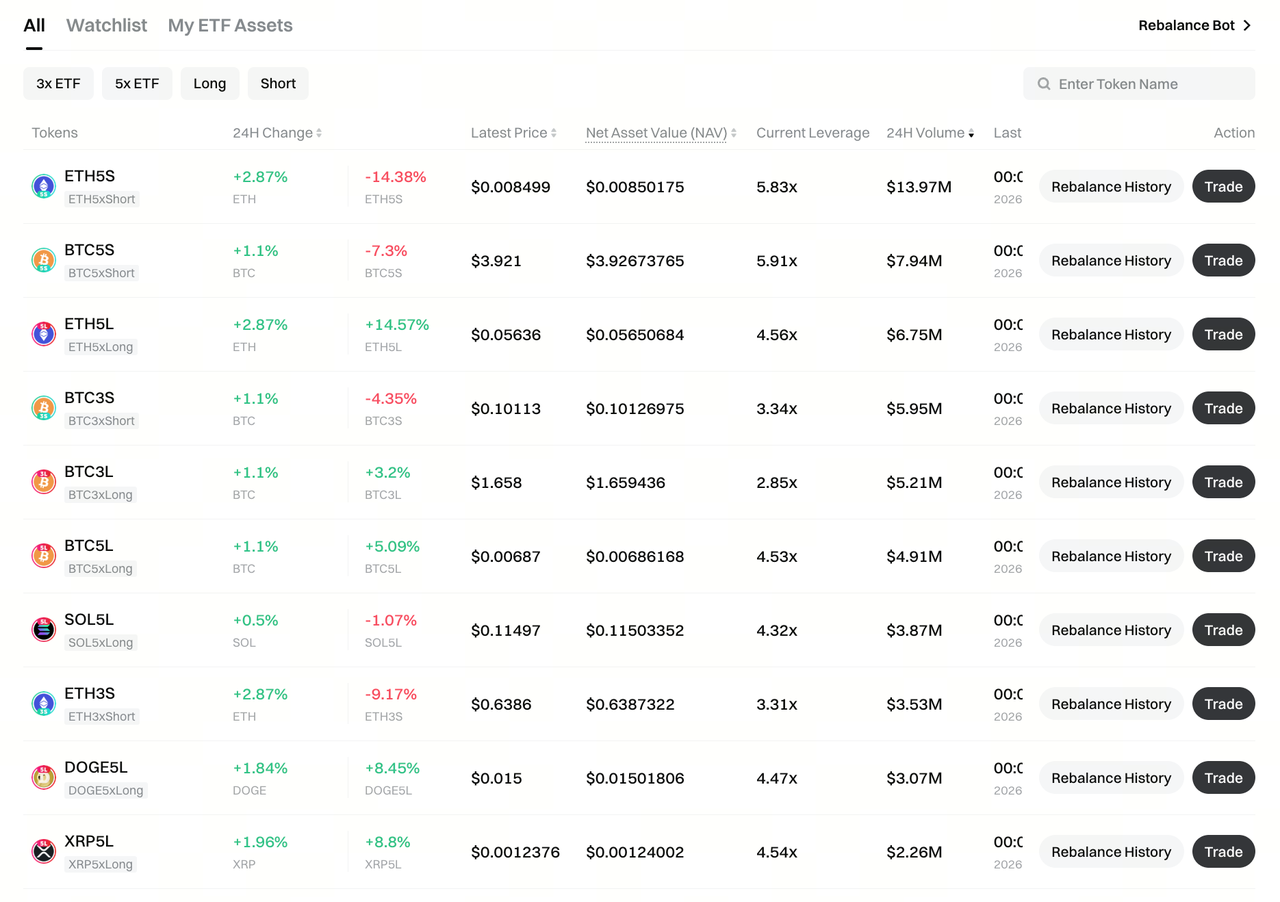 Image source: Gate ETF Leveraged Tokens
Overall Operating Logic of Gate ETF
The operation of Gate ETF can be understood as an automated loop system, with the following core process:
-
Users purchase ETF tokens
-
The system establishes corresponding perpetual contract positions
-
Net asset value (NAV) is calculated based on market changes
-
Rebalancing occurs when leverage deviates from the target
-
The token price continues to track amplified market performance
The key idea is simple: users only buy and sell, while all leverage implementation, position adjustments, and risk control are handled automatically by the system.
Underlying Structure: How Leverage Is Achieved
The leverage in Gate ETF comes from its underlying perpetual contract positions, not from the token itself.
When a user buys a leveraged token, for example a 3x long BTC token, the system opens a corresponding long position at a multiple of the net asset value. This allows the ETF to deliver amplified returns.
As market prices change, profits and losses from these positions update in real time and are reflected directly in the ETF’s NAV. Meanwhile, the system continuously adjusts position sizes to keep leverage close to its target range.
Pricing Foundation of Gate ETF: The Net Asset Value (NAV) Mechanism
The core pricing basis of Gate ETF is its net asset value, rather than pure market supply and demand. The general formula is:
NAV = value of underlying positions + cash balance − fees and management costs
When the underlying asset price changes, gains or losses in the contract positions directly impact NAV, which in turn drives the ETF price.
In actual trading, the market price of the ETF may briefly deviate from NAV. However, due to arbitrage mechanisms, these deviations are usually corrected quickly, bringing the price back to a reasonable range.
Automatic Rebalancing: The Core of Risk Control
Automatic rebalancing is the key mechanism that allows Gate ETF to maintain target leverage.
When market movements cause actual leverage to drift away from the target, the system adjusts positions automatically. For example:
-
During upward trends, if leverage increases passively, the system may reduce positions to lower risk
-
During downward trends, it may adjust positions to prevent leverage from spiraling out of control
In addition, sharp market volatility or predefined thresholds may trigger extra rebalancing actions.
The essence of this mechanism is that risk control is embedded directly into the product, rather than relying on users to manage it themselves.
What Happens When Users Trade Gate ETF?
From a user’s perspective, trading Gate ETF feels similar to spot trading, involving only buying and selling.
Behind the scenes, however, a series of complex operations takes place:
-
When users buy, the system creates corresponding shares and increases underlying contract positions
-
When users sell, the system reduces positions and settles NAV
This process is similar to subscription and redemption in traditional funds, but the underlying assets here are dynamically managed derivative positions rather than conventional financial instruments.
Why Are Gate ETF Returns Not a Fixed Multiple?
Although Gate ETF targets a fixed leverage ratio, actual returns often deviate from a simple multiple. The main reasons include:
-
Path dependency, returns depend on the price movement path, not just the final change
-
Rebalancing loss, frequent adjustments can erode returns in volatile markets
-
Fee structure, management fees and funding costs gradually affect NAV
Because of this, the product is generally more suitable for trending markets rather than long term holding.
Advantages and Limitations of Gate ETF
From a design perspective, Gate ETF significantly lowers the barrier to using leverage. Users do not need to manage margins or worry about liquidation risks.
However, its limitations are equally clear. Rebalancing can lead to losses in sideways markets, and long term holding may result in performance drift due to fees and path dependency.
This means performance depends not only on market direction but also heavily on market structure and volatility patterns.
Conclusion
Gate ETF transforms leveraged trading into a productized format through underlying contract positions, NAV calculations, and automatic rebalancing. This structure allows users to access leveraged exposure via spot trading, while delegating complex risk management to the system.
Understanding how it works helps clarify both its return drivers and risk characteristics, providing a more complete framework for evaluating the product.
FAQs
What determines the NAV of Gate ETF?
It is mainly determined by the profit and loss of underlying contract positions, cash balance, and related fees.
Is automatic rebalancing triggered at fixed times?
Usually not. It is triggered when leverage deviates from the target or when market volatility reaches certain thresholds.
Why does the ETF price deviate from NAV?
Short term deviations may occur due to supply and demand, but arbitrage mechanisms typically bring the price back in line.
Can Gate ETF be considered a fund?
It is similar in terms of subscription and redemption logic, but the underlying assets are derivative positions, so the risk structure differs.
Is Gate ETF suitable for long term holding?
It is designed more for use in trending markets. Long term holding may be affected by fees and volatility related losses.