Gate GTETH: Unlocking Yield and Liquidity for ETH Holders

Beginner
Quick Reads
Last Updated 2026-03-24 20:09:57
Reading Time: 1m
As Ethereum moves to the Proof-of-Stake mechanism, staking has become a primary avenue for ETH holders to earn on-chain returns. Yet, the conventional lock-up approach has exposed significant liquidity limitations. GTETH aims to achieve equilibrium between yield and asset flexibility, allowing holders to benefit from staking rewards while maintaining the freedom to allocate their funds dynamically.

Staking Should Be More Than Just Waiting
Staking Should Be More Than Just Waiting

With the introduction of the PoS mechanism, staking has become a core source of yield within the ETH ecosystem. However, most traditional approaches require users to lock and unlock their assets, making it difficult to adjust positions quickly during periods of high market volatility. As market cycles accelerate, assets that only generate stable returns but lack flexibility carry higher opportunity costs. Investors are now focused not only on annualized returns, but also on maintaining control over their assets.

GTETH’s Structural Design

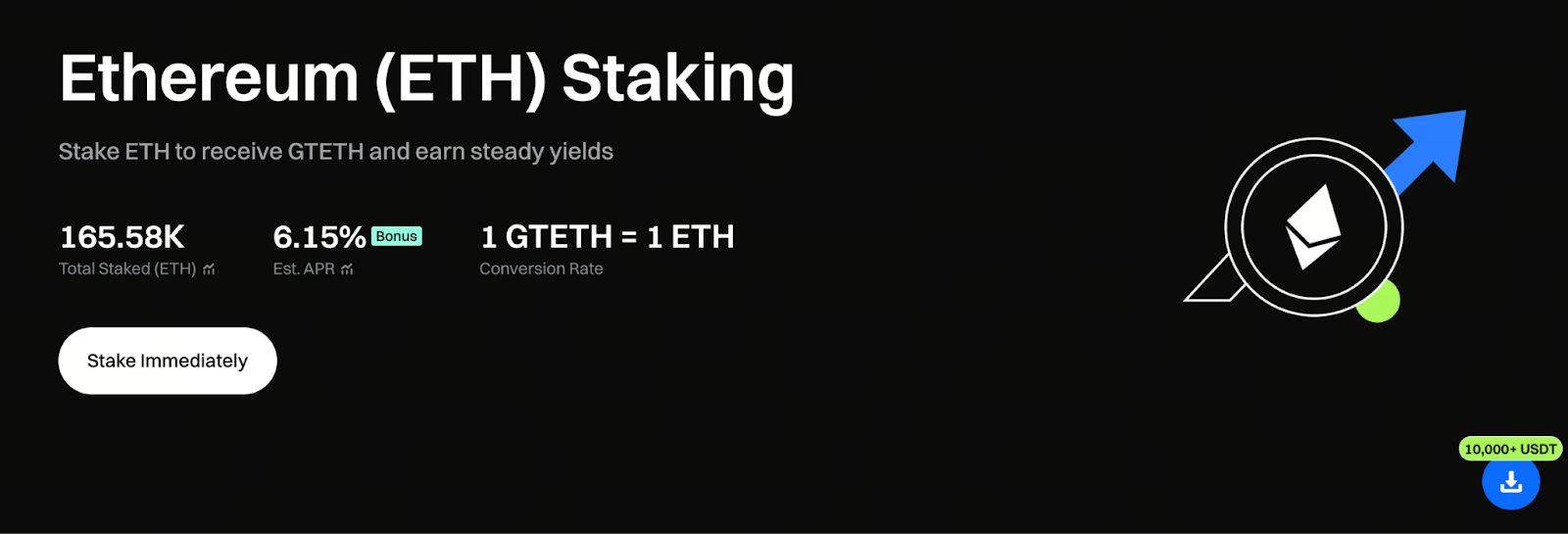
GTETH implements a 1:1 correspondence mechanism. When users stake ETH, the system issues an equivalent amount of GTETH as an on-chain representative token. This transforms the typically locked ETH into an asset that can be held and transferred.

Staking rewards are reflected in the value of GTETH and accumulate over time. If users choose to exit, they can redeem their ETH according to the mechanism—without the uncertainty of traditional long-term unlock periods.

Lowering Barriers and Enhancing Flexibility

Unlike early staking, which required high thresholds and complex processes, GTETH supports small-scale participation so more holders can take part. With no fixed lock-up period, investors can quickly adjust positions as the market shifts. This flexibility is especially valuable in volatile environments. Additionally, GTETH is fully backed by 100% ETH reserves, ensuring each unit is fully collateralized and redemption remains stable.

Yield Sources and Dynamic Adjustment Mechanism

GTETH returns primarily come from two sources:

  • Ethereum on-chain validator rewards (which fluctuate with the network staking ratio and block rewards)
  • Additional incentives provided by the platform

The overall annualized yield is not fixed; it adjusts based on network conditions and market participation. The platform deducts a service fee from actual returns to support node operations and system stability. Users with higher VIP levels enjoy service fee discounts—the higher the level, the greater the net yield advantage.

Join Gate ETH staking now and start your on-chain mining journey: https://www.gate.com/staking/ETH?ch=ann46659

From Liquid Staking to Integrated Allocation Tools

Most liquid staking tokens (LSTs) on the market solve the problem of illiquidity caused by locked assets. GTETH, however, focuses on asset integration capabilities.

It offers three key features:

  • Yield is automatically embedded in the asset value
  • Can be reallocated based on strategic needs
  • Can be incorporated into diversified portfolios as a core stable-yield component

This means ETH is no longer just a long-term, passive holding—it becomes a strategic unit that can dynamically balance between yield and liquidity.

Maintaining Yield and Flexibility Amid Volatility

As market volatility becomes the norm, assets that combine yield generation with instant liquidity gain a clear competitive edge. GTETH does not increase operational complexity; its structure embeds the yield mechanism directly into the asset. Investors can participate in on-chain returns without constant management, while still retaining the flexibility to adjust as needed.

Summary

Staking should not be a passive yield model—it should be an integral part of asset allocation. Through 1:1 mapping and a redemption mechanism, GTETH enables ETH to deliver both yield and liquidity. In fast-moving markets, assets that generate ongoing returns while preserving investor control are better suited for modern investment strategies. GTETH is more than a yield tool—it represents a more flexible approach to asset management.

Author: Allen
Disclaimer
* The information is not intended to be and does not constitute financial advice or any other recommendation of any sort offered or endorsed by Gate.
* This article may not be reproduced, transmitted or copied without referencing Gate. Contravention is an infringement of Copyright Act and may be subject to legal action.

Related Articles

What is Fartcoin? All You Need to Know About FARTCOIN
Intermediate

What is Fartcoin? All You Need to Know About FARTCOIN

Fartcoin (FARTCOIN) is a representative meme coin within the Solana ecosystem based on an AI-driven narrative. Its core concept originated from an experiment aimed at exploring the "boundaries between AI Agents and humor." More than just a digital asset with social attributes, the project deeply couples absurd humor culture with on-chain financial logic by integrating autonomous AI interaction models.
2026-04-04 22:01:19
Gold Price Forecast for the Next Five Years: 2026–2030 Trend Outlook and Investment Implications, Could It Reach $6,000?
Beginner

Gold Price Forecast for the Next Five Years: 2026–2030 Trend Outlook and Investment Implications, Could It Reach $6,000?

Analyze current gold price trends alongside authoritative five-year forecasts, integrating an evaluation of market risks and opportunities. This gives investors insight into the potential trajectory of gold prices and the main drivers expected to shape the market over the next five years.
2026-03-25 18:13:30
Aster vs Hyperliquid: Which Perp DEX Will Prevail?
Beginner

Aster vs Hyperliquid: Which Perp DEX Will Prevail?

Aster and Hyperliquid are the two representative protocols of the "purpose-built L1 path" within the current decentralized perpetual exchange (Perp DEX) sector. As a pioneer in the field, Hyperliquid has built a deep liquidity moat through its highly mature order book architecture and strong community consensus. Conversely, Aster, as a rising challenger, seeks to leapfrog the competition in high-performance trading through more aggressive multi-chain aggregation logic, private transaction modules, and an underlying execution environment optimized for 2026 market demands.
2026-03-24 11:58:33
AI-Native Settlement Layers: How United Stables Is Building the Next Financial Rail
Beginner

AI-Native Settlement Layers: How United Stables Is Building the Next Financial Rail

Stablecoins were originally designed as dollar substitutes within exchanges, primarily used for asset pricing and trade settlement. As on-chain financial ecosystems have matured, their role has expanded beyond simple payments to include collateral assets, cross-chain liquidity mediums, and unified settlement units. In particular, as AI systems and automated agents begin to participate directly in economic activity, demand has risen sharply for programmable value units capable of instant settlement. This shift is pushing stablecoins toward the role of foundational financial infrastructure.
2026-03-25 03:16:17
ASTER Tokenomics: Buybacks, Burns, and Staking as the Value Foundation of ASTER in 2026
Beginner

ASTER Tokenomics: Buybacks, Burns, and Staking as the Value Foundation of ASTER in 2026

ASTER is the native equity and governance token of the Aster ecosystem, with its core value built upon a radical "Deflationary Engine." Beyond serving as a governance tool, ASTER integrates multiple utilities including staking rewards, trading fee discounts, and liquidity incentives. Through its deep integration with the upcoming dedicated Layer 1 mainnet, it enables direct value capture from protocol cash flow to token holders.
2026-03-25 07:38:07
2026 Silver Price Forecast: Bull Market Continuation or High-Level Pullback? In-Depth Analysis of Silver Candlestick Chart
Beginner

2026 Silver Price Forecast: Bull Market Continuation or High-Level Pullback? In-Depth Analysis of Silver Candlestick Chart

2026 Silver Price Forecast: Latest Outlook This article integrates current market trends, silver candlestick chart analysis, and momentum factors to assess the potential key support and resistance levels, upside targets, and pullback risks for silver prices. The goal is to help investors make informed, rational decisions.
2026-03-25 16:08:59