1. DOUG Coin project background
DOUG Coin is a MEME project based on the Solana blockchain, featuring an image of a beach dog named ‘Doug.’ The project was initially launched by the community on March 16, 2025, and was listed in the Pilot section of Gate.com. It officially started trading on March 17, 2025. According to the official introduction, DOUG Coin aims to aggregate community consensus through a relaxed and entertaining MEME image, combining Solana’s ecosystem with low transaction fees and high processing speed to provide users with a more interactive and fun decentralized experience.
Project Vision
- Attract more young users to enter the world of blockchain through the cartoon image of the beach puppy ‘Doug’.
- With the advantage of high speed and low Gas cost of Solana, providing MEME enthusiasts with a fast and inexpensive trading experience.
- Backed by a strong community-driven force, laying the foundation for potential cross-border collaborations in the future (such as gaming, NFTs, metaverse).
Business form
- Community-driven: Promote through community, forums, X (Twitter), and other platforms to cultivate core fan culture.
- Token issuance: DOUG Coin mainly circulates in the form of ‘fun tokens’ to enhance community stickiness.
- Ecological derivatives: Subsequent expansion may extend to gamified application scenarios, inspiring more interaction and secondary creation.

Source:DOUG
2. DOUG Coin Technology Principle
2.1 Solana Underlying Features
DOUG Coin relies on the Solana public chain, its biggest advantage is:
- High throughput: Solana can support thousands of transactions per second, allowing MEME tokens to remain smooth even under high concurrency.
- Low transaction costs: Compared to some other chains, Solana’s Gas fees are relatively low, suitable for frequent small transfers.
- Powerful developer ecosystem: Solana’s programming environment (such as Rust) and supporting development tools enable rapid iteration of DOUG Coin’s functionality.
2.2 DOUG Coin smart contract
- Contract Address: AQiE2ghyFbBsbsfHiTEbKWcCLTDgyGzceKEPWftZpump
- Security Audit: As of now (April 2, 2025), the official report from a major audit firm has not been released, but the community is continuously monitoring the security of the code.
- Scalability: As DOUG Coin was originally a MEME project, complex DeFi features have not been developed yet, but it can still be extended for secondary functions based on SPL.
2.3 Transaction and Storage
- Users can trade DOUG Coin within the Gate.com Pilot area, and can also store it using a Solana-supported wallet (such as Phantom).
- Transaction speed is faster compared to other MEME tokens, suitable for frequent small-value interactions or in-game prop settlements.
3. DOUG Coin token economic model
As a MEME Coin, the token distribution and economic model of DOUG Coin are often the core points of community concern.
The following table shows the core data overview of DOUG Coin
(Data is from official sources and DexScreene, as of April 2, 2025):
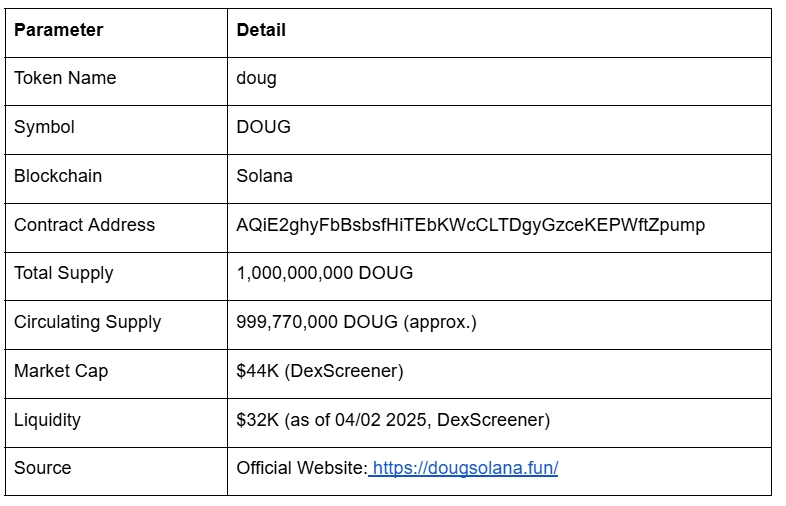
3.1 Issuance and Distribution
- Total supply: 1,000,000,000 DOUG Coin
- Initial LP: According to the official announcement, the project initially created a liquidity pool on Solana DEX and locked or burned LP Tokens (referred to as ‘LP’ by the official, but essentially a certificate for providing liquidity). The community has stated that a portion of LP has been burnt to reduce potential selling pressure.
- Community Hold: Most tokens are held in a decentralized manner by the community, without traditional private placement or pre-mining mechanisms.
Destruction mechanism: Currently, there is no official announcement of a subsequent destruction plan, only partial LP destruction during the initial liquidity creation.
According to DexScreener data, the liquidity is approximately $32K and the total market value is around $44K as of February 4, 2025, suggesting that this is a MEME Coin with a relatively small market capitalization, characterized by high risk and significant volatility..

Source:Dexscreener
4. DOUG Coin market performance and capital flow
4.1 Gate.com listing and price trend
- Listing Date: DOUG Coin officially landed on Gate.com Pilot Zone on March 17, 2025.
Initial Price: According to the announcement by Gate.com, the opening price on the same day was approximately $0.0001513. The highest and lowest prices of the day were both $0.0001513, indicating relatively limited fluctuations in trading on the first day.
The all-time low (according to current public data): $0.0001513 (recorded on Gate.com during the initial listing), on March 17, 2025.
Risk Warning: Due to relatively limited market value and liquidity, any large buy or sell orders may significantly impact the price.

Source:Gate.com Innovation Trading Zone
4.2 Capital Flow and Position Distribution
According to Gate.com’s Capital Flow data (April 2, 2025):
This means that the overall outflow slightly exceeded the inflow within the past 1 day, with a net outflow of about 2.45K US dollars. However, looking at the large and small orders, the buying and selling are relatively balanced, with only the medium orders showing a more significant negative difference.
4.3 Holding Addresses and Concentration
- Holding Addresses: Approximately 2.26K addresses (as of April 2, 2025), representing that DOUG Coin is still in its early development stage.
- Smart Money Addresses: 21
- Top 50 & Top 100: According to the community’s analysis of on-chain data, the proportion of holdings by the Top 50 addresses is close to 70% - 80%, while the proportion held by the Top 100 addresses is around 85% - 90%, indicating a high degree of concentration with limited retail participation.
5. Summary
Since its official launch in mid-March 2025, DOUG Coin has experienced several “twists” and “rebirths” in a short period of time, from the initial suspicious team operation to the later community takeover, and now with the cute image of beach dog Doug quickly gaining momentum in the MEME field. The whole process is full of drama, and it has won high topicality and attention for the project itself. In terms of fund flow, although the overall net outflow is slightly larger at present, the market still maintains a relatively high interest in DOUG Coin, which is reflected in both community activity and trading volume.
From a long-term perspective, DOUG Coin needs to continue to strengthen its use cases, such as developing NFTs, on-chain games, cross-border collaborations, etc., to support more holding demand and enhance liquidity. As a MEME token with a relatively small market value, DOUG Coin has high price volatility, so investors should remain rational and manage risks cautiously. However, if its community culture continues to evolve and its technology and ecosystem construction steadily progress, it is not ruled out that there may be greater opportunities in the new wave of MEME craze. In any case, the story of DOUG Coin is still being written and worth continuous attention.
For more content, you can learn more related knowledge on Gate Learn, visit the link:https://www.Gate.com/learn







