Bitcoin Price Prediction: Why Liquidity Peak Could Trigger A Downside Cycle For BTC

Last Updated 2026-03-27 10:25:58
Reading Time: 1m
Global liquidity expert Michael Howell warned on the Bankless podcast that the Everything Bubble, built up in the aftermath of the financial crisis, is coming to an end. The cryptocurrency market is not entering a new cycle; instead, it is currently in the latter half of a 65-month global debt refinancing cycle.

Is BTC Entering a New Phase Amid Global Liquidity Cycle Shifts?

Global liquidity expert Michael Howell recently cautioned on the Bankless podcast that risk assets face headwinds: the massive bubbles that have built up since the financial crisis are now gradually deflating. Rather than starting a new cycle, the crypto market has likely entered its latter stages.

Howell’s approach differs from the traditional M2 money supply metric. Instead, he examines actual capital flows in financial markets, including the repo market, shadow banking, and cross-border fund movements. His Global Liquidity Index (GLI) indicates that global liquidity stood below $100 trillion in 2010 but has nearly doubled to $200 trillion over the past 15 years.

Has Global Liquidity Peaked?

Howell argues that the direction of liquidity is more critical than its scale. The 65-month global liquidity cycle he tracks reflects the pace of global debt refinancing. He notes that currently, 70% to 80% of financial market activity revolves around debt refinancing—not new investment.

Roughly 75% of loans worldwide are collateralized, so liquidity hinges on debt, and debt depends on liquidity. To gauge overall market health, Howell uses the Debt-to-Liquidity Ratio (total debt divided by refinancing liquidity) for high-income economies:

  • Lower ratio → abundant liquidity → asset bubbles form easily
  • Higher ratio → liquidity tightens → financing pressures mount, raising the risk of financial events

He points out that the world is emerging from an extended “Everything Bubble.” The surge in long-term, low-rate borrowing during the pandemic delayed real stress, causing a concentration of debt maturities between 2025 and 2028.

Crypto Market Positioning

In Howell’s model, crypto assets are positioned between technology stocks and commodities:

  • Roughly 40%–45% of Bitcoin’s price action is driven by Global Liquidity
  • The remainder is shaped by its Safe-Haven Appeal and Risk Sentiment

On the widely discussed four-year Halving Cycle, Howell is direct: “I haven’t seen compelling evidence. What truly drives BTC is the 65-month Global Liquidity Cycle.” Based on this, he believes the crypto market is in the late stage of the cycle, not the beginning.

Market Overview

With volatility rising and liquidity tightening, Howell remains neutral in the short term—not bearish, but also not optimistic. If risk assets see a further pullback, he views it as a long-term buying opportunity.

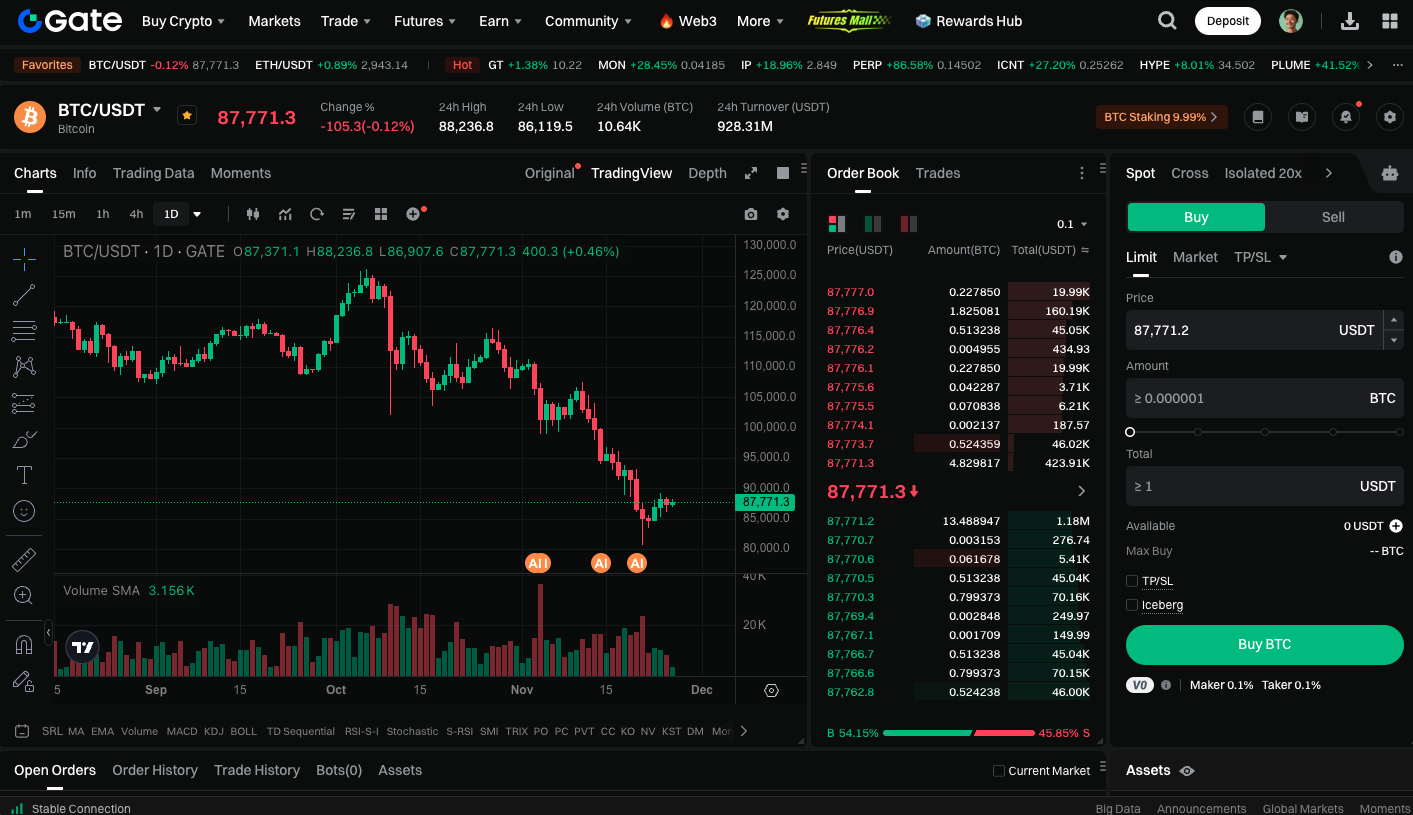
You can start Spot Trading BTC now: https://www.gate.com/trade/BTC_USDT
Summary

According to Michael Howell’s framework, Bitcoin’s price trajectory hinges not on Sentiment or Halving events, but on the Global Debt Refinancing and Liquidity Cycle. With Global Liquidity near a cyclical peak, BTC may already be in the latter half of its cycle. Short-term Volatility Risks are rising, while ongoing Monetary Inflation continues to provide robust support over the long term. Investors should monitor Liquidity Pressures in the financial markets in the near term, while the case for holding BTC as a long-term Inflation Hedge remains fundamentally strong.

Author:  Allen
Disclaimer
* The information is not intended to be and does not constitute financial advice or any other recommendation of any sort offered or endorsed by Gate.
* This article may not be reproduced, transmitted or copied without referencing Gate. Contravention is an infringement of Copyright Act and may be subject to legal action.

Related Articles

AI-Native Settlement Layers: How United Stables Is Building the Next Financial Rail
Beginner

AI-Native Settlement Layers: How United Stables Is Building the Next Financial Rail

Stablecoins were originally designed as dollar substitutes within exchanges, primarily used for asset pricing and trade settlement. As on-chain financial ecosystems have matured, their role has expanded beyond simple payments to include collateral assets, cross-chain liquidity mediums, and unified settlement units. In particular, as AI systems and automated agents begin to participate directly in economic activity, demand has risen sharply for programmable value units capable of instant settlement. This shift is pushing stablecoins toward the role of foundational financial infrastructure.
2026-03-25 03:16:17
DePIN Identity Network and Real World Applications: How Humanity Protocol Brings on-chain Identity Into the Physical World
Beginner

DePIN Identity Network and Real World Applications: How Humanity Protocol Brings on-chain Identity Into the Physical World

Most Web3 identity systems remain confined to on-chain environments and struggle to achieve meaningful adoption in real world settings. Through a DePIN architecture and physical verification hardware, Humanity Protocol aims to bring decentralized identity into access control systems, hospitality, public services, and offline events, allowing on-chain identity to function not just as a digital credential, but as foundational infrastructure for real world access.
2026-03-25 07:40:53
Gold Price Forecast for the Next Five Years: 2026–2030 Trend Outlook and Investment Implications, Could It Reach $6,000?
Beginner

Gold Price Forecast for the Next Five Years: 2026–2030 Trend Outlook and Investment Implications, Could It Reach $6,000?

Analyze current gold price trends alongside authoritative five-year forecasts, integrating an evaluation of market risks and opportunities. This gives investors insight into the potential trajectory of gold prices and the main drivers expected to shape the market over the next five years.
2026-03-25 18:13:30
Aster vs Hyperliquid: Which Perp DEX Will Prevail?
Beginner

Aster vs Hyperliquid: Which Perp DEX Will Prevail?

Aster and Hyperliquid are the two representative protocols of the "purpose-built L1 path" within the current decentralized perpetual exchange (Perp DEX) sector. As a pioneer in the field, Hyperliquid has built a deep liquidity moat through its highly mature order book architecture and strong community consensus. Conversely, Aster, as a rising challenger, seeks to leapfrog the competition in high-performance trading through more aggressive multi-chain aggregation logic, private transaction modules, and an underlying execution environment optimized for 2026 market demands.
2026-03-24 11:58:33
Aerodrome Tokenomics: How ve(3,3) Powers Base's Most Profitable DEX
Beginner

Aerodrome Tokenomics: How ve(3,3) Powers Base's Most Profitable DEX

AERO is the native token of Aerodrome Finance, a core decentralized exchange and liquidity protocol in the Base ecosystem. It is primarily used for liquidity incentives and ecosystem operations. veAERO is a governance NFT that users receive by locking AERO, representing both voting power and the right to share protocol revenue. Through a dual track structure of AERO as a utility token and veAERO as a governance credential, Aerodrome separates liquidity usage value from long term governance power, allowing participants to act as liquidity providers, governance decision makers, and revenue sharers within the same system.
2026-03-25 06:40:31
The ve(3,3) Flywheel Explained: How AERO Tokenomics Powers Aerodrome’s DeFi Economy
Beginner

The ve(3,3) Flywheel Explained: How AERO Tokenomics Powers Aerodrome’s DeFi Economy

In the competition for DeFi liquidity, high-inflation mining alone is no longer enough to build lasting advantages. Aerodrome applies the ve(3,3) economic model to redesign token emissions, voting mechanisms, and revenue distribution, creating a liquidity flywheel centered on governance and cash flow. This article examines AERO tokenomics, the veAERO locking mechanism, and protocol revenue models to explain how Aerodrome builds a sustainable DeFi economic system.
2026-03-25 06:41:58





