Are Futures Trading Features Suitable for a Beginner’s First Trade? A Rational Analysis Using Gate as an Example

Beginner
Quick Reads
Last Updated 2026-03-25 17:38:10
Reading Time: 1m
The suitability of contract trading for beginners remains a subject of ongoing debate. This article uses Gate Exchange as a case study to evaluate whether newcomers should select contract trading for their initial transaction, focusing on risk structure, functional complexity, and learning curve considerations.

Why Beginners Are Attracted to Contract Trading Features
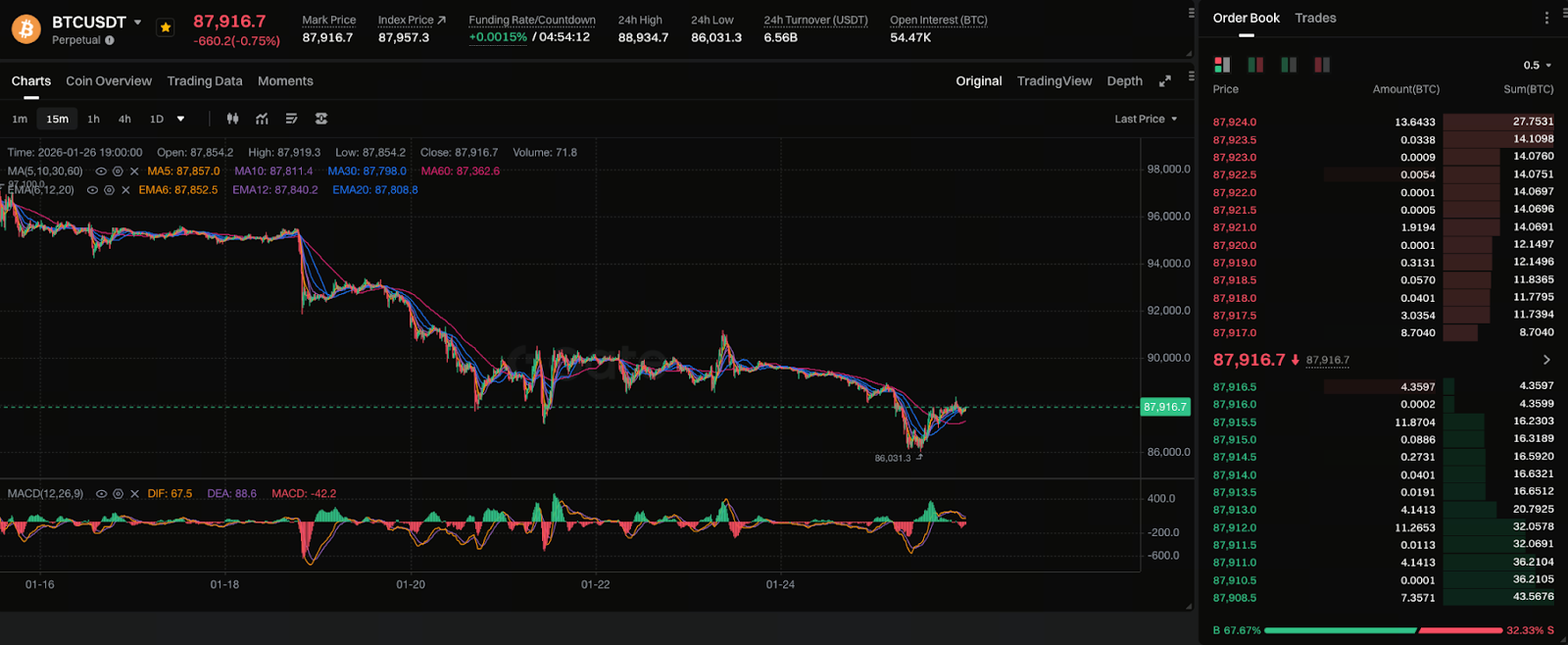

Image: https://www.gate.com/futures/USDT/BTC_USDT

For newcomers entering the trading market, contract trading features are often highly appealing:

  • Ability to take both long and short positions
  • Leverage larger positions with relatively small capital
  • Immediate and transparent profit and loss feedback

Gate’s contract trading platform offers a clear entry point and a professional interface, which frequently prompts beginners to want to try it right away.

What Contract Trading Features Mean for Beginners

Functionally, contract trading is more than just adding leverage. It means:

  • You must understand the margin system
  • You must accept forced liquidation rules
  • You are responsible for your positions and risk management

For beginners, these are cognitive hurdles rather than technical barriers.

The Most Overlooked Risks in a First Trade

In their first contract trade, beginners tend to overlook structural risks instead of market conditions:

  • Leverage accelerates the rate of losses
  • Little room to correct mistakes after a wrong judgment
  • Emotional swings can impact decision-making

Gate’s contract trading interface displays these risks in real time, but users need to understand what they mean.

How Beginner-Friendly Is Gate’s Contract Trading Feature?

Gate’s contract trading feature is designed to be relatively friendly for beginners:

  • Parameters are clearly displayed
  • Risk rate and liquidation price are easy to see
  • Supports isolated margin mode for controlling risk per trade

These features help simplify operations but do not eliminate the high-risk nature of contract trading itself.

Contract Trading and the Learning Curve

Compared to spot trading, contract trading has a much steeper learning curve.

Beginners need to grasp all of the following at once:

  • Market volatility
  • Functional parameters
  • Risk control logic

If you use contract trading features before building a basic understanding of trading, you can easily face excessive psychological and financial pressure in a short period.

How Beginners Should Approach Contract Trading

For beginners interested in contract trading, a more rational approach is gradual adoption:

  • Start with low leverage
  • Use isolated margin mode
  • Treat every trade as a learning opportunity

Gate’s contract trading platform supports this low-risk approach—the key is whether you can restrain impulsive trading.

When Not to Use Contract Trading Features Directly

The following situations are not suitable for making contract trading your first experience:

  • Lack of basic understanding of price movements
  • Unable to accept short-term floating losses
  • Tendency toward emotional trading

In these cases, jumping into contract trading usually does more harm than good.

Summary: The First Trade Matters More Than Profit

Contract trading features are not off-limits for beginners, but they are far from a shortcut. For your first trade, learning to control risk is more important than seeking profits. On a robust platform like Gate, contract trading tools are highly mature. Whether you choose to use them depends on whether you are ready to accept the responsibilities and risks involved.

Author: Max
Disclaimer
* The information is not intended to be and does not constitute financial advice or any other recommendation of any sort offered or endorsed by Gate.
* This article may not be reproduced, transmitted or copied without referencing Gate. Contravention is an infringement of Copyright Act and may be subject to legal action.

Related Articles

What is Fartcoin? All You Need to Know About FARTCOIN
Intermediate

What is Fartcoin? All You Need to Know About FARTCOIN

Fartcoin (FARTCOIN) is a representative meme coin within the Solana ecosystem based on an AI-driven narrative. Its core concept originated from an experiment aimed at exploring the "boundaries between AI Agents and humor." More than just a digital asset with social attributes, the project deeply couples absurd humor culture with on-chain financial logic by integrating autonomous AI interaction models.
2026-04-04 22:01:19
Gold Price Forecast for the Next Five Years: 2026–2030 Trend Outlook and Investment Implications, Could It Reach $6,000?
Beginner

Gold Price Forecast for the Next Five Years: 2026–2030 Trend Outlook and Investment Implications, Could It Reach $6,000?

Analyze current gold price trends alongside authoritative five-year forecasts, integrating an evaluation of market risks and opportunities. This gives investors insight into the potential trajectory of gold prices and the main drivers expected to shape the market over the next five years.
2026-03-25 18:13:30
Aster vs Hyperliquid: Which Perp DEX Will Prevail?
Beginner

Aster vs Hyperliquid: Which Perp DEX Will Prevail?

Aster and Hyperliquid are the two representative protocols of the "purpose-built L1 path" within the current decentralized perpetual exchange (Perp DEX) sector. As a pioneer in the field, Hyperliquid has built a deep liquidity moat through its highly mature order book architecture and strong community consensus. Conversely, Aster, as a rising challenger, seeks to leapfrog the competition in high-performance trading through more aggressive multi-chain aggregation logic, private transaction modules, and an underlying execution environment optimized for 2026 market demands.
2026-03-24 11:58:33
AI-Native Settlement Layers: How United Stables Is Building the Next Financial Rail
Beginner

AI-Native Settlement Layers: How United Stables Is Building the Next Financial Rail

Stablecoins were originally designed as dollar substitutes within exchanges, primarily used for asset pricing and trade settlement. As on-chain financial ecosystems have matured, their role has expanded beyond simple payments to include collateral assets, cross-chain liquidity mediums, and unified settlement units. In particular, as AI systems and automated agents begin to participate directly in economic activity, demand has risen sharply for programmable value units capable of instant settlement. This shift is pushing stablecoins toward the role of foundational financial infrastructure.
2026-03-25 03:16:17
2026 Silver Price Forecast: Bull Market Continuation or High-Level Pullback? In-Depth Analysis of Silver Candlestick Chart
Beginner

2026 Silver Price Forecast: Bull Market Continuation or High-Level Pullback? In-Depth Analysis of Silver Candlestick Chart

2026 Silver Price Forecast: Latest Outlook This article integrates current market trends, silver candlestick chart analysis, and momentum factors to assess the potential key support and resistance levels, upside targets, and pullback risks for silver prices. The goal is to help investors make informed, rational decisions.
2026-03-25 16:08:59
ASTER Tokenomics: Buybacks, Burns, and Staking as the Value Foundation of ASTER in 2026
Beginner

ASTER Tokenomics: Buybacks, Burns, and Staking as the Value Foundation of ASTER in 2026

ASTER is the native equity and governance token of the Aster ecosystem, with its core value built upon a radical "Deflationary Engine." Beyond serving as a governance tool, ASTER integrates multiple utilities including staking rewards, trading fee discounts, and liquidity incentives. Through its deep integration with the upcoming dedicated Layer 1 mainnet, it enables direct value capture from protocol cash flow to token holders.
2026-03-25 07:38:07