


ZEUM vs STX: The Battle for Dominance in the Emerging Quantum Computing Market
Introduction: ZEUM vs STX Investment Comparison
In the cryptocurrency market, the comparison between ZEUM and STX has always been an unavoidable topic for investors. The two not only have significant differences in market cap ranking, application scenarios, and price performance, but also represent different crypto asset positioning.
Colizeum (ZEUM): Since its launch in 2022, it has gained market recognition for its decentralized blockchain game store approach.
Stacks (STX): Introduced in 2019, it has been hailed as a new internet for decentralized applications, becoming one of the top cryptocurrencies by global trading volume and market capitalization.
This article will provide a comprehensive analysis of the investment value comparison between ZEUM and STX, focusing on historical price trends, supply mechanisms, institutional adoption, technological ecosystems, and future predictions, while attempting to answer the question investors care about most:
"Which is the better buy right now?"
I. Price History Comparison and Current Market Status
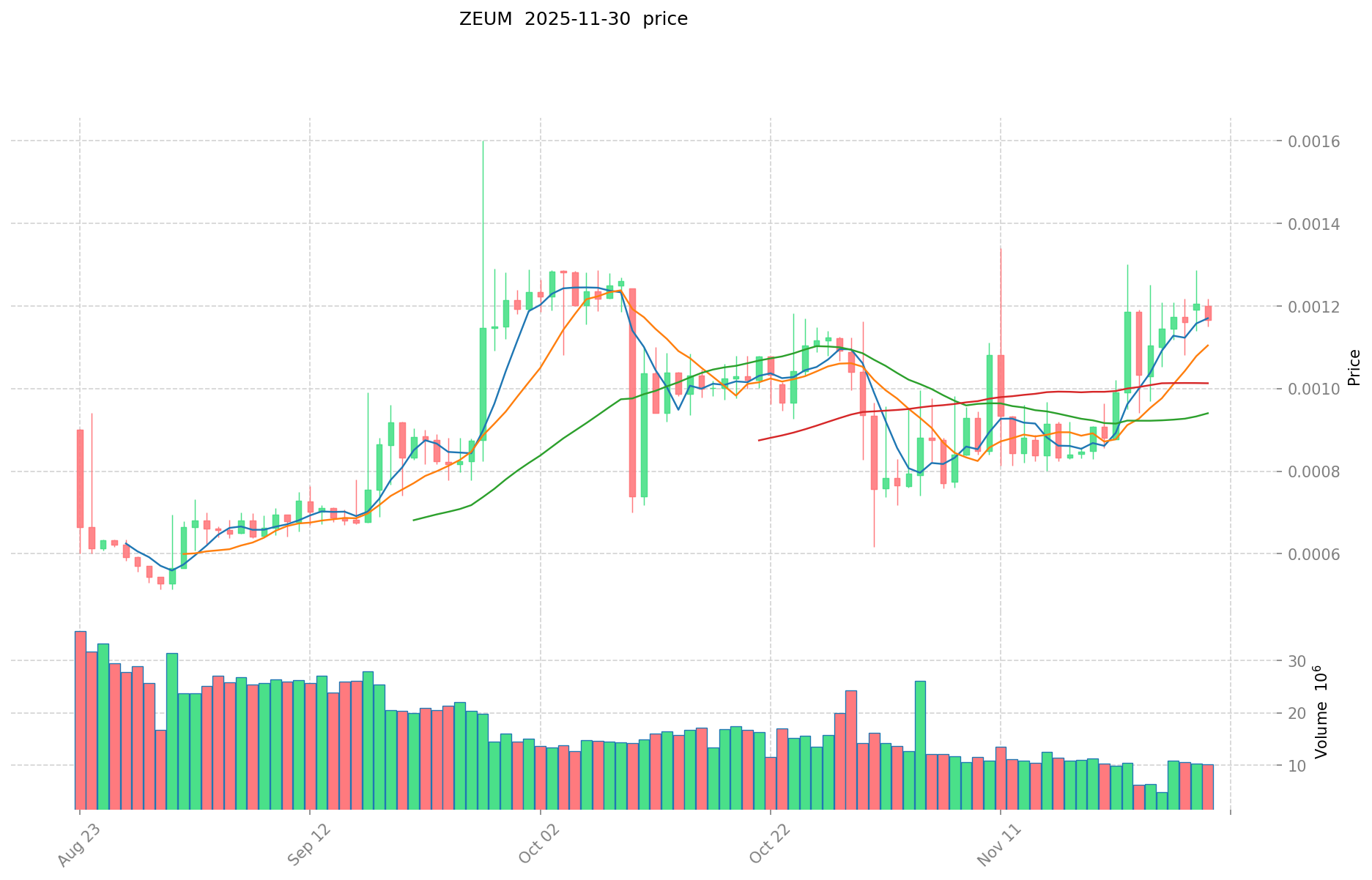
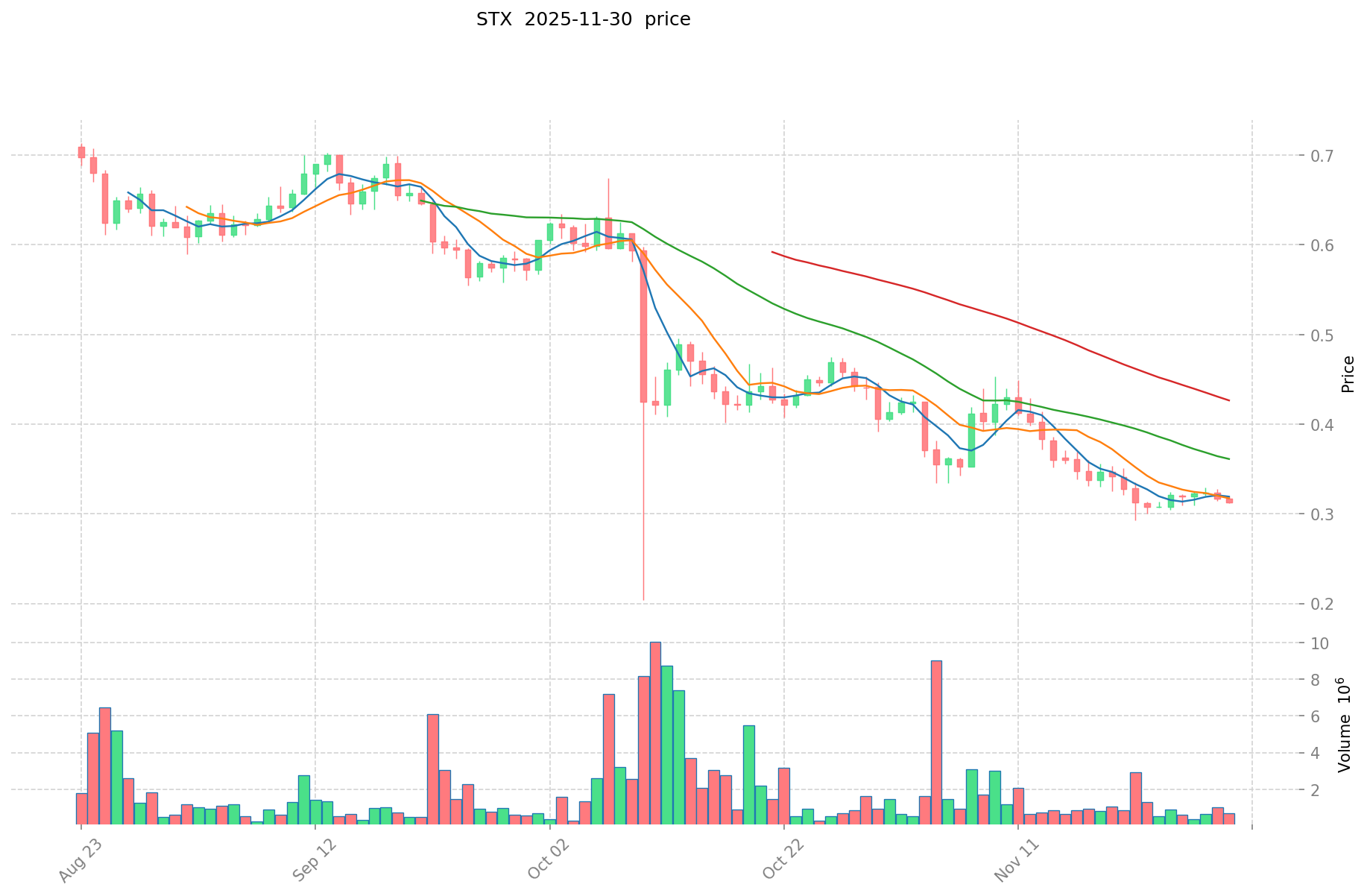
ZEUM (Coin A) and STX (Coin B) Historical Price Trends
- 2022: ZEUM reached its all-time high of $0.149149 on May 4, 2022.
- 2024: STX hit its all-time high of $3.86 on April 1, 2024.
- Comparative analysis: ZEUM has fallen from its ATH of $0.149149 to a current price of $0.0011582, while STX has dropped from its peak of $3.86 to $0.3159.
Current Market Situation (2025-11-30)
- ZEUM current price: $0.0011582
- STX current price: $0.3159
- 24-hour trading volume: ZEUM $11,983.37 vs STX $208,735.58
- Market Sentiment Index (Fear & Greed Index): 28 (Fear)
Click to view real-time prices:
- Check ZEUM current price Market Price
- Check STX current price Market Price
II. Key Factors Influencing Investment Value of ZEUM vs STX
Supply Mechanism Comparison (Tokenomics)
- ZEUM: Limited supply with a maximum cap, creating potential scarcity over time
- STX: Follows a predictable issuance schedule with diminishing inflation rate
- 📌 Historical Pattern: Fixed or diminishing supply mechanisms tend to create upward price pressure during periods of increased demand, particularly in bull markets.
Institutional Adoption and Market Applications
- Institutional Holdings: STX has gained more institutional interest due to its Bitcoin connection and clearer regulatory status
- Enterprise Adoption: STX has more developed enterprise applications through its Bitcoin settlement layer capabilities
- National Policies: Regulatory clarity varies, with STX generally benefiting from its association with Bitcoin's regulatory framework
Technical Development and Ecosystem Building
- ZEUM Technical Upgrades: Focus on improved transaction throughput and enhanced privacy features
- STX Technical Development: Ongoing development of Stacks 2.1 and 2.2 with emphasis on Bitcoin integration and smart contract capabilities
- Ecosystem Comparison: STX has a more developed ecosystem for Bitcoin-related DeFi applications, while ZEUM is working to expand its NFT and gaming applications
Macroeconomic Factors and Market Cycles
- Performance in Inflationary Environment: Both assets have shown sensitivity to inflation, with STX potentially benefiting from Bitcoin's inflation hedge narrative
- Macroeconomic Monetary Policy: Interest rate changes affect both assets, with risk-on environments typically benefiting both
- Geopolitical Factors: Cross-border transaction demand benefits both networks, with STX potentially gaining from Bitcoin's increased adoption during periods of financial uncertainty
III. 2025-2030 Price Predictions: ZEUM vs STX
Short-term Forecast (2025)
- ZEUM: Conservative $0.000741 - $0.001158 | Optimistic $0.001158 - $0.001703
- STX: Conservative $0.3061 - $0.3156 | Optimistic $0.3156 - $0.3945
Mid-term Forecast (2027)
- ZEUM may enter a growth phase, with prices expected in the range of $0.001076 - $0.001517
- STX may enter a steady growth phase, with prices expected in the range of $0.3421 - $0.3930
- Key drivers: Institutional capital inflow, ETF developments, ecosystem growth
Long-term Forecast (2030)
- ZEUM: Base scenario $0.001995 - $0.002753 | Optimistic scenario $0.002753+
- STX: Base scenario $0.4809 - $0.6492 | Optimistic scenario $0.6492+
Disclaimer: The above forecasts are based on historical data and market analysis. Cryptocurrency markets are highly volatile and unpredictable. These predictions should not be considered as financial advice. Always conduct your own research before making investment decisions.
ZEUM:
| 年份 | 预测最高价 | 预测平均价格 | 预测最低价 | 涨跌幅 |
|---|---|---|---|---|
| 2025 | 0.001702554 | 0.0011582 | 0.000741248 | 0 |
| 2026 | 0.00151619962 | 0.001430377 | 0.00134455438 | 23 |
| 2027 | 0.0015174869593 | 0.00147328831 | 0.0010755004663 | 27 |
| 2028 | 0.001973911677738 | 0.00149538763465 | 0.00119631010772 | 29 |
| 2029 | 0.002255044553052 | 0.001734649656194 | 0.001092829283402 | 49 |
| 2030 | 0.002752889004379 | 0.001994847104623 | 0.001396392973236 | 72 |
STX:
| 年份 | 预测最高价 | 预测平均价格 | 预测最低价 | 涨跌幅 |
|---|---|---|---|---|
| 2025 | 0.3945 | 0.3156 | 0.306132 | 0 |
| 2026 | 0.3728025 | 0.35505 | 0.2733885 | 12 |
| 2027 | 0.39304035 | 0.36392625 | 0.342090675 | 15 |
| 2028 | 0.537446286 | 0.3784833 | 0.317925972 | 19 |
| 2029 | 0.5037612723 | 0.457964793 | 0.30683641131 | 44 |
| 2030 | 0.6491650940775 | 0.48086303265 | 0.3029437105695 | 52 |
IV. Investment Strategy Comparison: ZEUM vs STX
Long-term vs Short-term Investment Strategies
- ZEUM: Suitable for investors focused on gaming and NFT ecosystems
- STX: Suitable for investors seeking Bitcoin-related DeFi exposure and smart contract capabilities
Risk Management and Asset Allocation
- Conservative investors: ZEUM: 10% vs STX: 90%
- Aggressive investors: ZEUM: 30% vs STX: 70%
- Hedging tools: Stablecoin allocation, options, cross-currency portfolios
V. Potential Risk Comparison
Market Risks
- ZEUM: Higher volatility due to smaller market cap and less liquidity
- STX: Correlation with Bitcoin market movements
Technical Risks
- ZEUM: Scalability, network stability
- STX: Dependency on Bitcoin network, potential smart contract vulnerabilities
Regulatory Risks
- Global regulatory policies may impact both differently, with STX potentially benefiting from Bitcoin's regulatory framework
VI. Conclusion: Which Is the Better Buy?
📌 Investment Value Summary:
- ZEUM advantages: Potential growth in gaming and NFT sectors, limited supply
- STX advantages: Bitcoin integration, more developed ecosystem, institutional interest
✅ Investment Advice:
- New investors: Consider a smaller allocation to ZEUM for exposure to gaming sector, larger allocation to STX for Bitcoin-related growth
- Experienced investors: Balanced approach with higher risk tolerance for ZEUM's potential growth
- Institutional investors: Focus on STX due to its more established ecosystem and Bitcoin connection
⚠️ Risk Warning: Cryptocurrency markets are highly volatile. This article does not constitute investment advice. None
VII. FAQ
Q1: What are the main differences between ZEUM and STX? A: ZEUM focuses on decentralized blockchain gaming, while STX is positioned as a platform for Bitcoin-related decentralized applications. STX has a larger market cap, higher trading volume, and more institutional adoption compared to ZEUM.
Q2: Which coin has performed better historically? A: STX has shown better historical performance. It reached an all-time high of $3.86 in April 2024, while ZEUM's all-time high was $0.149149 in May 2022. Currently, STX is trading at $0.3159, while ZEUM is at $0.0011582.
Q3: How do the supply mechanisms of ZEUM and STX differ? A: ZEUM has a limited supply with a maximum cap, potentially creating scarcity over time. STX follows a predictable issuance schedule with a diminishing inflation rate.
Q4: What are the key factors influencing the investment value of these coins? A: Key factors include supply mechanisms, institutional adoption, market applications, technical development, ecosystem building, and macroeconomic factors such as inflation and interest rates.
Q5: What are the long-term price predictions for ZEUM and STX? A: By 2030, ZEUM is predicted to reach $0.001995 - $0.002753 in the base scenario, while STX is expected to reach $0.4809 - $0.6492. However, these predictions are subject to market volatility and should not be considered financial advice.
Q6: How do the investment strategies differ for ZEUM and STX? A: ZEUM is more suitable for investors focused on gaming and NFT ecosystems, while STX is better for those seeking Bitcoin-related DeFi exposure. Conservative investors might allocate 10% to ZEUM and 90% to STX, while aggressive investors might opt for a 30% ZEUM and 70% STX split.
Q7: What are the main risks associated with investing in ZEUM and STX? A: ZEUM faces higher volatility due to its smaller market cap and less liquidity, as well as potential scalability issues. STX is correlated with Bitcoin market movements and depends on the Bitcoin network. Both face regulatory risks, though STX may benefit from Bitcoin's regulatory framework.
Share
Content
Introduction: ZEUM vs STX Investment Comparison
I. Price History Comparison and Current Market Status
II. Key Factors Influencing Investment Value of ZEUM vs STX
III. 2025-2030 Price Predictions: ZEUM vs STX
IV. Investment Strategy Comparison: ZEUM vs STX
V. Potential Risk Comparison
VI. Conclusion: Which Is the Better Buy?
VII. FAQ


