


What is SGR: Understanding the Select Graphic Rendition in Terminal Emulators
Schrodinger's Positioning and Significance
In 2024, Project Schrodinger launched Schrodinger (SGR), aiming to revolutionize the NFT and AI spaces. As an AI-generated NFT creation platform, Schrodinger plays a crucial role in the intersection of artificial intelligence and non-fungible tokens.
As of 2025, Schrodinger has become a unique asset in the NFT ecosystem, offering creators, projects, and users the ability to obtain AI-generated, one-of-a-kind NFTs. The platform's innovative approach allows these NFTs to be traded on both traditional NFT marketplaces and decentralized exchanges, expanding their utility and potential value.
Origin and Development History
Birth Background
Schrodinger was created in 2024 to address the growing demand for AI-generated content in the NFT space. It emerged during a period of rapid advancement in both AI technology and blockchain applications, aiming to provide a platform where anyone could create and own unique, AI-generated NFTs.
The launch of Schrodinger brought new possibilities to artists, collectors, and blockchain enthusiasts, offering a novel way to interact with and trade AI-created digital assets.
Important Milestones
- 2024: Platform launch, introducing AI-generated NFTs with dual trading functionality.
- March 20, 2024: SGR token reaches its all-time high of $3.7067.
- November 29, 2025: SGR is listed on Gate.com, expanding its accessibility to a wider audience.
Supported by its community and development team, Schrodinger continues to enhance its technology, security, and real-world applications in the AI-NFT space.
How Does Schrodinger Work?
Decentralized Control
Schrodinger operates on the Ethereum blockchain, leveraging its decentralized network of nodes worldwide. This structure ensures that the platform remains free from centralized control, providing users with greater autonomy and enhancing the network's resilience.
Blockchain Core
Schrodinger's NFTs are minted and recorded on the Ethereum blockchain, ensuring a public and immutable digital ledger of ownership and transactions. Each NFT transaction is securely added to the blockchain, creating a transparent and trustless environment for users.
Ensuring Fairness
As an ERC20 token on the Ethereum network, SGR benefits from Ethereum's Proof-of-Stake consensus mechanism. This ensures fair validation of transactions and maintains network security. Participants can stake ETH to become validators, contributing to the network's integrity and potentially earning rewards.
Secure Transactions
Schrodinger utilizes Ethereum's robust cryptographic security measures:
- Private keys are used to sign transactions and prove ownership of SGR tokens and NFTs.
- Public keys serve as addresses for receiving tokens and NFTs.
This mechanism ensures the security of assets while maintaining a pseudonymous transaction environment. The smart contract governing SGR (0x478156DeAbfAc918369044D52A6BdB5Cc5597994) adds an extra layer of security and functionality to the token's operations.
SGR's Market Performance
Circulation Overview
As of November 29, 2025, SGR's circulating supply is 483,555 tokens, with a total supply of 21,000,000. The maximum supply is also set at 21,000,000, indicating a fixed supply model.
Price Fluctuations
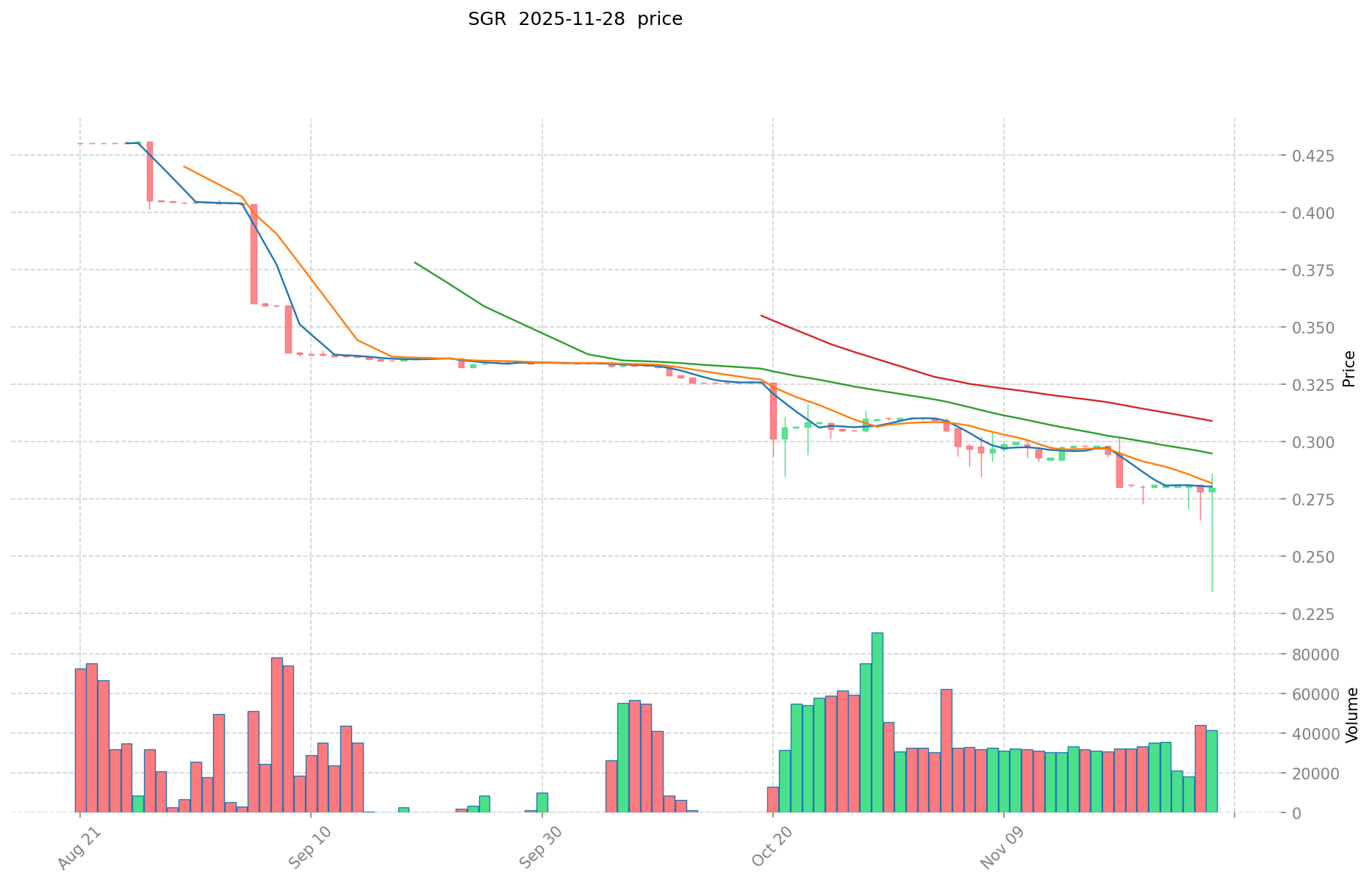
SGR reached its all-time high of $3.7067 on March 20, 2024. Its lowest price was $0.22, also occurring on March 20, 2024. These fluctuations reflect market sentiment, adoption trends, and external factors.
Click to view the current SGR market price
On-Chain Metrics
- Daily Trading Volume: $11,598.37 (indicates network activity)
- Active Addresses: 230 (reflects user engagement)
Schrodinger Ecosystem Applications and Partnerships
Core Use Cases
Schrodinger's ecosystem supports various applications:
- AI-generated NFTs: The platform allows creators, projects, and users to obtain unique NFTs created by AI.
- NFT Marketplaces: These AI-generated NFTs can be traded on NFT marketplaces, providing a new avenue for digital asset trading.
- Decentralized Exchanges: The NFTs also have functionality on decentralized exchanges, expanding their utility beyond traditional NFT use cases.
Strategic Collaborations
Schrodinger has established itself as an innovative platform in the AI-NFT space. While specific partnerships are not mentioned, the project's unique approach to NFT creation and trading suggests potential for future collaborations with AI companies and NFT marketplaces.
Controversies and Challenges
Schrodinger faces the following challenges:
- Market Volatility: The significant price fluctuations, as evidenced by the 76.81% decrease over the past year, pose a challenge for stability and adoption.
- Competition: The AI-NFT space is rapidly evolving, with potential competition from other blockchain projects and established NFT platforms.
- Adoption: As a relatively new project, Schrodinger may face challenges in gaining widespread adoption and recognition in the NFT and crypto communities.
These issues are likely topics of discussion within the community and may drive ongoing innovation for the project.
Schrodinger Community and Social Media Atmosphere
Fan Enthusiasm
Schrodinger's community is growing, with:
- 230 holders of the SGR token
- An active presence on X (formerly Twitter) under the handle @ProjSchrodinger
The project's unique approach to AI-generated NFTs has the potential to spark interest among NFT enthusiasts and AI technology followers.
Social Media Sentiment
On X, the sentiment around Schrodinger likely varies:
- Supporters may praise the innovative combination of AI and NFTs, seeing it as a new frontier for digital art and collectibles.
- Critics might focus on the project's recent price performance or question the long-term viability of AI-generated NFTs.
Recent trends suggest a challenging market environment, given the significant price decrease over the past year.
Hot Topics
X users may be discussing Schrodinger's:
- AI technology and its application in NFT creation
- The dual functionality of NFTs on both marketplaces and decentralized exchanges
- The project's potential impact on the broader NFT and crypto ecosystems
More Information Sources for Schrodinger
- Official Website: Visit Schrodinger's official website for features, use cases, and the latest updates.
- Whitepaper: Schrodinger's whitepaper details its technical architecture, goals, and vision.
- X Updates: On X, Schrodinger uses @ProjSchrodinger to engage with its community, sharing updates on project developments and NFT creations.
Schrodinger's Future Roadmap
While specific future plans are not provided, potential goals for Schrodinger could include:
- Enhancing AI algorithms for more sophisticated NFT generation
- Expanding partnerships with NFT marketplaces and decentralized exchanges
- Increasing the utility and adoption of SGR tokens within the ecosystem
How to Participate in Schrodinger?
- Purchase Options: Buy SGR tokens on Gate.com
- Storage Solutions: Use compatible Ethereum wallets for secure storage of SGR tokens
- Engage with NFTs: Explore the AI-generated NFTs on the Schrodinger platform
- Community Involvement: Follow @ProjSchrodinger on X for updates and community discussions
Summary
Schrodinger is redefining the NFT space through its innovative use of AI for NFT creation. It offers unique features such as AI-generated NFTs with dual functionality on both NFT marketplaces and decentralized exchanges. While facing challenges like market volatility and competition, Schrodinger's creative approach to combining AI with blockchain technology positions it as an interesting project in the evolving digital asset landscape. Despite recent price performance issues, the project's focus on AI-driven NFT creation could attract attention from both NFT enthusiasts and those interested in the intersection of AI and blockchain technologies. As the project develops, it will be worth watching how Schrodinger navigates the competitive NFT market and leverages its unique AI capabilities to create value for users and token holders.
FAQ
What is the meaning of SGR?
SGR stands for Stargate, a cross-chain liquidity transfer protocol in the DeFi space. It enables seamless asset transfers between different blockchain networks.
What is SGR in healthcare?
SGR in healthcare refers to Sustainable Growth Rate, a method used to control spending on physician services in Medicare. It was replaced by MACRA in 2015.
What is SGR in business?
SGR in business typically stands for Sustainable Growth Rate. It's the maximum rate a company can grow without needing external financing or changing its financial policies.
What is SGR in medical terms?
SGR in medical terms stands for Specific Growth Rate. It's used to measure the growth of microorganisms or cells over time in laboratory settings.
Share
Content
Schrodinger's Positioning and Significance
Origin and Development History
How Does Schrodinger Work?
SGR's Market Performance
Schrodinger Ecosystem Applications and Partnerships
Controversies and Challenges
Schrodinger Community and Social Media Atmosphere
More Information Sources for Schrodinger
Schrodinger's Future Roadmap
How to Participate in Schrodinger?
Summary
FAQ


