


What is DTEC: Revolutionizing Vehicle Safety with Dynamic Torque Enhancement Control
Dtec's Positioning and Significance
In 2024, Dtec (DTEC) was introduced as a revolutionary virtual assistant application for the automotive industry. As a software component that can be installed on any vehicle's operating system or smart platform, Dtec plays a crucial role in enhancing the driving experience through advanced communication and control features.
As of 2025, Dtec has become a significant player in the automotive technology sector, offering highly personalized, time-optimized assistance services tailored to each vehicle owner's unique needs. This article will delve into its technological architecture, market performance, and future potential.
Origins and Development History
Birth Background
Dtec was created in 2024 to address the evolving needs of the automotive industry in the face of rapid technological advancements. It was born during a period of increasing integration of blockchain technology, artificial intelligence, and sophisticated voice processing capabilities in vehicles.
Dtec's launch brought new possibilities for vehicle owners and manufacturers, aiming to revolutionize the traditional driving experience by providing seamless integration and enhanced functionality.
Important Milestones
- 2024: Main network launch, achieving breakthrough in vehicle communication and control of equipment.
- 2025: Adoption by various vehicle manufacturers, pushing the price to reach $0.21.
- 2025: Ecosystem expansion, with the number of compatible vehicles and smart platforms growing rapidly.
With support from its development team and community, Dtec continues to optimize its technology, security, and real-world applications in the automotive sector.
How Does Dtec Work?
Decentralized Control
Dtec operates on a decentralized network of computers (nodes) spread across the globe, free from control by any single entity. These nodes collaborate to validate interactions, ensuring system transparency and attack resistance, thus providing users with greater autonomy and enhancing network resilience.
Blockchain Core
Dtec's blockchain serves as a public, immutable digital ledger, recording every interaction and data point. Transactions are grouped into blocks and linked through cryptographic hashes, forming a secure chain. Anyone can view the records, establishing trust without intermediaries.
Ensuring Fairness
Dtec utilizes the Polygon network's consensus mechanism to validate transactions and prevent fraudulent activities. Participants maintain network security through staking and running nodes, receiving DTEC tokens as rewards.
Secure Transactions
Dtec employs public-private key encryption to protect transactions:
- Private keys (like secret passwords) are used to sign transactions
- Public keys (like account numbers) are used to verify ownership
This mechanism ensures fund security while maintaining transaction privacy. Additional security features may include multi-signature capabilities for enhanced protection of user data and vehicle control systems.
DTEC's Market Performance
Circulation Overview
As of November 29, 2025, DTEC's circulating supply is 11,760,000 tokens, with a total supply of 450,000,000. The maximum supply is capped at 450,000,000 tokens, indicating a fixed supply model.
Price Fluctuations
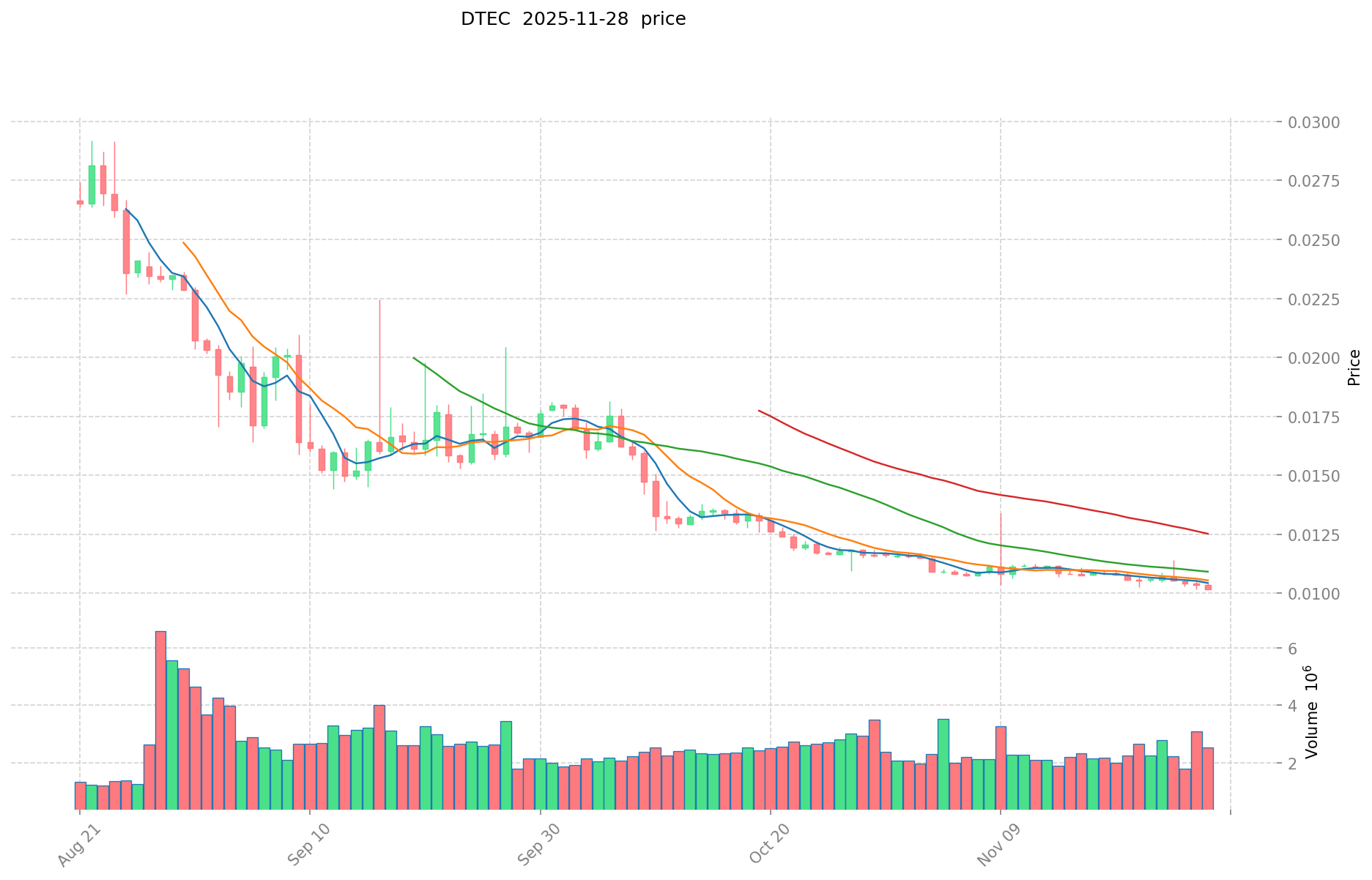
DTEC reached its all-time high of $0.21 on November 15, 2024, likely driven by market optimism and increased adoption of the Dtec virtual assistant technology in the automotive industry.
Its lowest price was $0.01007, recorded on November 28, 2025, possibly due to broader market corrections or specific challenges in the automotive tech sector.
These fluctuations reflect market sentiment, adoption trends, and external factors affecting the automotive and blockchain industries.
Click to view the current DTEC market price
On-Chain Metrics
- Daily Trading Volume: $56,349.4750688 (indicating network activity)
- Active Addresses: 7,141 (reflecting user engagement)
DTEC Ecosystem Applications and Partnerships
Core Use Cases
DTEC's ecosystem supports various applications:
- Vehicle Integration: Software component installable on vehicle operating systems, enabling communication and control of vehicle equipment.
- IoT Connectivity: Assists users with remote control of IoT devices, enhancing smart vehicle functionality.
Strategic Partnerships
DTEC has not disclosed specific partnerships. However, its integration with vehicle systems and IoT devices suggests potential collaborations within the automotive and smart technology sectors.
Controversies and Challenges
DTEC faces the following challenges:
- Market Adoption: As a relatively new project, gaining widespread adoption in the competitive automotive tech market.
- Regulatory Compliance: Ensuring compliance with evolving regulations around vehicle data and IoT security.
- Technological Integration: Seamlessly integrating with various vehicle operating systems and IoT platforms.
These issues drive ongoing discussions within the community and market, prompting continuous innovation for DTEC.
DTEC Community and Social Media Atmosphere
Fan Enthusiasm
DTEC's community is growing, with 7,141 holders as of November 29, 2025.
On X, the #DTEC hashtag is gaining traction among automotive tech enthusiasts and cryptocurrency followers.
Recent price movements and the project's innovative approach to vehicle assistance have sparked community interest.
Social Media Sentiment
Sentiment on X appears mixed:
- Supporters praise DTEC's potential to revolutionize in-vehicle assistance and IoT integration.
- Critics express concerns about the project's market performance and adoption rate.
Recent trends show cautious optimism as the project continues to develop its technology and use cases.
Hot Topics
X users discuss DTEC's potential impact on:
- Smart vehicle ecosystems
- IoT integration in automobiles
- Blockchain applications in automotive technology
These discussions highlight both the transformative potential and the challenges DTEC faces in the evolving automotive tech landscape.
More Information Sources for DTEC
- Official Website: Visit DTEC's official website for features, use cases, and latest updates.
- Whitepaper: The DTEC whitepaper details its technical architecture, goals, and vision.
- X Updates: On X, DTEC uses @DtecToken, sharing updates on technology developments and community activities.
DTEC Future Roadmap
- Ongoing Development: Enhance vehicle communication and IoT control features
- Ecosystem Goals: Expand integration with various vehicle manufacturers and IoT device providers
- Long-term Vision: Become a standard for in-vehicle virtual assistance and IoT connectivity in the automotive industry
How to Participate in DTEC?
- Purchase Options: Buy DTEC on Gate.com
- Storage Solutions: Use Web3 wallets compatible with Polygon network for secure storage
- Community Engagement: Follow DTEC's social media for updates and community discussions
- Ecosystem Contribution: Explore opportunities to develop applications or contribute to the DTEC ecosystem
Summary
DTEC is redefining vehicle assistance and IoT integration through blockchain technology, offering enhanced communication with vehicles and control of IoT devices. Its growing community and innovative approach position it uniquely in the intersection of automotive technology and blockchain. While facing challenges in market adoption and technological integration, DTEC's clear vision for revolutionizing in-vehicle experiences makes it a project to watch in the evolving landscape of automotive and blockchain technologies. Whether you're a tech enthusiast or an investor interested in automotive innovations, DTEC offers an intriguing opportunity to engage with the future of smart vehicle ecosystems.
FAQ
What is a DTEC engine?
A DTEC engine is a decentralized trading and exchange system that enables secure, fast, and efficient cryptocurrency transactions on the blockchain.
What does DTEC mean?
DTEC stands for Decentralized Technology, a term used in the blockchain and cryptocurrency space to refer to distributed and decentralized systems and technologies.
What is a DTEC inquiry?
A DTEC inquiry is a request for information about the DTEC cryptocurrency, its features, market performance, or technical aspects.
Is DTEC a software or hardware?
DTEC is a software solution, not hardware. It's a digital token or cryptocurrency used in the Web3 and blockchain ecosystem.
Share
Content
Dtec's Positioning and Significance
Origins and Development History
How Does Dtec Work?
DTEC's Market Performance
DTEC Ecosystem Applications and Partnerships
Controversies and Challenges
DTEC Community and Social Media Atmosphere
More Information Sources for DTEC
DTEC Future Roadmap
How to Participate in DTEC?
Summary
FAQ


