


What is BAC: Understanding Blood Alcohol Concentration and Its Impact on Driving
Basis Cash's Positioning and Significance
In 2020, Basis Cash (BAC) was launched, aiming to address the issue of stable value preservation in the cryptocurrency market. As an algorithmic stablecoin project, Basis Cash plays a key role in the DeFi sector.
As of 2025, Basis Cash has become an asset in the stablecoin ecosystem, with a market cap of $110,569 and an active community of 3,033 holders. This article will delve into its technical architecture, market performance, and future potential.
Origin and Development History
Birth Background
Basis Cash was created in 2020 with the goal of solving the challenge of maintaining a stable value in the volatile cryptocurrency market. It emerged during the DeFi boom, aiming to provide a decentralized stablecoin solution. The launch of Basis Cash brought new possibilities for users seeking stability in the crypto space.
Important Milestones
- 2020: Mainnet launch, implementing algorithmic stability mechanisms.
- 2020: Price peaked at $1010.99 on November 30.
- 2024: Lowest price recorded at $0.00130316 on October 27.
With support from its community, Basis Cash continues to optimize its technology, security, and real-world applications.
How Does Basis Cash Work?
Decentralized Control
Basis Cash operates on a decentralized network of computers (nodes) worldwide, free from control by banks or governments. These nodes collaborate to validate transactions, ensuring system transparency and attack resistance, granting users greater autonomy and enhancing network resilience.
Blockchain Core
Basis Cash's blockchain is a public, immutable digital ledger that records every transaction. Transactions are grouped into blocks and linked through cryptographic hashes to form a secure chain. Anyone can view the records, establishing trust without intermediaries.
Ensuring Fairness
Basis Cash uses smart contracts to manage its supply and maintain price stability. Participants interact with these contracts to maintain network stability and potentially earn rewards. Its innovation lies in attempting to create an algorithmic approach to stablecoin management.
Secure Transactions
Basis Cash uses public-private key encryption to protect transactions:
- Private keys (like secret passwords) are used to sign transactions
- Public keys (like account numbers) are used to verify ownership
This mechanism ensures fund security, while transactions remain pseudonymous. Additional security features may include integration with various DeFi protocols.
BAC Market Performance
Circulation Overview
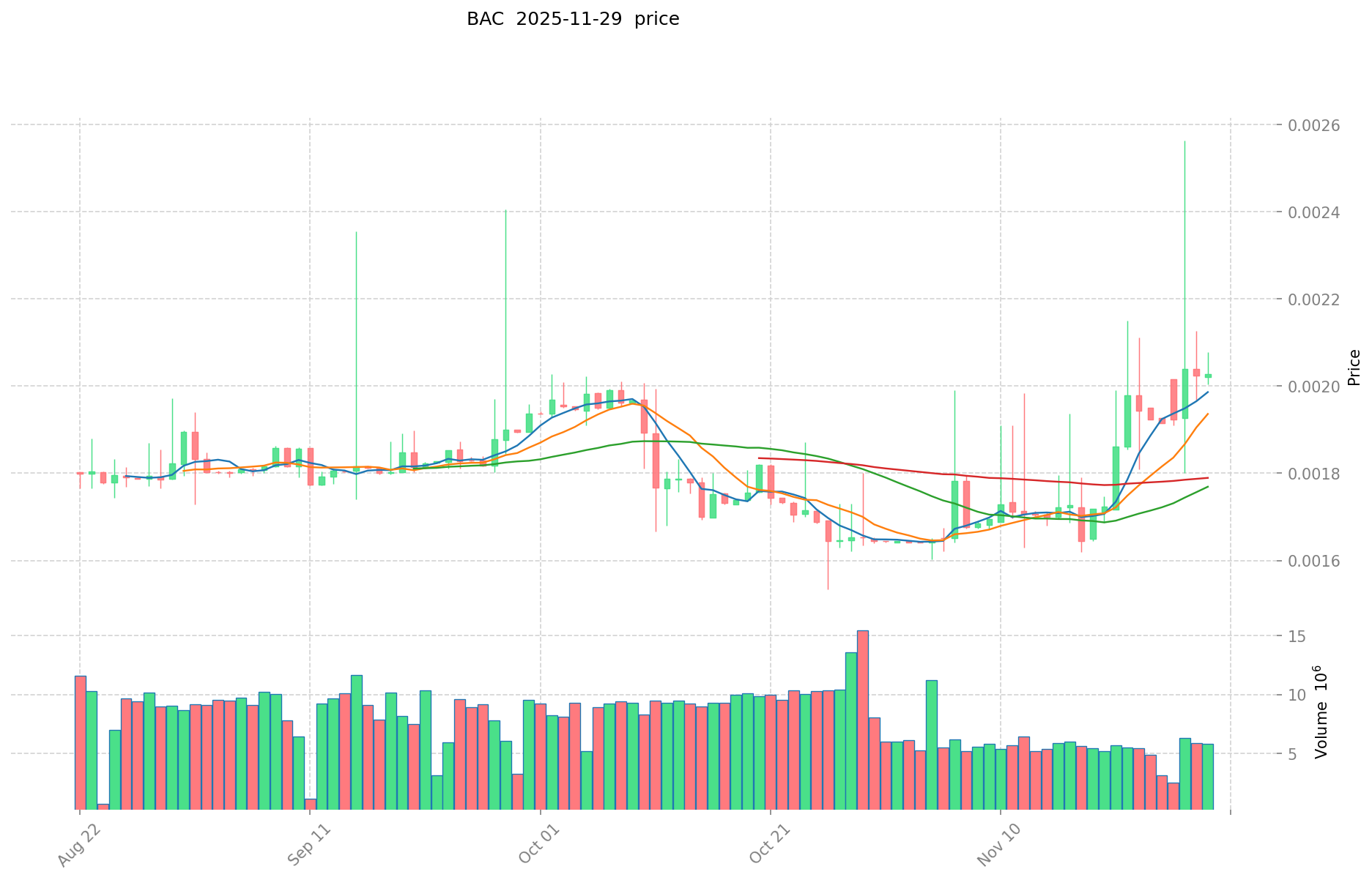
As of November 29, 2025, BAC's circulating supply is 54,575,249.82699095 tokens, which is equal to its total supply of 54,575,249.82699095.
Price Fluctuations
BAC reached its all-time high of $1010.99 on November 30, 2020.
Its lowest price was $0.00130316, recorded on October 27, 2024.
These fluctuations reflect market sentiment, adoption trends, and external factors.
Click to view the current BAC market price
On-chain Metrics
- Number of Holders: 3,033 (indicating community engagement)
BAC Ecosystem Applications and Partnerships
Core Use Cases
BAC's ecosystem supports various applications:
- DeFi: Basis Cash, aiming to provide a stable cryptocurrency pegged to the US dollar.
- Yield Farming: Basis Share, offering ownership tokens that receive inflation rewards from Basis Cash.
Strategic Partnerships
BAC has not established any notable partnerships at this time. The project's focus remains on its core stablecoin and governance token functionalities.
Controversies and Challenges
BAC faces the following challenges:
- Technical Issues: Maintaining the 1:1 peg to the US dollar
- Regulatory Risks: Potential scrutiny from financial regulators due to its stablecoin nature
- Competitive Pressure: Competition from other algorithmic stablecoins and established fiat-backed stablecoins
These issues have sparked discussions within the community and market, driving ongoing innovation efforts for BAC.
BAC Community and Social Media Atmosphere
Fan Enthusiasm
BAC's community activity is relatively low, with only 3,033 holders as of the latest data. On X platform, posts and hashtags related to BAC are infrequent and do not trend regularly. Price fluctuations occasionally spark community interest.
Social Media Sentiment
Sentiment on X is mixed:
- Supporters praise BAC's attempt at creating an algorithmic stablecoin and see it as a potential alternative to traditional fiat-backed stablecoins.
- Critics focus on price instability and challenges in maintaining the peg.
Recent trends show cautious sentiment due to the project's low market cap and trading volume.
Hot Topics
X users discuss BAC's stability mechanisms, adoption challenges, and its place in the broader stablecoin ecosystem.
More Information Sources for BAC
- Official Website: Visit Basis Cash official website for features, use cases, and latest updates.
- X Updates: On X platform, Basis Cash uses @BasisCash handle. As of November 29, 2025, follower count and engagement metrics are not provided in the given data.
BAC Future Roadmap
No specific future roadmap is available in the provided information.
How to Participate in BAC?
- Purchase Channels: Buy BAC on Gate.com
- Storage Solutions: Use Web3 wallets compatible with Ethereum tokens for secure storage
- Participate in Governance: Specific governance participation methods are not provided in the given data
- Contribute to Ecosystem: Visit the Basis Cash GitHub to explore development opportunities
Summary
BAC, through its Basis Cash and Basis Share tokens, attempts to redefine algorithmic stablecoins, offering price stability and yield farming opportunities. Its community, while small, remains interested in the project's potential to provide an alternative stablecoin solution.
Despite facing challenges in maintaining its peg and attracting widespread adoption, BAC's innovative approach to stablecoin design keeps it relevant in discussions about the future of decentralized finance. Whether you're a newcomer or an experienced player in the crypto space, BAC presents an interesting case study in algorithmic stablecoin experiments.
FAQ
What is the meaning of BAC?
BAC stands for Bitcoin Asset Chain, a blockchain platform designed to tokenize real-world assets using Bitcoin's security and liquidity.
Is a BAC of 0.05 drunk?
Yes, a BAC of 0.05 is considered legally drunk in many places. It's above the legal limit for driving in most countries and can impair judgment and coordination.
What is 0.08 alcohol level?
0.08 alcohol level is the legal limit for blood alcohol concentration (BAC) in many countries. It means 0.08 grams of alcohol per 100 milliliters of blood.
What is a normal BAC level?
A normal BAC (Blood Alcohol Content) level is 0.00%. Any level above 0.08% is considered legally impaired in most jurisdictions.
Share
Content
Basis Cash's Positioning and Significance
Origin and Development History
How Does Basis Cash Work?
BAC Market Performance
BAC Ecosystem Applications and Partnerships
Controversies and Challenges
BAC Community and Social Media Atmosphere
More Information Sources for BAC
BAC Future Roadmap
How to Participate in BAC?
Summary
FAQ


