


TED vs OP: The Battle of Ideas that Shapes Our Future
Introduction: TED vs OP Investment Comparison
In the cryptocurrency market, the comparison between Tezos Domains (TED) vs Optimism (OP) has been an unavoidable topic for investors. The two not only show significant differences in market cap ranking, application scenarios, and price performance, but also represent different positions in crypto assets.
Tezos Domains (TED): Since its launch, it has gained market recognition for its decentralized, open, and adaptable naming system on the Tezos blockchain.
Optimism (OP): Introduced in 2022, it has been hailed as a low-cost, lightning-fast Ethereum Layer 2 solution, becoming one of the most traded and valued cryptocurrencies globally.
This article will comprehensively analyze the investment value comparison between TED and OP, focusing on historical price trends, supply mechanisms, institutional adoption, technological ecosystems, and future predictions, attempting to answer the question most concerning to investors:
"Which is the better buy right now?"
I. Price History Comparison and Current Market Status
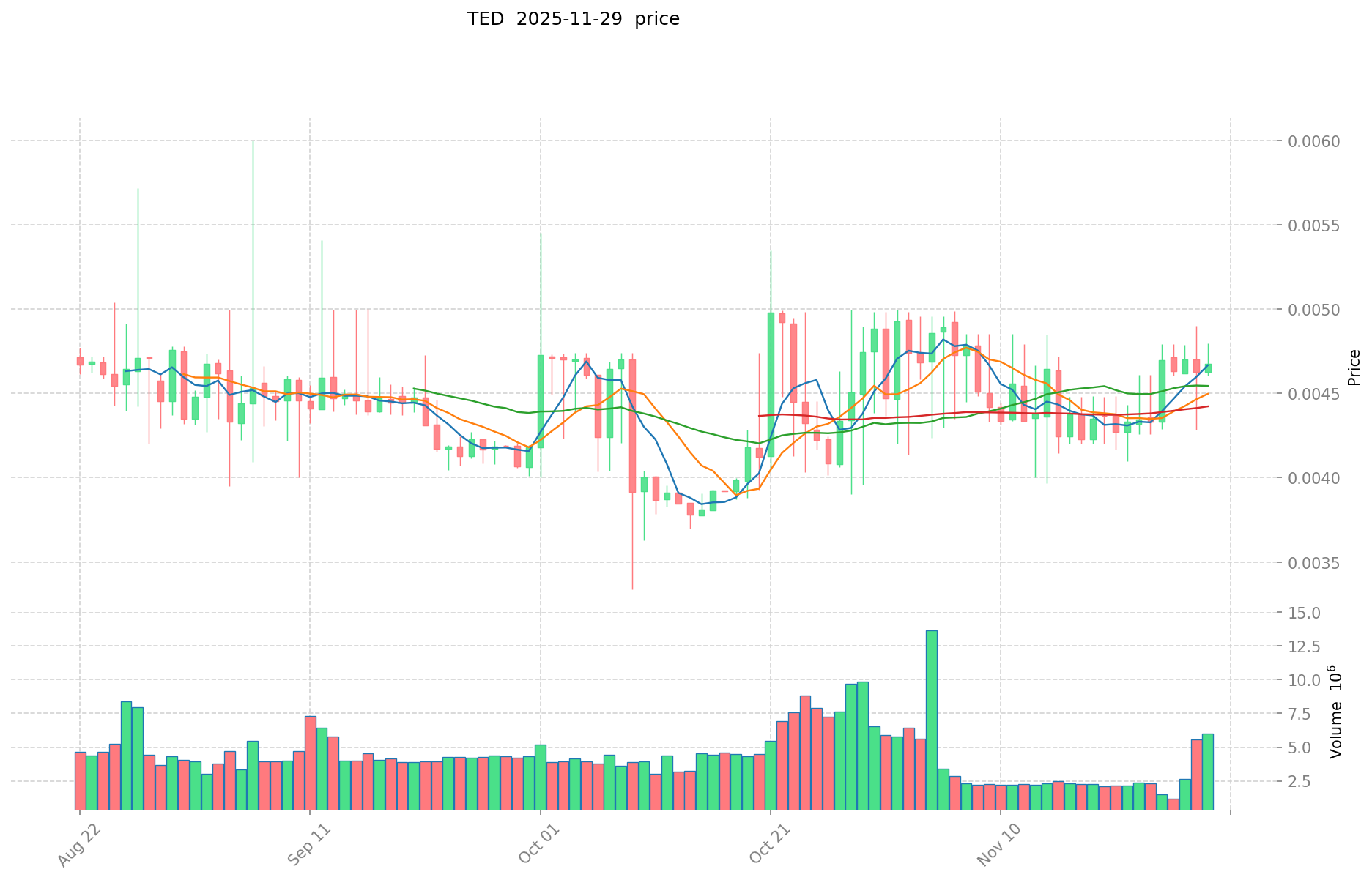
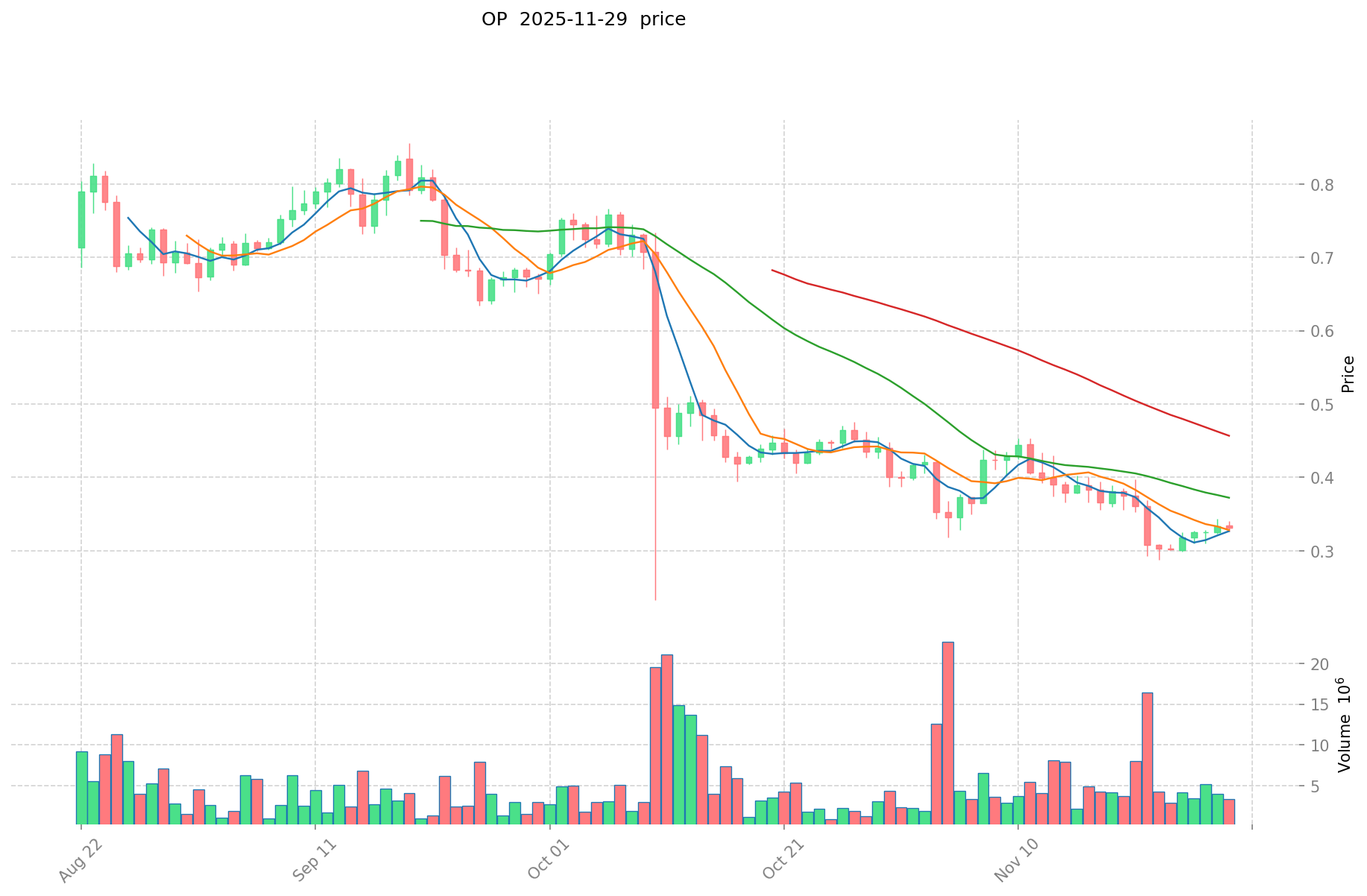
TED and OP Historical Price Trends
- 2023: TED reached its all-time high of $0.115496 on October 10, 2023.
- 2024: OP hit its all-time high of $4.84 on March 6, 2024.
- Comparative analysis: In the current market cycle, TED has fallen from its high of $0.115496 to a current price of $0.004748, while OP has declined from $4.84 to $0.3326.
Current Market Situation (2025-11-29)
- TED current price: $0.004748
- OP current price: $0.3326
- 24-hour trading volume: TED $28,582.86 vs OP $845,897.84
- Market Sentiment Index (Fear & Greed Index): 28 (Fear)
Click to view real-time prices:
- Check TED current price Market Price
- Check OP current price Market Price
II. Core Factors Affecting TED vs OP Investment Value
Supply Mechanism Comparison (Tokenomics)
- TED: Capped supply with deflationary model, reducing token volume over time
- OP: Governance token with defined emission schedule, focusing on community and ecosystem incentives
- 📌 Historical Pattern: Deflationary models like TED's tend to create scarcity-driven price appreciation in bull markets, while OP's controlled emission supports ecosystem growth with more predictable inflation.
Institutional Adoption and Market Applications
- Institutional Holdings: OP has gained more institutional traction due to Optimism's Layer 2 scaling solution for Ethereum and backing from the Ethereum Foundation
- Enterprise Adoption: OP shows stronger enterprise integration through Optimism's infrastructure partnerships, while TED focuses more on retail DeFi applications
- National Policies: Both tokens face similar regulatory scrutiny as utility tokens, though OP benefits from greater regulatory clarity due to its established ecosystem role
Technical Development and Ecosystem Building
- TED Technical Upgrades: Enhanced security features and DeFi interoperability improvements
- OP Technical Development: Continued optimization of Layer 2 scaling solutions, implementing EIP-4844 for improved transaction efficiency
- Ecosystem Comparison: OP has a more developed ecosystem across DeFi applications, NFT marketplaces, and enterprise solutions, while TED demonstrates stronger growth in specialized DeFi niches
Macroeconomic and Market Cycles
- Performance in Inflationary Environments: OP typically shows stronger correlation with broader crypto market movements, while TED's deflationary model provides better theoretical protection against inflation
- Macroeconomic Monetary Policy: Both tokens are affected by interest rate changes, but OP demonstrates higher sensitivity to tech sector investment flows
- Geopolitical Factors: Cross-border transaction demand benefits both tokens, with OP having slight advantages due to its more established global infrastructure
III. 2025-2030 Price Prediction: TED vs OP
Short-term Prediction (2025)
- TED: Conservative $0.00451968 - $0.004708 | Optimistic $0.004708 - $0.00579084
- OP: Conservative $0.235791 - $0.3321 | Optimistic $0.3321 - $0.435051
Mid-term Prediction (2027)
- TED may enter a growth phase, with an estimated price range of $0.00340162416 - $0.0072441996
- OP may enter a bullish market, with an estimated price range of $0.35154694575 - $0.576897552
- Key drivers: Institutional capital inflow, ETF, ecosystem development
Long-term Prediction (2030)
- TED: Base scenario $0.00757183427517 - $0.0089347644447 | Optimistic scenario $0.0089347644447+
- OP: Base scenario $0.67071371358915 - $0.764613633491631 | Optimistic scenario $0.764613633491631+
Disclaimer: This analysis is based on historical data and current market trends. Cryptocurrency markets are highly volatile and subject to rapid changes. These predictions should not be considered as financial advice. Always conduct your own research before making any investment decisions.
TED:
| 年份 | 预测最高价 | 预测平均价格 | 预测最低价 | 涨跌幅 |
|---|---|---|---|---|
| 2025 | 0.00579084 | 0.004708 | 0.00451968 | 0 |
| 2026 | 0.007349188 | 0.00524942 | 0.0045669954 | 10 |
| 2027 | 0.0072441996 | 0.006299304 | 0.00340162416 | 32 |
| 2028 | 0.007719797052 | 0.0067717518 | 0.004604791224 | 42 |
| 2029 | 0.00789789412434 | 0.007245774426 | 0.00659365472766 | 52 |
| 2030 | 0.0089347644447 | 0.00757183427517 | 0.007268960904163 | 59 |
OP:
| 年份 | 预测最高价 | 预测平均价格 | 预测最低价 | 涨跌幅 |
|---|---|---|---|---|
| 2025 | 0.435051 | 0.3321 | 0.235791 | 0 |
| 2026 | 0.517826925 | 0.3835755 | 0.318367665 | 15 |
| 2027 | 0.576897552 | 0.4507012125 | 0.35154694575 | 35 |
| 2028 | 0.585731295765 | 0.51379938225 | 0.32883160464 | 54 |
| 2029 | 0.7916620881708 | 0.5497653390075 | 0.533272378837275 | 65 |
| 2030 | 0.764613633491631 | 0.67071371358915 | 0.650592302181475 | 101 |
IV. Investment Strategy Comparison: TED vs OP
Long-term vs Short-term Investment Strategy
- TED: Suitable for investors focused on niche DeFi applications and deflationary tokenomics
- OP: Suitable for investors interested in Layer 2 scaling solutions and broader ecosystem growth
Risk Management and Asset Allocation
- Conservative investors: TED: 30% vs OP: 70%
- Aggressive investors: TED: 40% vs OP: 60%
- Hedging tools: Stablecoin allocation, options, cross-currency portfolios
V. Potential Risk Comparison
Market Risk
- TED: Limited liquidity and higher volatility due to smaller market cap
- OP: More susceptible to overall crypto market trends and Ethereum ecosystem developments
Technical Risk
- TED: Scalability, network stability
- OP: Network congestion during high demand, potential Layer 2 vulnerabilities
Regulatory Risk
- Global regulatory policies may impact both, with OP potentially facing more scrutiny due to its larger ecosystem and higher trading volume
VI. Conclusion: Which Is the Better Buy?
📌 Investment Value Summary:
- TED advantages: Deflationary model, niche DeFi focus, potential for higher percentage gains
- OP advantages: Established Layer 2 solution, stronger institutional adoption, broader ecosystem
✅ Investment Advice:
- New investors: Consider a higher allocation to OP for its more established ecosystem and lower volatility
- Experienced investors: Balance between TED and OP based on risk tolerance and market cycle position
- Institutional investors: Focus on OP for its liquidity and ecosystem integration, with a smaller allocation to TED for diversification
⚠️ Risk Warning: The cryptocurrency market is highly volatile, and this article does not constitute investment advice. None
VII. FAQ
Q1: What are the main differences between TED and OP? A: TED is a decentralized naming system on the Tezos blockchain with a deflationary model, while OP is an Ethereum Layer 2 scaling solution with a defined emission schedule. OP has a larger market cap, higher trading volume, and broader ecosystem adoption.
Q2: Which token has shown better price performance recently? A: Based on the current market data, OP has shown better price performance. While both tokens have fallen from their all-time highs, OP maintains a higher current price of $0.3326 compared to TED's $0.004748.
Q3: How do the supply mechanisms of TED and OP differ? A: TED has a capped supply with a deflationary model, reducing token volume over time. OP, on the other hand, is a governance token with a defined emission schedule focused on community and ecosystem incentives.
Q4: Which token has stronger institutional adoption? A: OP has gained more institutional traction due to Optimism's Layer 2 scaling solution for Ethereum and backing from the Ethereum Foundation. It also shows stronger enterprise integration through infrastructure partnerships.
Q5: What are the key factors affecting the long-term price predictions for TED and OP? A: Key factors include institutional capital inflow, potential ETF approvals, ecosystem development, technological upgrades, regulatory changes, and overall market cycles in the cryptocurrency space.
Q6: How should investors allocate their portfolio between TED and OP? A: Conservative investors might consider allocating 30% to TED and 70% to OP, while aggressive investors might opt for 40% TED and 60% OP. The exact allocation should be based on individual risk tolerance and investment goals.
Q7: What are the main risks associated with investing in TED and OP? A: Both tokens face market risks, technical risks, and regulatory risks. TED has limited liquidity and higher volatility due to its smaller market cap, while OP is more susceptible to overall crypto market trends and Ethereum ecosystem developments. Both may be impacted by global regulatory policies.
Share
Content
Introduction: TED vs OP Investment Comparison
I. Price History Comparison and Current Market Status
II. Core Factors Affecting TED vs OP Investment Value
III. 2025-2030 Price Prediction: TED vs OP
IV. Investment Strategy Comparison: TED vs OP
V. Potential Risk Comparison
VI. Conclusion: Which Is the Better Buy?
VII. FAQ


