


PSY vs XLM: The Battle of K-Pop and AI in Music Production
Introduction: PSY vs XLM Investment Comparison
In the cryptocurrency market, the comparison between PsyFi (PSY) and Stellar (XLM) has been an unavoidable topic for investors. The two not only show significant differences in market cap ranking, application scenarios, and price performance but also represent different positioning in the crypto asset space.
Stellar (XLM): Since its launch in 2014, it has gained market recognition for its efficiency in cross-border payments and as a decentralized gateway for transferring digital assets.
PsyFi (PSY): Introduced in 2022, it has positioned itself as an ecosystem of financial products built on the Solana blockchain.
This article will provide a comprehensive analysis of the investment value comparison between PSY and XLM, focusing on historical price trends, supply mechanisms, institutional adoption, technological ecosystems, and future predictions, attempting to answer the question most crucial to investors:
"Which is the better buy right now?"
I. Price History Comparison and Current Market Status
PSY and XLM Historical Price Trends
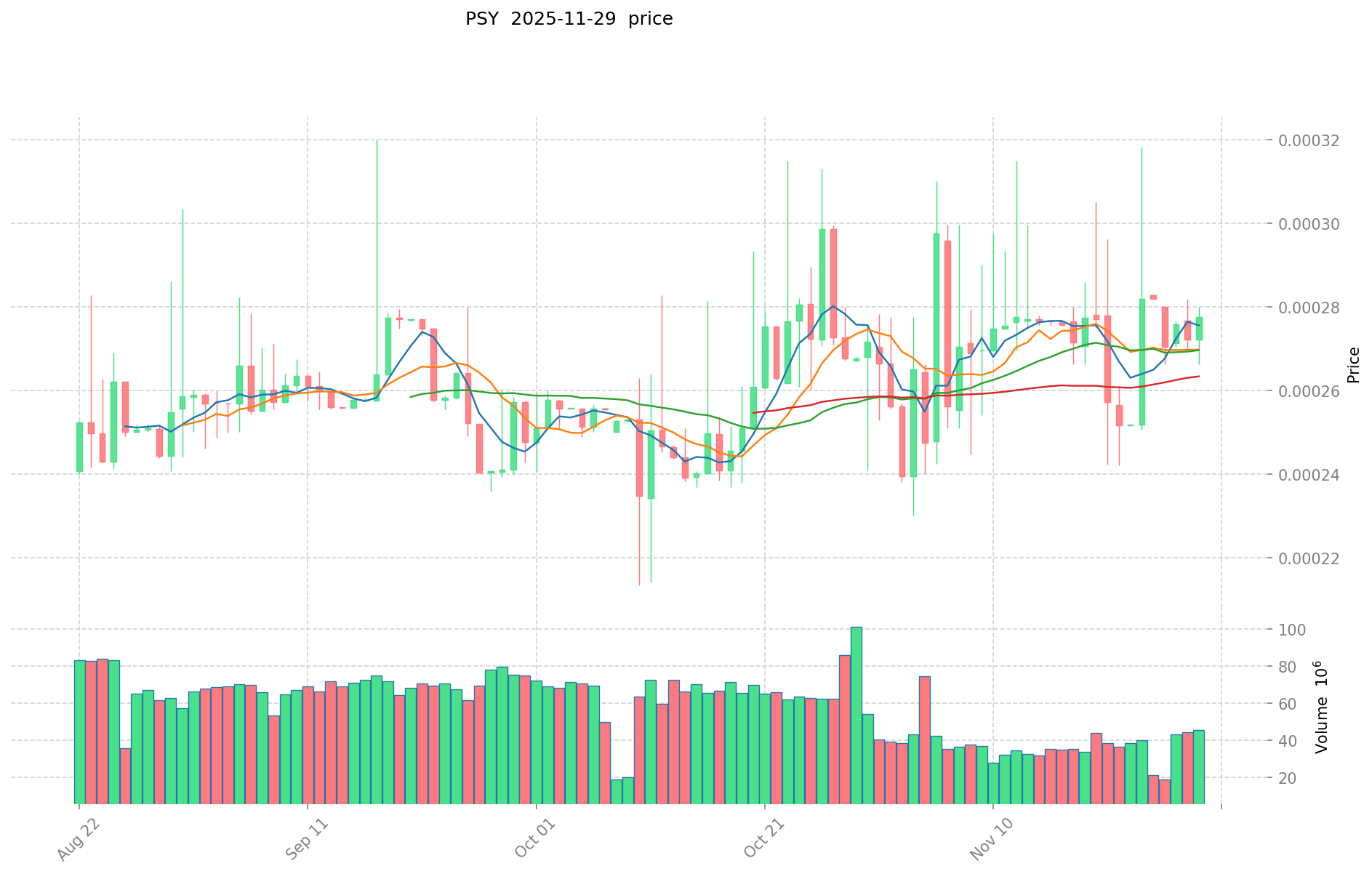
- 2022: PSY reached its all-time high of $0.422114 on January 21, 2022, before experiencing a significant price decline.
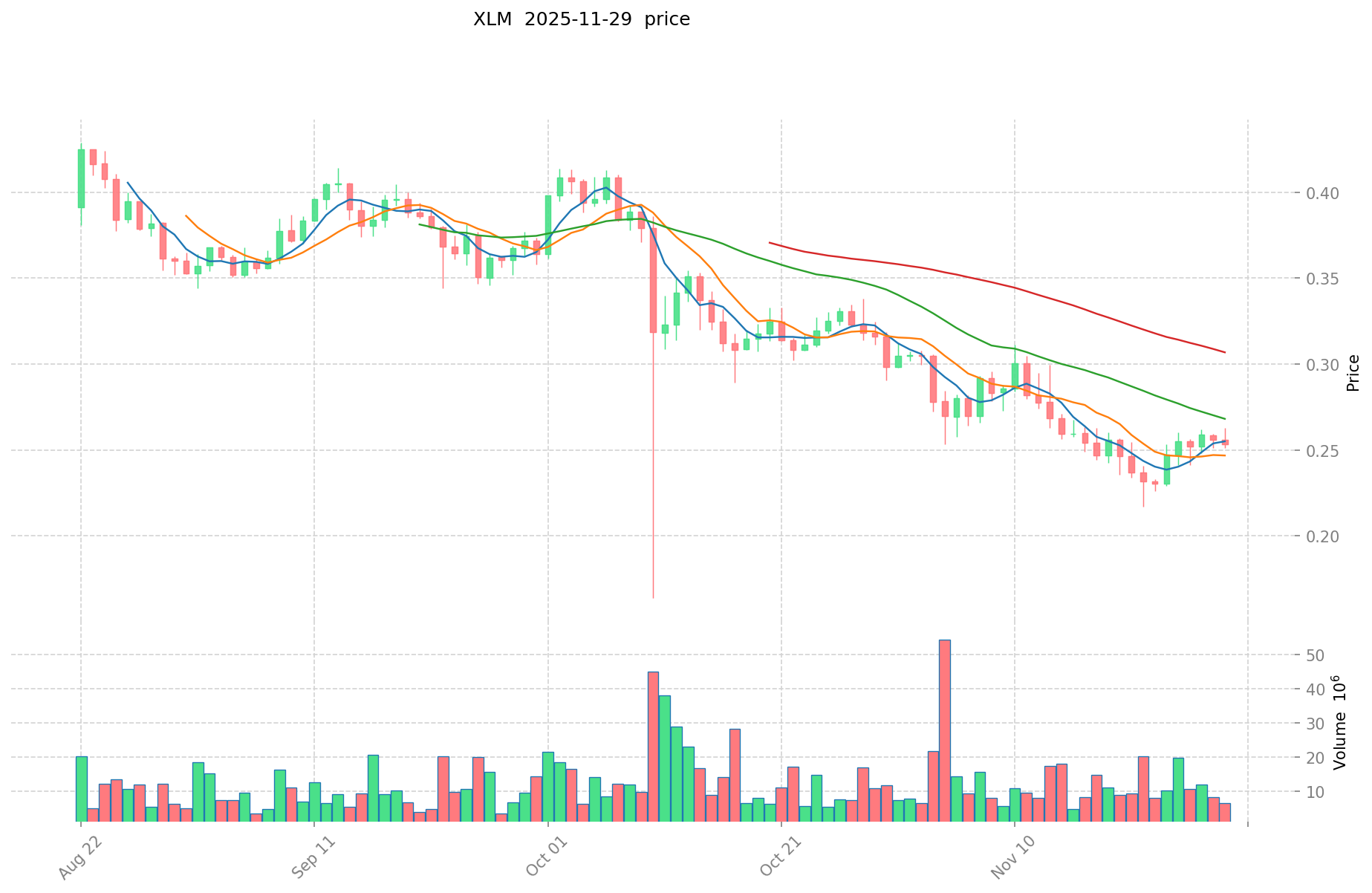
- 2018: XLM hit its all-time high of $0.875563 on January 3, 2018, during the broader cryptocurrency bull market.
- Comparative analysis: Over the past year, PSY has declined from its peak by 54.51%, while XLM has fallen by 49.69% from its yearly high.
Current Market Situation (2025-11-29)
- PSY current price: $0.00026791
- XLM current price: $0.25158
- 24-hour trading volume: PSY $12,443.92 vs XLM $1,629,559.40
- Crypto Fear & Greed Index: 28 (Fear)
Click to view real-time prices:
- View PSY current price Market Price
- View XLM current price Market Price
II. Core Factors Affecting the Investment Value of PSY vs XLM
Supply Mechanisms Comparison (Tokenomics)
- PSY: Limited supply cap mechanism with a total of 100,000,000 tokens
- XLM: Fixed supply of 50 billion XLM tokens that was later reduced through token burning
- 📌 Historical pattern: Supply mechanisms with fixed caps tend to create scarcity value over time, potentially supporting price appreciation during market expansion phases.
Institutional Adoption and Market Applications
- Institutional holdings: XLM has greater institutional adoption with partnerships including IBM, Deloitte and financial institutions
- Enterprise adoption: XLM has established use in cross-border payments and settlements through the Stellar network, while PSY focuses on content creation and mental health applications
- Regulatory attitudes: XLM generally enjoys more favorable regulatory positioning due to its focus on compliant financial infrastructure
Technical Development and Ecosystem Building
- PSY technical upgrades: Integration with AI tools for mental health applications and content creator support systems
- XLM technical development: Soroban smart contracts platform enabling more complex applications on the Stellar network
- Ecosystem comparison: XLM has a more developed ecosystem for payments and financial applications, while PSY is building a specialized ecosystem around content creation and mental wellness
Macroeconomic and Market Cycles
- Performance in inflationary environments: XLM's established use cases in cross-border payments may provide more stability during inflation
- Macroeconomic monetary policies: Interest rate changes likely impact XLM's financial use cases more directly than PSY's content economy
- Geopolitical factors: XLM potentially benefits from increased cross-border transaction demand during global uncertainty
III. 2025-2030 Price Prediction: PSY vs XLM
Short-term Prediction (2025)
- PSY: Conservative $0.00018023 - $0.000269 | Optimistic $0.000269 - $0.00031473
- XLM: Conservative $0.1382975 - $0.25145 | Optimistic $0.25145 - $0.3143125
Mid-term Prediction (2027)
- PSY may enter a growth phase, with expected prices ranging from $0.0002523172925 to $0.00051544818325
- XLM may enter a growth phase, with expected prices ranging from $0.2013407296875 to $0.4243643071875
- Key drivers: Institutional fund inflows, ETF, ecosystem development
Long-term Prediction (2030)
- PSY: Base scenario $0.000494813156917 - $0.000596160430021 | Optimistic scenario $0.000596160430021 - $0.000810778184829
- XLM: Base scenario $0.317023444594492 - $0.519710564909004 | Optimistic scenario $0.519710564909004 - $0.649638206136255
Disclaimer: The above predictions are based on historical data and market analysis. Cryptocurrency markets are highly volatile and subject to rapid changes. These forecasts should not be considered as financial advice or investment recommendations. Always conduct your own research and consult with a qualified financial advisor before making any investment decisions.
PSY:
| 年份 | 预测最高价 | 预测平均价格 | 预测最低价 | 涨跌幅 |
|---|---|---|---|---|
| 2025 | 0.00031473 | 0.000269 | 0.00018023 | 0 |
| 2026 | 0.00042904155 | 0.000291865 | 0.00016052575 | 8 |
| 2027 | 0.00051544818325 | 0.000360453275 | 0.0002523172925 | 34 |
| 2028 | 0.000547438411406 | 0.000437950729125 | 0.000402914670795 | 63 |
| 2029 | 0.000699626289777 | 0.000492694570265 | 0.000275908959348 | 83 |
| 2030 | 0.000810778184829 | 0.000596160430021 | 0.000494813156917 | 122 |
XLM:
| 年份 | 预测最高价 | 预测平均价格 | 预测最低价 | 涨跌幅 |
|---|---|---|---|---|
| 2025 | 0.3143125 | 0.25145 | 0.1382975 | 0 |
| 2026 | 0.3366286875 | 0.28288125 | 0.220647375 | 12 |
| 2027 | 0.4243643071875 | 0.30975496875 | 0.2013407296875 | 23 |
| 2028 | 0.495530511257812 | 0.36705963796875 | 0.253271150198437 | 45 |
| 2029 | 0.608126055204726 | 0.431295074613281 | 0.2760288477525 | 71 |
| 2030 | 0.649638206136255 | 0.519710564909004 | 0.317023444594492 | 106 |
IV. Investment Strategy Comparison: PSY vs XLM
Long-term vs Short-term Investment Strategies
- PSY: Suitable for investors focused on content creation and mental health applications
- XLM: Suitable for investors interested in cross-border payments and financial infrastructure
Risk Management and Asset Allocation
- Conservative investors: PSY: 20% vs XLM: 80%
- Aggressive investors: PSY: 40% vs XLM: 60%
- Hedging tools: Stablecoin allocation, options, cross-currency portfolios
V. Potential Risk Comparison
Market Risks
- PSY: Higher volatility due to smaller market cap and newer project status
- XLM: Exposure to broader financial market trends and competition from traditional payment systems
Technical Risks
- PSY: Scalability, network stability on Solana blockchain
- XLM: Network congestion during high-volume periods, potential smart contract vulnerabilities
Regulatory Risks
- Global regulatory policies may have a more significant impact on XLM due to its focus on financial services, while PSY may face less scrutiny in the content creation space
VI. Conclusion: Which Is the Better Buy?
📌 Investment Value Summary:
- PSY advantages: Niche focus on mental health and content creation, potential for rapid growth in emerging markets
- XLM advantages: Established presence in cross-border payments, partnerships with major institutions, more stable regulatory position
✅ Investment Recommendations:
- Novice investors: Consider a higher allocation to XLM for its established market presence and use cases
- Experienced investors: Balanced approach with both PSY and XLM, leveraging PSY's growth potential and XLM's stability
- Institutional investors: Focus on XLM for its regulatory compliance and established financial use cases
⚠️ Risk Warning: The cryptocurrency market is highly volatile, and this article does not constitute investment advice. None
VII. FAQ
Q1: What are the main differences between PSY and XLM? A: PSY is a newer token focused on content creation and mental health applications on the Solana blockchain, while XLM is an established cryptocurrency designed for cross-border payments and financial infrastructure since 2014.
Q2: Which cryptocurrency has shown better price performance recently? A: Over the past year, XLM has shown slightly better price performance, with a decline of 49.69% from its yearly high, compared to PSY's 54.51% decline.
Q3: How do the supply mechanisms of PSY and XLM differ? A: PSY has a limited supply cap of 100,000,000 tokens, while XLM initially had a fixed supply of 50 billion tokens that was later reduced through token burning.
Q4: Which cryptocurrency has greater institutional adoption? A: XLM has greater institutional adoption, with partnerships including IBM, Deloitte, and various financial institutions.
Q5: What are the key factors affecting the long-term value of PSY and XLM? A: Key factors include supply mechanisms, institutional adoption, technical development, ecosystem building, and macroeconomic conditions such as inflation and interest rates.
Q6: How do the 2030 price predictions compare for PSY and XLM? A: For 2030, PSY's optimistic scenario predicts a range of $0.000596160430021 - $0.000810778184829, while XLM's optimistic scenario predicts $0.519710564909004 - $0.649638206136255.
Q7: What are the main risks associated with investing in PSY and XLM? A: PSY faces higher volatility due to its smaller market cap and newer status, while XLM is exposed to broader financial market trends and regulatory scrutiny. Both cryptocurrencies are subject to technical risks and market volatility.
Q8: Which cryptocurrency might be more suitable for different types of investors? A: Conservative investors might prefer a higher allocation to XLM due to its established market presence. Experienced investors could consider a balanced approach with both PSY and XLM. Institutional investors may focus more on XLM for its regulatory compliance and established financial use cases.
Share
Content
Introduction: PSY vs XLM Investment Comparison
I. Price History Comparison and Current Market Status
II. Core Factors Affecting the Investment Value of PSY vs XLM
III. 2025-2030 Price Prediction: PSY vs XLM
IV. Investment Strategy Comparison: PSY vs XLM
V. Potential Risk Comparison
VI. Conclusion: Which Is the Better Buy?
VII. FAQ


