The article "LYP vs AVAX: A Comparative Analysis of Two Rising Blockchain Platforms" provides a thorough examination of the investment potential and market dynamics between Lympid (LYP) and Avalanche (AVAX). It analyzes historical price trends, supply mechanisms, institutional adoption, technical ecosystems, and macroeconomic factors impacting their investment value. The piece addresses crucial investor questions about which cryptocurrency, LYP or AVAX, presents a more advantageous investment option, entailing risk comparison and strategy recommendations. Targeted towards investors at different experience levels, the article offers insights into the unique propositions and risks associated with both blockchain platforms.
Introduction: Investment Comparison of LYP vs AVAX
In the cryptocurrency market, the comparison between Lympid (LYP) vs Avalanche (AVAX) has been an unavoidable topic for investors. The two not only show significant differences in market cap ranking, application scenarios, and price performance, but also represent different positioning in crypto assets.
Lympid (LYP): Since its launch, it has gained market recognition for its focus on tokenizing premium Real World Assets (RWAs).
Avalanche (AVAX): Since its inception in 2020, it has been hailed as a platform for launching decentralized applications and interoperable blockchains, becoming one of the cryptocurrencies with high global trading volume and market capitalization.
This article will comprehensively analyze the investment value comparison between LYP and AVAX, focusing on historical price trends, supply mechanisms, institutional adoption, technological ecosystems, and future predictions, attempting to answer the question most concerning investors:
"Which is the better buy right now?"
I. Price History Comparison and Current Market Status
LYP and AVAX Historical Price Trends
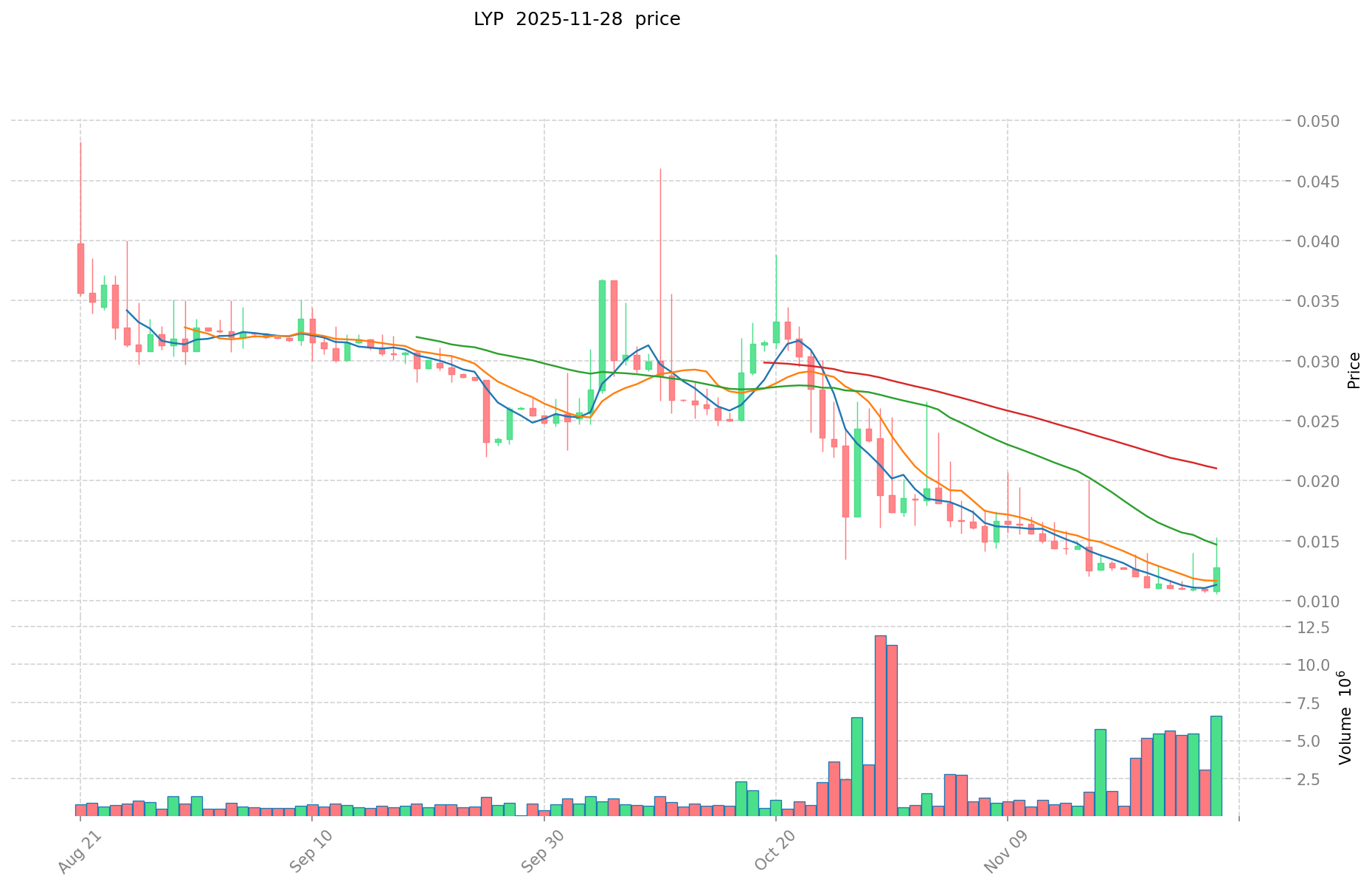
- 2025: LYP reached its all-time high of $0.82201 on January 24, 2025, and its all-time low of $0.01054 on November 27, 2025.
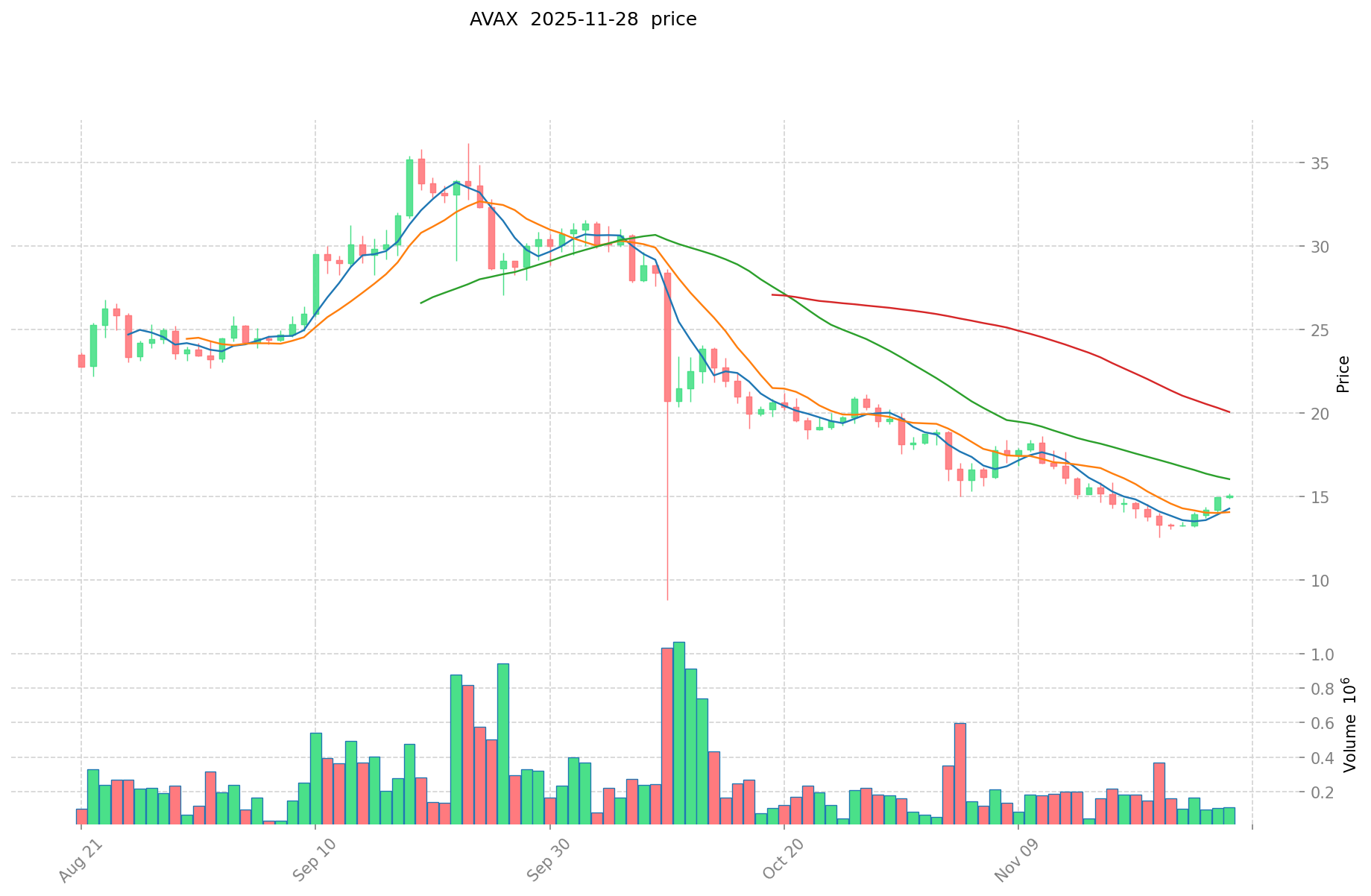
- 2021: AVAX hit its all-time high of $144.96 on November 21, 2021, while its all-time low of $2.8 was recorded on December 31, 2020.
- Comparative Analysis: In the recent market cycle, LYP has experienced significant volatility, dropping from its peak to near its all-time low within the same year. AVAX, on the other hand, has shown a more extended price history with its all-time high dating back to 2021.
Current Market Situation (2025-11-29)
- LYP current price: $0.01285
- AVAX current price: $14.88
- 24-hour trading volume: LYP $47,230.96 vs AVAX $1,969,691.81
- Market Sentiment Index (Fear & Greed Index): 25 (Extreme Fear)
Click to view real-time prices:
- View LYP current price Market Price
- View AVAX current price Market Price
II. Key Factors Affecting Investment Value of LYP vs AVAX
Supply Mechanism Comparison (Tokenomics)
- LYP: The token features a deflationary model with token burns, where 70% of protocol revenue is used to buy back and burn LYP tokens.
- AVAX: Fixed supply cap of 720 million tokens, with three different token emissions mechanisms - primary sale, platform rewards, and staking rewards.
- 📌 Historical pattern: Deflationary models like LYP's tend to create upward price pressure over time, while AVAX's fixed cap creates scarcity as adoption increases.
Institutional Adoption and Market Applications
- Institutional holdings: AVAX has attracted more institutional interest, with backing from traditional venture capital firms like Andreessen Horowitz, Polychain Capital, and Three Arrows Capital.
- Enterprise adoption: AVAX has been integrated into more enterprise solutions through its subnet architecture, allowing businesses to create customized blockchains. LYP's enterprise adoption remains more limited.
- Regulatory attitudes: Both tokens operate in uncertain regulatory environments, though AVAX's positioning as a platform technology has helped it navigate regulatory scrutiny better than many other tokens.
Technical Development and Ecosystem Building
- LYP technical upgrades: Focus on improving scalability and transaction processing capabilities to enhance platform performance.
- AVAX technical development: Continuous development of its subnet architecture, C-Chain compatibility with Ethereum, and consensus mechanism improvements.
- Ecosystem comparison: AVAX has a more developed ecosystem spanning DeFi, NFTs, and gaming applications, with over $3 billion in total value locked. LYP's ecosystem is still developing, with fewer applications built on its platform.
Macroeconomic Factors and Market Cycles
- Performance during inflation: AVAX has demonstrated stronger performance during inflationary periods due to its broader market adoption and utility.
- Macroeconomic monetary policy: Both tokens show sensitivity to interest rate changes and dollar strength, typical of the broader crypto market.
- Geopolitical factors: AVAX's more global presence and wider adoption provide potential advantages during geopolitical uncertainty.
III. 2025-2030 Price Prediction: LYP vs AVAX
Short-term Prediction (2025)
- LYP: Conservative $0.0108276 - $0.01289 | Optimistic $0.01289 - $0.0161125
- AVAX: Conservative $10.5364 - $14.84 | Optimistic $14.84 - $19.8856
Mid-term Prediction (2027)
- LYP may enter a growth phase, with an estimated price range of $0.0118504215 - $0.017446453875
- AVAX may enter a bullish market, with an estimated price range of $16.17692076 - $27.3116844
- Key drivers: Institutional fund inflows, ETF, ecosystem development
Long-term Prediction (2030)
- LYP: Base scenario $0.01940531620476 - $0.020416967760459 | Optimistic scenario $0.020416967760459 - $0.025420964228236
- AVAX: Base scenario $32.50048425624 - $36.49177179648 | Optimistic scenario $36.49177179648 - $39.000581107488
View detailed price predictions for LYP and AVAX
Disclaimer: This information is for educational purposes only and should not be considered as financial advice. Cryptocurrency markets are highly volatile and unpredictable. Always conduct your own research before making any investment decisions.
LYP:
| 年份 |
预测最高价 |
预测平均价格 |
预测最低价 |
涨跌幅 |
| 2025 |
0.0161125 |
0.01289 |
0.0108276 |
0 |
| 2026 |
0.0184165875 |
0.01450125 |
0.0127611 |
12 |
| 2027 |
0.017446453875 |
0.01645891875 |
0.0118504215 |
28 |
| 2028 |
0.019834642985625 |
0.0169526863125 |
0.014748837091875 |
31 |
| 2029 |
0.020416967760459 |
0.018393664649062 |
0.0117719453754 |
43 |
| 2030 |
0.025420964228236 |
0.01940531620476 |
0.009896711264428 |
51 |
AVAX:
| 年份 |
预测最高价 |
预测平均价格 |
预测最低价 |
涨跌幅 |
| 2025 |
19.8856 |
14.84 |
10.5364 |
0 |
| 2026 |
24.655176 |
17.3628 |
13.89024 |
16 |
| 2027 |
27.3116844 |
21.008988 |
16.17692076 |
41 |
| 2028 |
32.858057232 |
24.1603362 |
21.019492494 |
62 |
| 2029 |
36.49177179648 |
28.509196716 |
23.94772524144 |
91 |
| 2030 |
39.000581107488 |
32.50048425624 |
22.1003292942432 |
118 |
IV. Investment Strategy Comparison: LYP vs AVAX
Long-term vs Short-term Investment Strategies
- LYP: Suitable for investors focused on real-world asset tokenization and deflationary models
- AVAX: Suitable for investors interested in ecosystem growth and platform adoption
Risk Management and Asset Allocation
- Conservative investors: LYP: 20% vs AVAX: 80%
- Aggressive investors: LYP: 40% vs AVAX: 60%
- Hedging tools: Stablecoin allocation, options, cross-currency portfolios
V. Potential Risk Comparison
Market Risks
- LYP: High volatility, relatively new to the market
- AVAX: Susceptible to overall crypto market trends, competition from other smart contract platforms
Technical Risks
- LYP: Scalability, network stability
- AVAX: Network congestion during high demand, potential vulnerabilities in subnet architecture
Regulatory Risks
- Global regulatory policies may impact both differently, with AVAX potentially facing less scrutiny due to its platform nature
VI. Conclusion: Which Is the Better Buy?
📌 Investment Value Summary:
- LYP advantages: Deflationary model, focus on real-world asset tokenization
- AVAX advantages: Established ecosystem, institutional backing, subnet architecture
✅ Investment Advice:
- Novice investors: Consider AVAX for its more established market presence
- Experienced investors: Balanced portfolio with both LYP and AVAX, leveraging their different value propositions
- Institutional investors: AVAX for its broader ecosystem and institutional adoption, with potential allocation to LYP for diversification
⚠️ Risk Warning: The cryptocurrency market is highly volatile. This article does not constitute investment advice.
None
VII. FAQ
Q1: What are the main differences between LYP and AVAX?
A: The main differences are:
- Market cap and adoption: AVAX has a larger market cap and more widespread adoption.
- Focus: LYP focuses on tokenizing real-world assets, while AVAX is a platform for decentralized applications and interoperable blockchains.
- Supply mechanism: LYP has a deflationary model with token burns, while AVAX has a fixed supply cap of 720 million tokens.
- Ecosystem: AVAX has a more developed ecosystem spanning DeFi, NFTs, and gaming applications.
Q2: Which cryptocurrency has shown better historical price performance?
A: AVAX has shown better historical price performance. It reached its all-time high of $144.96 in November 2021, while LYP's all-time high was $0.82201 in January 2025. AVAX also has a longer price history and has maintained a higher current price of $14.88 compared to LYP's $0.01285 as of November 29, 2025.
Q3: How do the supply mechanisms of LYP and AVAX differ?
A: LYP features a deflationary model with token burns, where 70% of protocol revenue is used to buy back and burn LYP tokens. AVAX, on the other hand, has a fixed supply cap of 720 million tokens, with three different token emissions mechanisms: primary sale, platform rewards, and staking rewards.
Q4: Which cryptocurrency has attracted more institutional interest?
A: AVAX has attracted more institutional interest, with backing from traditional venture capital firms like Andreessen Horowitz, Polychain Capital, and Three Arrows Capital. It has also been integrated into more enterprise solutions through its subnet architecture.
Q5: What are the key factors affecting the investment value of LYP and AVAX?
A: The key factors include:
- Supply mechanism (tokenomics)
- Institutional adoption and market applications
- Technical development and ecosystem building
- Macroeconomic factors and market cycles
Q6: What are the potential risks associated with investing in LYP and AVAX?
A: Potential risks include:
- Market risks: Both are subject to high volatility, with LYP being relatively new to the market.
- Technical risks: LYP faces scalability and network stability challenges, while AVAX may experience network congestion during high demand.
- Regulatory risks: Both may be impacted by global regulatory policies, with AVAX potentially facing less scrutiny due to its platform nature.
Q7: What investment strategies are recommended for LYP and AVAX?
A: Investment strategies vary based on investor profiles:
- Conservative investors: 20% LYP, 80% AVAX
- Aggressive investors: 40% LYP, 60% AVAX
- Novice investors may consider AVAX for its more established market presence
- Experienced investors could maintain a balanced portfolio with both LYP and AVAX
- Institutional investors might focus on AVAX for its broader ecosystem and institutional adoption, with potential allocation to LYP for diversification
* The information is not intended to be and does not constitute financial advice or any other recommendation of any sort offered or endorsed by Gate.












