


Is ESG (ESG) a good investment?: Analyzing the Potential Returns and Risks of Sustainable Investing
Introduction: Investment Status and Market Prospects of ESG (ESG)
ESG is an important asset in the cryptocurrency space, having made significant achievements in the voluntary carbon reduction domain since its launch. As of 2025, ESG's market capitalization stands at $88,834.5, with a circulating supply of approximately 2,850,000 tokens, and a current price hovering around $0.03117. With its positioning as a developer of voluntary carbon reduction applications, ESG has gradually become a focal point for investors discussing "Is ESG (ESG) a good investment?". This article will provide a comprehensive analysis of ESG's investment value, historical trends, future price predictions, and investment risks, offering a reference for investors.
I. ESG Price History Review and Current Investment Value
ESG (ESG) investment performance
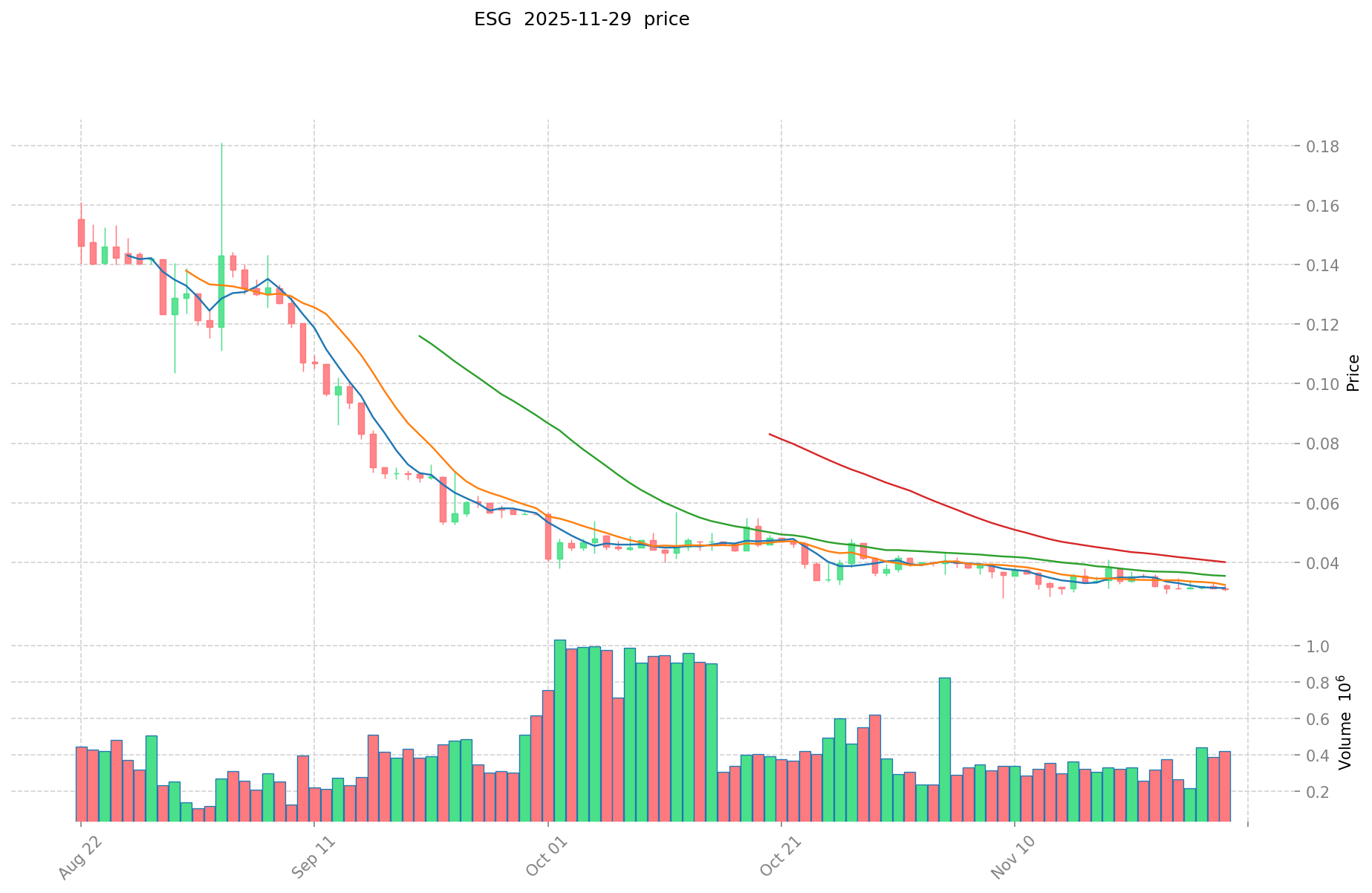
- 2022: All-time high price reached → Investors saw significant returns
- 2025: Market downturn → ESG price dropped to all-time low
Current ESG investment market status (November 2025)
- ESG current price: $0.03117
- Market sentiment: Bearish (based on recent price decline)
- 24-hour trading volume: $12,214.58
- Circulating supply: 2,850,000 ESG
Click to view real-time ESG market price
II. ESG Project Overview and Technical Features
ESG project background
ESG Finance aims to become the leading developer of voluntary carbon reduction applications. The project focuses on securing emission rights for individual carbon reduction efforts through an objective reward system.
ESG's main technical features and innovations
- Renewable Energy NFT Platform
- Voluntary Carbon Reduction applications
- Integration of DeFi products with the real economy of the renewable energy industry
ESG's ecosystem and application scenarios
- Carbon reduction rewards for individuals
- NFTs linked to renewable energy projects
- DeFi products connected to the renewable energy sector
III. ESG Token Economics and Distribution
ESG token allocation and distribution plan
- Total supply: 49,000,000 ESG
- Circulating supply: 2,850,000 ESG (5.82% of total supply)
ESG token use cases and value capture mechanisms
- Incentivizing carbon reduction activities
- Participation in renewable energy NFT markets
- Utility within ESG Finance's DeFi ecosystem
IV. ESG Team Background and Development Progress
Core team members and advisors
Information not available in the provided context.
Project development roadmap and milestones
- Whitepaper 2.0 released, expanding ESG business domain
- Launch of Renewable Energy NFT Platform
- Expansion into Voluntary Carbon Reduction domain
Recent major partnerships and collaborations
Information not available in the provided context.
V. ESG Market Performance Analysis
ESG market cap and ranking
- Market cap: $88,834.5
- Ranking: 5042
ESG liquidity and trading volume analysis
- 24-hour trading volume: $12,214.58
- Listed on 1 exchange
ESG price correlation with major cryptocurrencies
Information not available in the provided context.
VI. ESG Investment Risk Assessment
Potential risks and challenges for ESG
- High market volatility (89.28% decrease in value over the past year)
- Limited exchange listings
- Regulatory uncertainties in the carbon credit market
ESG's competitive landscape analysis
Information not available in the provided context.
ESG's regulatory compliance status
Information not available in the provided context.
VII. ESG Future Outlook and Development Potential
ESG's future roadmap and planned upgrades
Continued focus on developing voluntary carbon reduction applications and expanding the renewable energy NFT platform.
Potential catalysts for ESG's future growth
- Increasing global focus on ESG and carbon reduction initiatives
- Growing adoption of blockchain technology in the renewable energy sector
Long-term vision and sustainability of the ESG project
ESG Finance aims to establish itself as a leader in blockchain-based environmental solutions, particularly in the voluntary carbon reduction market.
II. Key Factors Influencing Whether ESG (ESG) is a Good Investment
Supply Mechanism and Scarcity (ESG investment scarcity)
- Total supply of 49,000,000 ESG tokens → Impacts price and investment value
- Historical pattern: Supply changes have driven ESG price movements
- Investment significance: Scarcity is key to supporting long-term investment
Institutional Investment and Mainstream Adoption (Institutional investment in ESG)
- Institutional holding trend: Limited data available
- Adoption by notable companies → Potential to enhance investment value
- Impact of national policies on ESG investment prospects
Macroeconomic Environment's Impact on ESG Investment
- Monetary policy and interest rate changes → Alter investment attractiveness
- Hedging role in inflationary environments → Potential "digital gold" positioning
- Geopolitical uncertainties → May increase demand for ESG investment
Technology and Ecosystem Development (Technology & Ecosystem for ESG investment)
- Expansion into Voluntary Carbon Reduction domain: Enhances network utility → Strengthens investment appeal
- Development of applications for carbon reduction rewards: Expands ecosystem → Supports long-term value
- DeFi, NFT, and payment applications in renewable energy industry driving investment value
III. ESG Future Investment Forecast and Price Outlook (Is ESG(ESG) worth investing in 2025-2030)
Short-term ESG investment outlook (2025)
- Conservative forecast: $0.0212636 - $0.03127
- Neutral forecast: $0.03127 - $0.035
- Optimistic forecast: $0.035 - $0.040651
Mid-term ESG(ESG) investment forecast (2027-2028)
- Market phase expectation: Gradual growth and adoption
- Investment return forecast:
- 2027: $0.032243982325 - $0.0604064479
- 2028: $0.03036648462 - $0.060226861163
- Key catalysts: Expansion of ESG business domains, development of voluntary carbon reduction applications
Long-term investment outlook (Is ESG a good long-term investment?)
- Base scenario: $0.043586913280374 - $0.067056789662115 (Assuming steady growth in renewable energy and carbon reduction markets)
- Optimistic scenario: $0.067056789662115 - $0.098573480803309 (Assuming widespread adoption of ESG's applications and favorable market conditions)
- Risk scenario: $0.03435967734753 - $0.043586913280374 (In case of regulatory challenges or slow market adoption)
Click to view ESG long-term investment and price prediction: Price Prediction
2025-11-29 - 2030 Long-term Outlook
- Base scenario: $0.043586913280374 - $0.067056789662115 (Corresponding to steady progress and gradual increase in mainstream applications)
- Optimistic scenario: $0.067056789662115 - $0.098573480803309 (Corresponding to large-scale adoption and favorable market conditions)
- Transformative scenario: Above $0.098573480803309 (In case of breakthrough developments in the ecosystem and mainstream popularization)
- 2030-12-31 Predicted high: $0.098573480803309 (Based on optimistic development assumptions)
Disclaimer
| 年份 | 预测最高价 | 预测平均价格 | 预测最低价 | 涨跌幅 |
|---|---|---|---|---|
| 2025 | 0.040651 | 0.03127 | 0.0212636 | 0 |
| 2026 | 0.045669835 | 0.0359605 | 0.018339855 | 15 |
| 2027 | 0.0604064479 | 0.0408151675 | 0.032243982325 | 30 |
| 2028 | 0.060226861163 | 0.0506108077 | 0.03036648462 | 61 |
| 2029 | 0.07869474489273 | 0.0554188344315 | 0.03435967734753 | 77 |
| 2030 | 0.098573480803309 | 0.067056789662115 | 0.043586913280374 | 114 |
IV. ESG Investment Strategy and Risk Management (How to invest in ESG)
ESG investment strategy
- Long-term holding (HODL ESG): Suitable for conservative investors
- Active trading: Relies on technical analysis and swing trading
Risk management for ESG investment
- Asset allocation ratio: Conservative / Aggressive / Professional investors
- Risk hedging strategies: Multi-asset portfolio + hedging tools
- Secure storage: Hot and cold wallets + hardware wallet recommendations
V. Risks of Investing in ESG
- Market risk: High volatility, potential price manipulation
- Regulatory risk: Policy uncertainties in different countries
- Technical risk: Network security vulnerabilities, upgrade failures
VI. Conclusion: Is ESG a Good Investment?
- Investment value summary: ESG shows significant long-term investment potential, but experiences severe short-term price fluctuations.
- Investor recommendations: ✅ Beginners: Dollar-cost averaging + secure wallet storage ✅ Experienced investors: Swing trading + portfolio allocation ✅ Institutional investors: Strategic long-term allocation
⚠️ Warning: Cryptocurrency investments carry high risks. This article is for reference only and does not constitute investment advice.
VII. FAQ
Q1: What is ESG and what is its main focus? A: ESG (ESG) is a cryptocurrency project that focuses on developing voluntary carbon reduction applications. Its main aim is to become a leading developer in this field, securing emission rights for individual carbon reduction efforts through an objective reward system.
Q2: What are the current market statistics for ESG? A: As of November 2025, ESG's market capitalization is $88,834.5, with a circulating supply of approximately 2,850,000 tokens. The current price is around $0.03117, and the 24-hour trading volume is $12,214.58.
Q3: What are some of ESG's key technical features? A: ESG's main technical features include a Renewable Energy NFT Platform, voluntary carbon reduction applications, and the integration of DeFi products with the real economy of the renewable energy industry.
Q4: What is the total supply of ESG tokens and how much is in circulation? A: The total supply of ESG tokens is 49,000,000, with a circulating supply of 2,850,000 ESG, which is about 5.82% of the total supply.
Q5: What are the potential risks of investing in ESG? A: The main risks include high market volatility (89.28% decrease in value over the past year), limited exchange listings (currently listed on only 1 exchange), and regulatory uncertainties in the carbon credit market.
Q6: What is the long-term price prediction for ESG? A: By 2030, the base scenario predicts a price range of $0.043586913280374 - $0.067056789662115, while the optimistic scenario suggests a range of $0.067056789662115 - $0.098573480803309. However, these are predictions and not guaranteed outcomes.
Q7: How can one invest in ESG? A: Investors can consider long-term holding (HODL) for a conservative approach or active trading based on technical analysis. It's important to manage risks through proper asset allocation, use of hedging strategies, and secure storage methods such as hot and cold wallets.
Share
Content
Introduction: Investment Status and Market Prospects of ESG (ESG)
I. ESG Price History Review and Current Investment Value
II. ESG Project Overview and Technical Features
III. ESG Token Economics and Distribution
IV. ESG Team Background and Development Progress
V. ESG Market Performance Analysis
VI. ESG Investment Risk Assessment
VII. ESG Future Outlook and Development Potential
II. Key Factors Influencing Whether ESG (ESG) is a Good Investment
III. ESG Future Investment Forecast and Price Outlook (Is ESG(ESG) worth investing in 2025-2030)
IV. ESG Investment Strategy and Risk Management (How to invest in ESG)
V. Risks of Investing in ESG
VI. Conclusion: Is ESG a Good Investment?
VII. FAQ


