


GETA vs NEAR: Comparing Two Innovative Blockchain Platforms for Web3 Development
Introduction: GETA vs NEAR Investment Comparison
In the cryptocurrency market, the comparison between GETA and NEAR has always been a topic that investors cannot ignore. The two not only show significant differences in market cap ranking, application scenarios, and price performance, but also represent different positioning in crypto assets.
Getaverse (GETA): Since its launch in 2023, it has gained market recognition for its DID credit protocol and decentralized identity management.
NEAR (NEAR): Introduced in 2020, it has been hailed as a highly scalable protocol for supporting DApps on mobile devices, becoming one of the top cryptocurrencies by global trading volume and market capitalization.
This article will comprehensively analyze the investment value comparison between GETA and NEAR, focusing on historical price trends, supply mechanisms, institutional adoption, technological ecosystems, and future predictions, attempting to answer the question most concerning to investors:
"Which is the better buy right now?"
I. Price History Comparison and Current Market Status
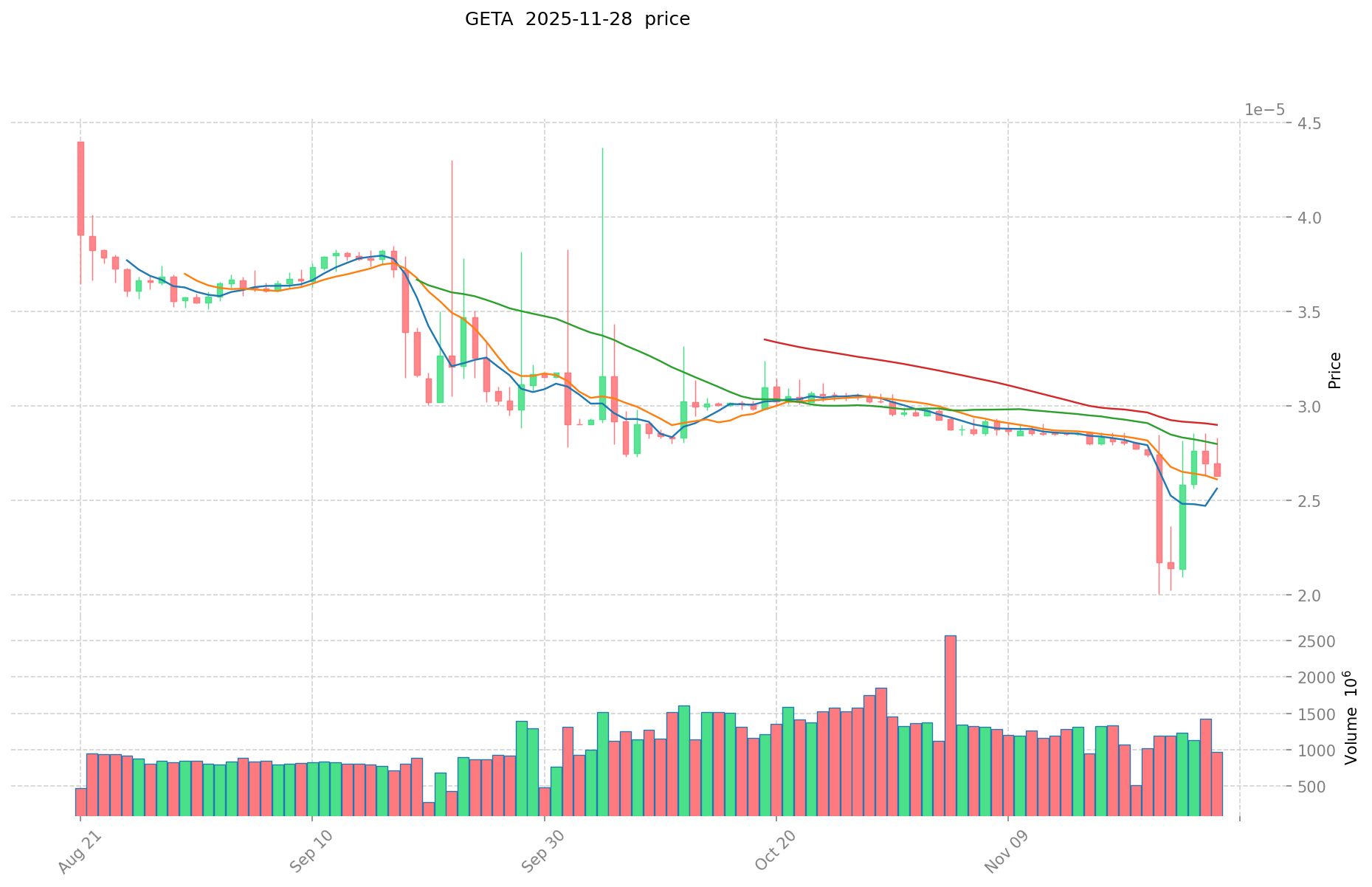
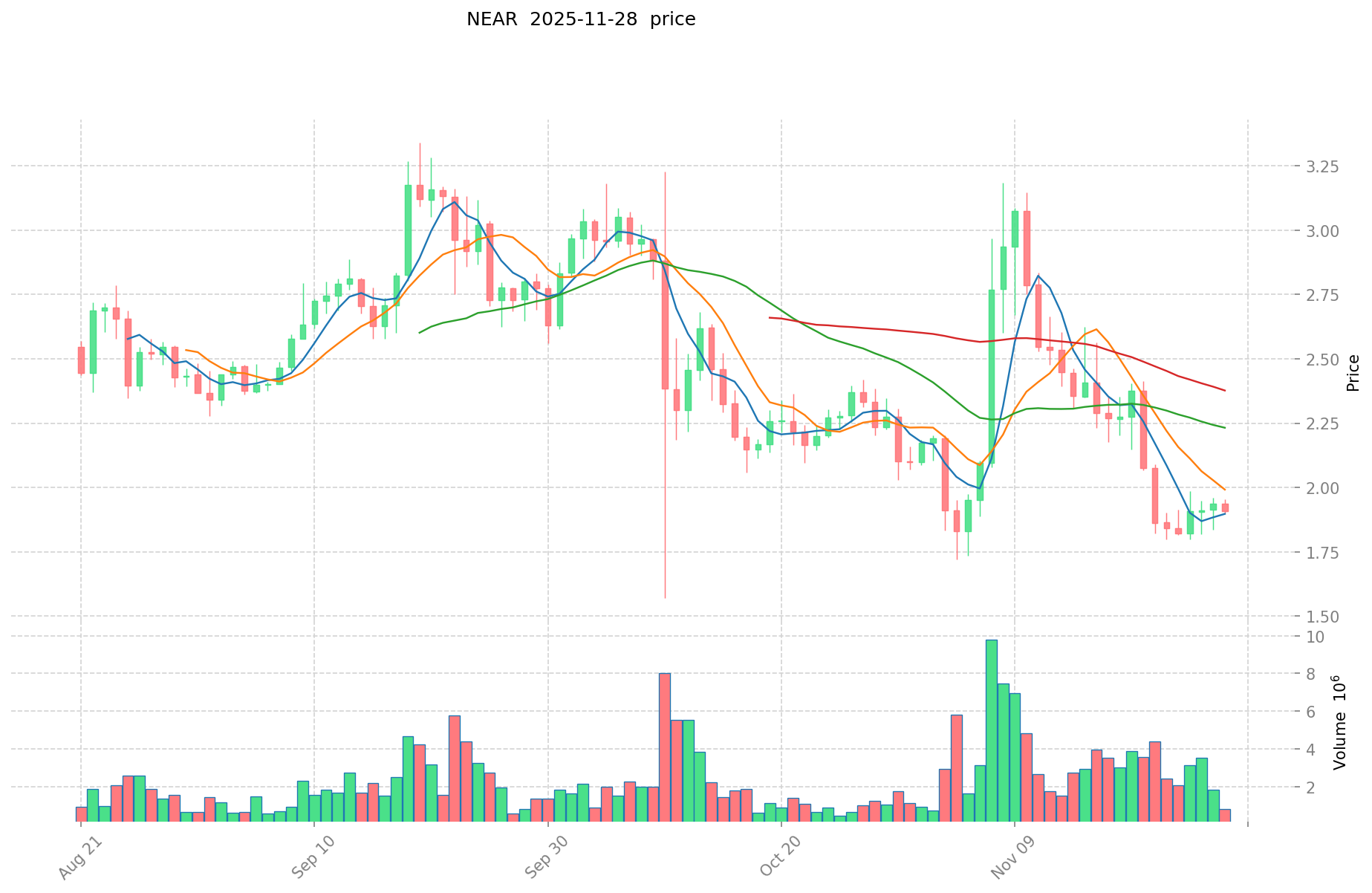
GETA (Coin A) and NEAR (Coin B) Historical Price Trends
- 2023: GETA reached its all-time high of $0.045001 on October 3, 2023.
- 2022: NEAR hit its all-time high of $20.44 on January 17, 2022.
- Comparative Analysis: During the market cycle, GETA dropped from its high of $0.045001 to a low of $0.00002001, while NEAR declined from $20.44 to its current price of $1.884.
Current Market Situation (2025-11-29)
- GETA current price: $0.00002781
- NEAR current price: $1.884
- 24-hour trading volume: GETA $23,068.77 vs NEAR $1,614,245.56
- Market Sentiment Index (Fear & Greed Index): 25 (Extreme Fear)
Click to view real-time prices:
- View GETA current price Market Price
- View NEAR current price Market Price
II. Core Factors Affecting the Investment Value of GETA vs NEAR
Supply Mechanism Comparison (Tokenomics)
- GETA: Fixed supply model with a maximum cap of 10 billion tokens, creating scarcity as adoption increases
- NEAR: Inflationary model with dynamic supply, initially minting 5% annually with gradual reduction to 1.67% as protocol matures
- 📌 Historical Pattern: Fixed supply tokens like GETA tend to show stronger price appreciation during bull markets, while NEAR's controlled inflation supports ecosystem development but may dilute value
Institutional Adoption and Market Applications
- Institutional Holdings: NEAR has attracted more institutional interest with investments from Andreessen Horowitz, Coinbase Ventures, and Pantera Capital
- Enterprise Adoption: NEAR's scaling technology and interoperability solutions have gained traction in enterprise environments, while GETA focuses more on retail user applications
- Regulatory Attitudes: Both projects face similar regulatory scrutiny in major markets, though NEAR's foundation structure provides somewhat clearer compliance frameworks
Technical Development and Ecosystem Building
- GETA Technical Upgrades: Implementation of zero-knowledge proofs for enhanced privacy and transaction efficiency
- NEAR Technical Development: Nightshade sharding technology enabling significant throughput improvements and "Aurora" EVM compatibility layer
- Ecosystem Comparison: NEAR has a more mature DeFi ecosystem with established DEXes and lending protocols; GETA shows strength in NFT marketplaces and gaming applications
Macroeconomic and Market Cycles
- Performance During Inflation: NEAR has historically shown more resilience during high inflation periods due to its staking rewards offsetting inflation
- Macroeconomic Monetary Policy: Both tokens demonstrate sensitivity to Federal Reserve policy changes, with rate hikes typically affecting GETA more severely
- Geopolitical Factors: NEAR's decentralized infrastructure provides better censorship resistance for cross-border transactions in uncertain geopolitical environments
III. 2025-2030 Price Prediction: GETA vs NEAR
Short-term Prediction (2025)
- GETA: Conservative $0.0000265335 - $0.00002793 | Optimistic $0.00002793 - $0.0000410571
- NEAR: Conservative $1.3174 - $1.882 | Optimistic $1.882 - $2.3525
Mid-term Prediction (2027)
- GETA may enter a growth phase, with expected price range of $0.0000242144721 - $0.00004358604978
- NEAR may enter a bullish market, with expected price range of $1.94787 - $3.36007575
- Key drivers: Institutional capital inflow, ETF, ecosystem development
Long-term Prediction (2030)
- GETA: Base scenario $0.000036531163333 - $0.000048708217778 | Optimistic scenario $0.000048708217778 - $0.000066243176178
- NEAR: Base scenario $3.640223252639531 - $3.831813950146875 | Optimistic scenario $3.831813950146875 - $5.057994414193875
Disclaimer: This information is for educational purposes only and should not be considered as financial advice. Cryptocurrency markets are highly volatile and unpredictable. Always conduct your own research before making any investment decisions.
GETA:
| 年份 | 预测最高价 | 预测平均价格 | 预测最低价 | 涨跌幅 |
|---|---|---|---|---|
| 2025 | 0.0000410571 | 0.00002793 | 0.0000265335 | 0 |
| 2026 | 0.000046221357 | 0.00003449355 | 0.000021386001 | 24 |
| 2027 | 0.00004358604978 | 0.0000403574535 | 0.0000242144721 | 45 |
| 2028 | 0.000050366101968 | 0.00004197175164 | 0.000024343615951 | 50 |
| 2029 | 0.000051247508752 | 0.000046168926804 | 0.000043860480463 | 66 |
| 2030 | 0.000066243176178 | 0.000048708217778 | 0.000036531163333 | 75 |
NEAR:
| 年份 | 预测最高价 | 预测平均价格 | 预测最低价 | 涨跌幅 |
|---|---|---|---|---|
| 2025 | 2.3525 | 1.882 | 1.3174 | 0 |
| 2026 | 2.752425 | 2.11725 | 1.1644875 | 12 |
| 2027 | 3.36007575 | 2.4348375 | 1.94787 | 29 |
| 2028 | 3.79566817875 | 2.897456625 | 1.85437224 | 53 |
| 2029 | 4.31706549841875 | 3.346562401875 | 3.2126999058 | 77 |
| 2030 | 5.057994414193875 | 3.831813950146875 | 3.640223252639531 | 103 |
IV. Investment Strategy Comparison: GETA vs NEAR
Long-term vs Short-term Investment Strategies
- GETA: Suitable for investors focused on decentralized identity solutions and NFT/gaming ecosystems
- NEAR: Suitable for investors seeking scalable DApp platforms with established institutional backing
Risk Management and Asset Allocation
- Conservative investors: GETA: 10% vs NEAR: 90%
- Aggressive investors: GETA: 30% vs NEAR: 70%
- Hedging tools: Stablecoin allocation, options, cross-currency portfolios
V. Potential Risk Comparison
Market Risks
- GETA: Higher volatility due to lower market cap and trading volume
- NEAR: Susceptible to broader crypto market trends and competitor advancements
Technical Risks
- GETA: Scalability, network stability
- NEAR: Centralization concerns, potential security vulnerabilities in smart contracts
Regulatory Risks
- Global regulatory policies may impact both, with NEAR potentially facing more scrutiny due to its larger market presence
VI. Conclusion: Which Is the Better Buy?
📌 Investment Value Summary:
- GETA advantages: Unique DID protocol, potential for high growth in emerging sectors
- NEAR advantages: Established ecosystem, institutional backing, scalable infrastructure
✅ Investment Advice:
- New investors: Consider a smaller allocation to GETA within a diversified portfolio
- Experienced investors: Balance between GETA and NEAR based on risk tolerance and market outlook
- Institutional investors: NEAR may offer more liquidity and established use cases
⚠️ Risk Warning: The cryptocurrency market is highly volatile. This article does not constitute investment advice. None
VII. FAQ
Q1: What are the main differences between GETA and NEAR in terms of supply mechanisms? A: GETA has a fixed supply model with a maximum cap of 10 billion tokens, creating scarcity as adoption increases. NEAR, on the other hand, has an inflationary model with dynamic supply, initially minting 5% annually with gradual reduction to 1.67% as the protocol matures.
Q2: How do GETA and NEAR compare in terms of institutional adoption? A: NEAR has attracted more institutional interest with investments from major players like Andreessen Horowitz, Coinbase Ventures, and Pantera Capital. GETA, being newer, has less institutional backing at this stage.
Q3: What are the key technical developments for each project? A: GETA has implemented zero-knowledge proofs for enhanced privacy and transaction efficiency. NEAR has developed Nightshade sharding technology for improved throughput and the "Aurora" EVM compatibility layer.
Q4: How do GETA and NEAR perform during different market conditions? A: Historically, fixed supply tokens like GETA tend to show stronger price appreciation during bull markets. NEAR has shown more resilience during high inflation periods due to its staking rewards offsetting inflation.
Q5: What are the long-term price predictions for GETA and NEAR by 2030? A: For GETA, the base scenario predicts a range of $0.000036531163333 - $0.000048708217778, with an optimistic scenario of $0.000048708217778 - $0.000066243176178. For NEAR, the base scenario predicts $3.640223252639531 - $3.831813950146875, with an optimistic scenario of $3.831813950146875 - $5.057994414193875.
Q6: How should investors allocate their portfolio between GETA and NEAR? A: Conservative investors might consider allocating 10% to GETA and 90% to NEAR, while aggressive investors might opt for 30% GETA and 70% NEAR. However, this should be adjusted based on individual risk tolerance and market outlook.
Share
Content
Introduction: GETA vs NEAR Investment Comparison
I. Price History Comparison and Current Market Status
II. Core Factors Affecting the Investment Value of GETA vs NEAR
III. 2025-2030 Price Prediction: GETA vs NEAR
IV. Investment Strategy Comparison: GETA vs NEAR
V. Potential Risk Comparison
VI. Conclusion: Which Is the Better Buy?
VII. FAQ


