


DTEC vs CRO: Comparing Data-Driven Testing and Conventional Risk-Based Optimization in Software Quality Assurance
Introduction: Investment Comparison of DTEC vs CRO
In the cryptocurrency market, the comparison between DTEC vs CRO has always been a topic that investors cannot avoid. The two not only have significant differences in market cap ranking, application scenarios, and price performance, but also represent different positioning in crypto assets.
DTEC (DTEC): Since its launch, it has gained market recognition for its innovative virtual assistant application in the automotive industry.
Cronos (CRO): Since 2018, it has been hailed as a leading blockchain ecosystem, representing one of the most widely traded and highest market cap cryptocurrencies globally.
This article will provide a comprehensive analysis of the investment value comparison between DTEC vs CRO, focusing on historical price trends, supply mechanisms, institutional adoption, technological ecosystems, and future predictions, attempting to answer the question that concerns investors the most:
"Which is the better buy right now?"
I. Price History Comparison and Current Market Status
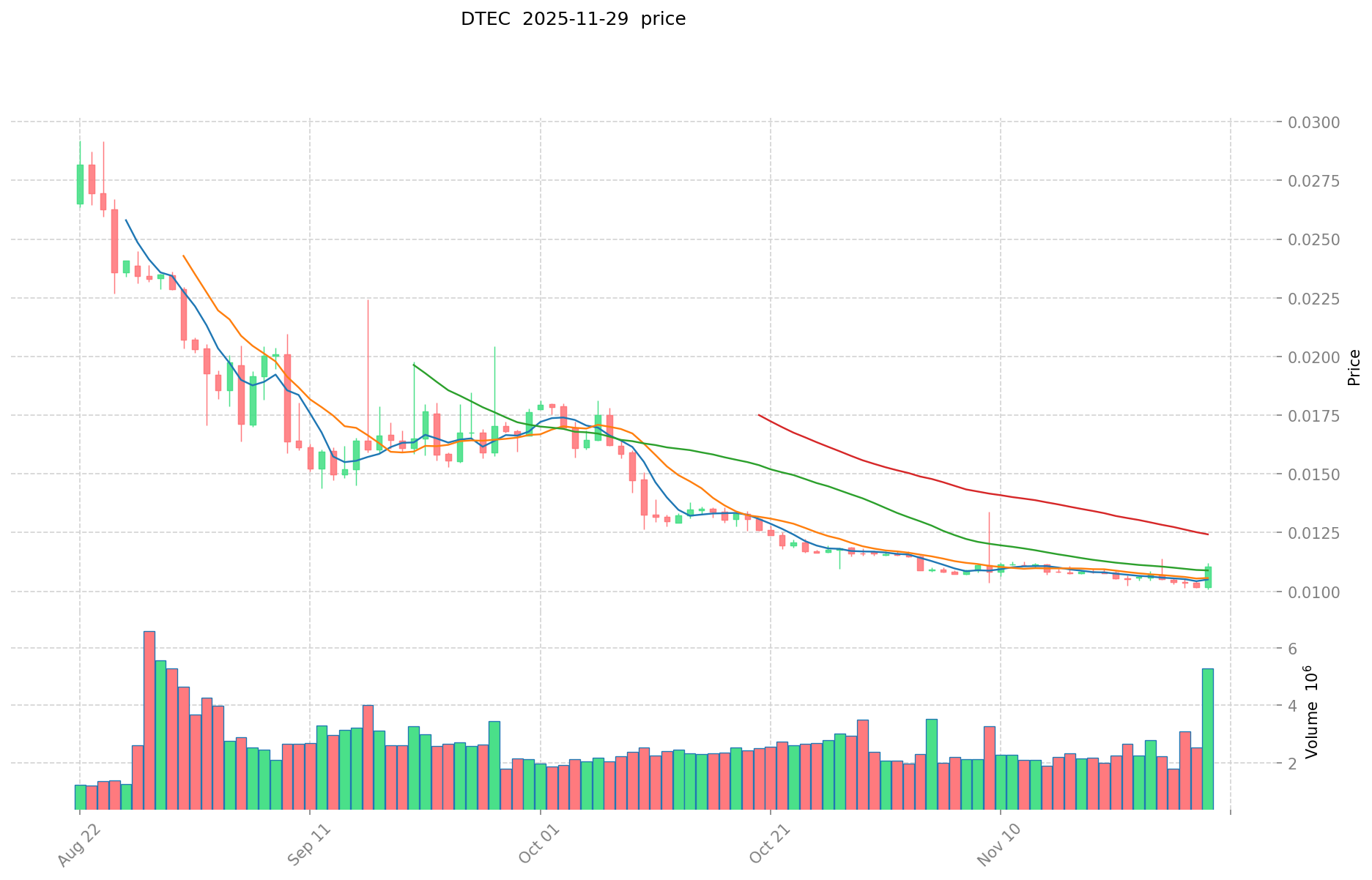
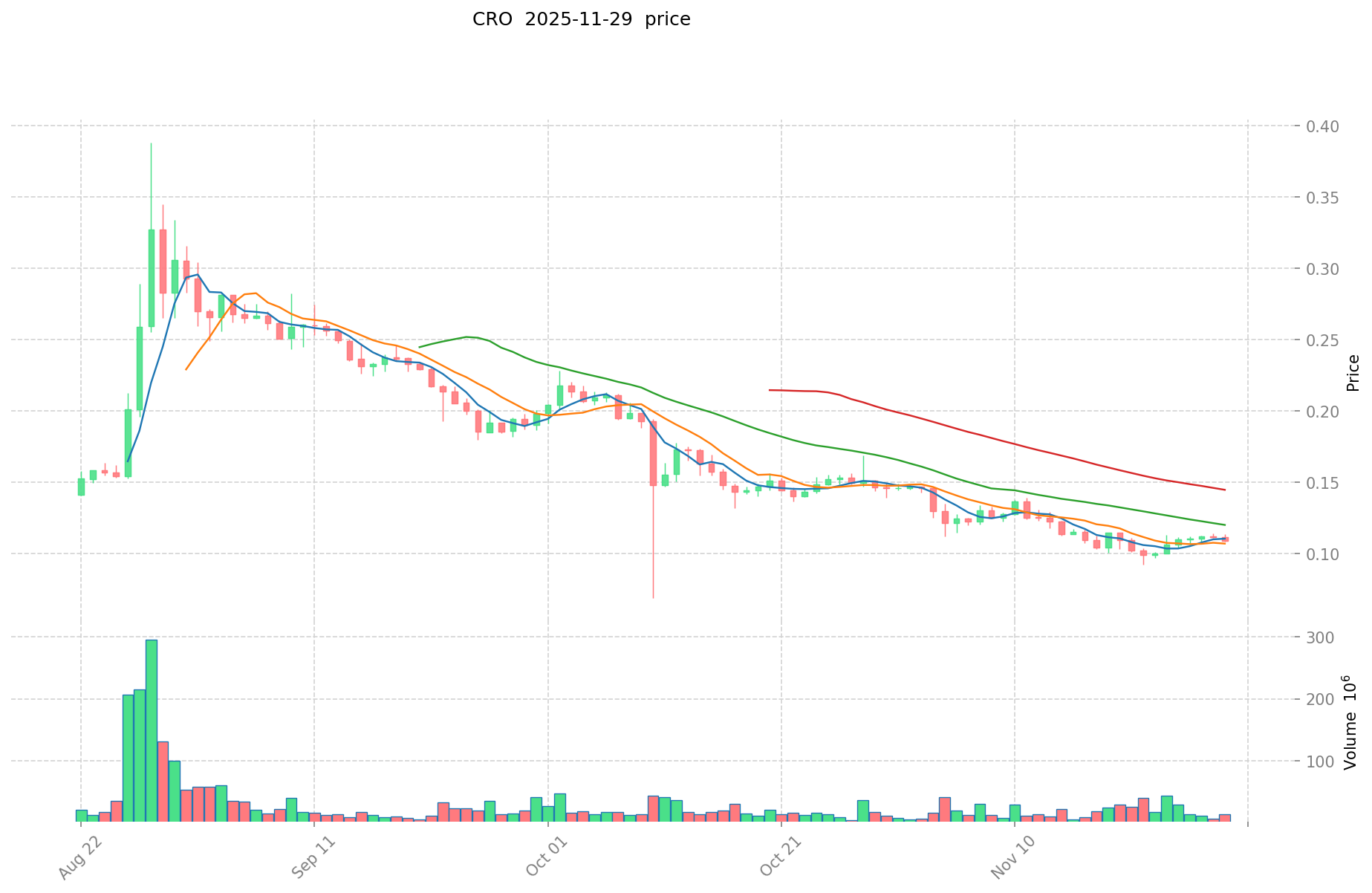
DTEC and CRO Historical Price Trends
- 2024: DTEC reached its all-time high of $0.21 on November 15, 2024.
- 2021: CRO hit its all-time high of $0.965407 on November 24, 2021.
- Comparative analysis: DTEC has dropped from its high of $0.21 to a current price of $0.01106, while CRO has fallen from its peak of $0.965407 to $0.10877.
Current Market Situation (2025-11-29)
- DTEC current price: $0.01106
- CRO current price: $0.10877
- 24-hour trading volume: DTEC $56,369.33 vs CRO $1,512,923.84
- Market Sentiment Index (Fear & Greed Index): 25 (Extreme Fear)
Click to view real-time prices:
- Check DTEC current price Market Price
- Check CRO current price Market Price
II. Project Overview and Technological Innovations
DTEC (Dtec)
- Project description: Dtec is a revolutionary virtual assistant application for the automotive industry, utilizing blockchain technology, artificial intelligence, and advanced voice processing capabilities.
- Key features:
- Integration with traditional driving experience
- Highly personalized, time-optimized assistance services
- Can be installed on the operating system of any type of vehicle or smart platform
- Enables communication with the vehicle and control of vehicle equipment & remote IoT devices
CRO (Cronos)
- Project description: Cronos is a leading blockchain ecosystem partnered with Crypto.com and over 500 application developers and contributors.
- Key features:
- Focus on decentralized finance (DeFi) and gaming
- Mission to unlock the future of finance for everyone
- Aims to make self-custody and Web3 adoption easy and safe for communities
III. Market Performance Analysis
DTEC Market Data
- Market Cap: $130,065.60
- Circulating Supply: 11,760,000 DTEC
- Total Supply: 450,000,000 DTEC
- 24h Trading Volume: $56,369.33
CRO Market Data
- Market Cap: $4,059,952,880.95
- Circulating Supply: 37,326,035,496.47 CRO
- Total Supply: 98,192,730,943.16 CRO
- 24h Trading Volume: $1,512,923.84
Comparative Analysis
- Market Capitalization: CRO's market cap is significantly larger than DTEC's, indicating a more established position in the market.
- Trading Volume: CRO has a much higher 24-hour trading volume, suggesting greater liquidity and trading activity.
- Supply Distribution: DTEC has a smaller circulating supply relative to its total supply compared to CRO, which may impact price dynamics differently.
IV. Investment Risks and Opportunities
Potential Risks
- Market Volatility: Both tokens have experienced significant price fluctuations, with DTEC showing a 92.17% decrease over the past year.
- Project Development: As a newer project, DTEC may face challenges in achieving widespread adoption and competing with established players.
- Regulatory Environment: Changes in regulations could impact both projects, particularly in the areas of DeFi and automotive technology integration.
Potential Opportunities
- Technological Advancements: DTEC's focus on automotive industry innovation could lead to growth if successfully implemented and adopted.
- Ecosystem Growth: CRO's established ecosystem and partnerships may provide a strong foundation for future development and expansion.
- Market Recovery: The current "Extreme Fear" market sentiment could present buying opportunities if the market sentiment improves.
V. Future Outlook and Development Roadmap
DTEC Future Plans
- Continued development and improvement of the virtual assistant application for vehicles
- Potential expansion into additional smart platforms beyond automotive
CRO Future Plans
- Further development of the Cronos blockchain ecosystem
- Expansion of DeFi and gaming offerings
- Continued efforts to increase global adoption of Web3 and self-custody solutions
II. Core Factors Affecting DTEC vs CRO Investment Value
Supply Mechanisms Comparison (Tokenomics)
- DTEC: Fixed supply model of 100 million tokens
- CRO: Fixed maximum supply of 30 billion tokens with progressive burning mechanism
- 📌 Historical Pattern: Supply mechanisms with fixed caps tend to create scarcity value over time, while burning mechanisms can accelerate price appreciation during periods of high network usage.
Institutional Adoption and Market Applications
- Institutional Holdings: CRO has gained more institutional traction through Crypto.com's partnerships with major brands like UFC, Formula 1, and FIFA
- Enterprise Adoption: CRO has broader payment applications through Crypto.com's Visa card program, while DTEC remains more focused on its native ecosystem
- National Policies: Regulatory frameworks vary by jurisdiction, with CRO benefiting from Crypto.com's compliance efforts across multiple markets
Technical Development and Ecosystem Building
- DTEC Technical Upgrades: Focused on blockchain interoperability and scaling solutions
- CRO Technical Development: Built on Cosmos SDK with the Crypto.org Chain offering high throughput and low transaction costs
- Ecosystem Comparison: CRO has a more developed ecosystem spanning DeFi, NFTs, payments, and exchange services through the Crypto.com platform
Macroeconomic and Market Cycles
- Performance in Inflationary Environments: Both tokens have fixed supply models that could theoretically provide inflation resistance
- Macroeconomic Monetary Policy: Interest rate changes impact both tokens similarly as part of the broader crypto asset class
- Geopolitical Factors: CRO benefits from Crypto.com's global presence and regulatory compliance across different jurisdictions
III. 2025-2030 Price Predictions: DTEC vs CRO
Short-term Forecast (2025)
- DTEC: Conservative $0.0098434 - $0.01106 | Optimistic $0.01106 - $0.0159264
- CRO: Conservative $0.0608216 - $0.10861 | Optimistic $0.10861 - $0.1455374
Mid-term Forecast (2027)
- DTEC may enter a growth phase, with prices estimated between $0.0136348786 - $0.0179864356
- CRO may enter a consolidation phase, with prices estimated between $0.120764490795 - $0.16004932515
- Key drivers: Institutional capital inflow, ETFs, ecosystem development
Long-term Forecast (2030)
- DTEC: Base scenario $0.01863313499096 - $0.020310117140146 | Optimistic scenario $0.020310117140146
- CRO: Base scenario $0.183100065456262 - $0.267326095566143 | Optimistic scenario $0.267326095566143
Disclaimer: This forecast is for informational purposes only and should not be considered as financial advice. Cryptocurrency markets are highly volatile and unpredictable. Always conduct your own research before making any investment decisions.
DTEC:
| 年份 | 预测最高价 | 预测平均价格 | 预测最低价 | 涨跌幅 |
|---|---|---|---|---|
| 2025 | 0.0159264 | 0.01106 | 0.0098434 | 0 |
| 2026 | 0.01551718 | 0.0134932 | 0.009040444 | 22 |
| 2027 | 0.0179864356 | 0.01450519 | 0.0136348786 | 31 |
| 2028 | 0.020469724128 | 0.0162458128 | 0.012509275856 | 46 |
| 2029 | 0.01890850151792 | 0.018357768464 | 0.0119325495016 | 65 |
| 2030 | 0.020310117140146 | 0.01863313499096 | 0.017328815541592 | 68 |
CRO:
| 年份 | 预测最高价 | 预测平均价格 | 预测最低价 | 涨跌幅 |
|---|---|---|---|---|
| 2025 | 0.1455374 | 0.10861 | 0.0608216 | 0 |
| 2026 | 0.163925073 | 0.1270737 | 0.106741908 | 16 |
| 2027 | 0.16004932515 | 0.1454993865 | 0.120764490795 | 33 |
| 2028 | 0.158885330058 | 0.152774355825 | 0.09319235705325 | 40 |
| 2029 | 0.210370287971025 | 0.1558298429415 | 0.12778047121203 | 43 |
| 2030 | 0.267326095566143 | 0.183100065456262 | 0.122677043855695 | 68 |
IV. Investment Strategy Comparison: DTEC vs CRO
Long-term vs Short-term Investment Strategies
- DTEC: Suitable for investors focused on automotive industry innovation and potential growth
- CRO: Suitable for investors looking for established ecosystem and broader market adoption
Risk Management and Asset Allocation
- Conservative investors: DTEC: 10% vs CRO: 90%
- Aggressive investors: DTEC: 30% vs CRO: 70%
- Hedging tools: Stablecoin allocation, options, cross-currency portfolio
V. Potential Risk Comparison
Market Risks
- DTEC: High volatility due to lower market cap and trading volume
- CRO: Exposure to broader crypto market trends and sentiment
Technical Risks
- DTEC: Scalability, network stability
- CRO: Centralization concerns, potential security vulnerabilities
Regulatory Risks
- Global regulatory policies may have differing impacts on both tokens, with CRO potentially facing more scrutiny due to its wider adoption and use cases
VI. Conclusion: Which Is the Better Buy?
📌 Investment Value Summary:
- DTEC advantages: Innovative automotive industry application, potential for growth in a niche market
- CRO advantages: Established ecosystem, wider adoption, partnerships with major brands
✅ Investment Advice:
- New investors: Consider a smaller allocation to DTEC for potential growth, with a larger position in CRO for stability
- Experienced investors: Balanced approach with a slight overweight towards CRO, monitoring DTEC for potential breakout opportunities
- Institutional investors: Focus on CRO for its established market position and liquidity, with potential small allocation to DTEC for diversification
⚠️ Risk Warning: Cryptocurrency markets are highly volatile. This article does not constitute investment advice. None
VII. FAQ
Q1: What are the main differences between DTEC and CRO? A: DTEC is focused on virtual assistant applications in the automotive industry, while CRO is part of a broader blockchain ecosystem with Crypto.com. CRO has a significantly larger market cap, higher trading volume, and more established partnerships.
Q2: Which token has shown better price performance historically? A: CRO has shown better historical price performance, reaching an all-time high of $0.965407 in November 2021. DTEC's all-time high was $0.21 in November 2024, but it has since experienced a significant drop.
Q3: What are the key risk factors for investing in DTEC and CRO? A: Both tokens face market volatility risks. DTEC, being a newer project, faces challenges in adoption and competition. CRO may be more susceptible to regulatory risks due to its wider adoption. Both also face technical risks related to scalability and security.
Q4: How do the supply mechanisms differ between DTEC and CRO? A: DTEC has a fixed supply model of 100 million tokens, while CRO has a fixed maximum supply of 30 billion tokens with a progressive burning mechanism.
Q5: What are the future development plans for DTEC and CRO? A: DTEC plans to continue developing its virtual assistant application for vehicles and potentially expand into other smart platforms. CRO aims to further develop its blockchain ecosystem, expand DeFi and gaming offerings, and increase global adoption of Web3 solutions.
Q6: How do institutional adoption and market applications compare between DTEC and CRO? A: CRO has gained more institutional traction through Crypto.com's partnerships with major brands and has broader payment applications. DTEC remains more focused on its native ecosystem in the automotive industry.
Q7: What investment strategies are recommended for DTEC and CRO? A: For conservative investors, a suggested allocation is 10% DTEC and 90% CRO. For aggressive investors, 30% DTEC and 70% CRO. New investors might consider a smaller allocation to DTEC for potential growth, with a larger position in CRO for stability.
Share
Content
Introduction: Investment Comparison of DTEC vs CRO
I. Price History Comparison and Current Market Status
II. Project Overview and Technological Innovations
III. Market Performance Analysis
IV. Investment Risks and Opportunities
V. Future Outlook and Development Roadmap
II. Core Factors Affecting DTEC vs CRO Investment Value
III. 2025-2030 Price Predictions: DTEC vs CRO
IV. Investment Strategy Comparison: DTEC vs CRO
V. Potential Risk Comparison
VI. Conclusion: Which Is the Better Buy?
VII. FAQ


