The article compares DRESS and ADA, two cryptocurrencies with distinct positions in the market. It analyzes their investment value by examining historical prices, supply mechanisms, and institutional adoption. It addresses the needs of both novice and experienced investors by guiding their investment strategy and managing risks associated with each asset. The article's structure follows an analysis of price history, investment factors, future price predictions, and strategic advice. It concludes with FAQs, offering clear insights for investors seeking to balance risk and potential growth in the crypto market. View their prices on Gate [DRESS](https://www.gate.com/price/dressdio-dress) and [ADA](https://www.gate.com/pricecardano-ada).
Introduction: Investment Comparison of DRESS vs ADA
In the cryptocurrency market, the comparison between DRESS vs ADA has always been an unavoidable topic for investors. The two not only differ significantly in market cap ranking, application scenarios, and price performance, but also represent different crypto asset positions.
DRESSdio (DRESS): Launched in 2025, it has gained market recognition for its pioneering Web3-native fashion-tech platform.
Cardano (ADA): Since its inception in 2017, it has been hailed as a technology platform capable of running financial applications used by individuals, organizations, and governments worldwide.
This article will comprehensively analyze the investment value comparison between DRESS vs ADA, focusing on historical price trends, supply mechanisms, institutional adoption, technological ecosystems, and future predictions, attempting to answer the question investors care about most:
"Which is the better buy right now?"
I. Price History Comparison and Current Market Status
DRESS and ADA Historical Price Trends
- 2025: DRESS reached its all-time high of $0.15297 on October 1, 2025, but subsequently experienced a significant decline.
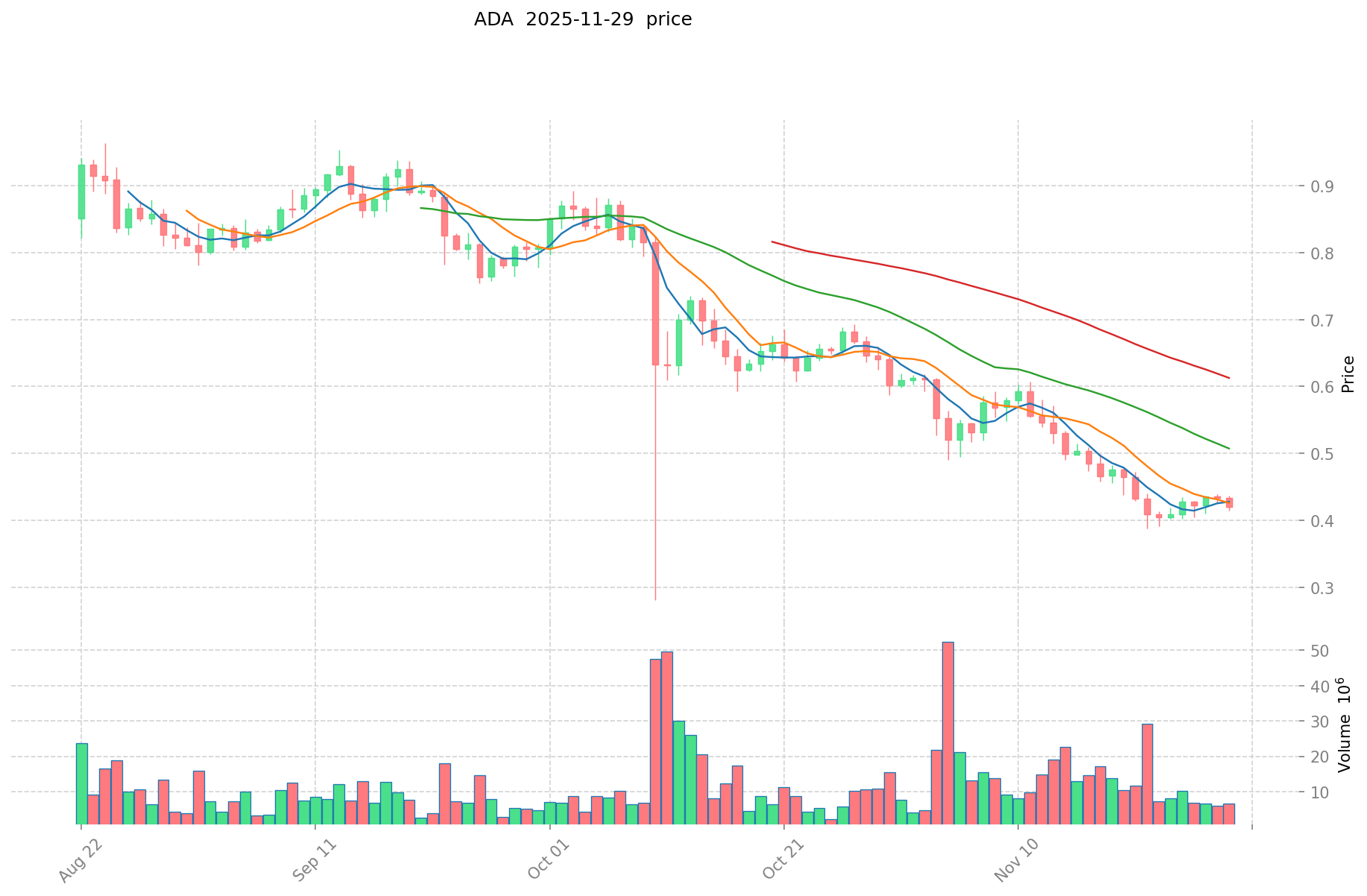
- 2025: ADA's price has shown volatility, with a yearly low of -59.48% compared to the previous year.
- Comparative analysis: In the current market cycle, DRESS has fallen from its peak of $0.15297 to a low of $0.00791, while ADA has demonstrated more stability, maintaining a higher market capitalization.
Current Market Situation (2025-11-29)
- DRESS current price: $0.00898
- ADA current price: $0.4184
- 24-hour trading volume: DRESS $20,695.556002 vs ADA $3,008,251.845626
- Market Sentiment Index (Fear & Greed Index): 28 (Fear)
Click to view real-time prices:
- View DRESS current price Market Price
- View ADA current price Market Price

II. Core Factors Affecting Investment Value: DRESS vs ADA
Supply Mechanism Comparison (Tokenomics)
- DRESS: Fixed maximum supply of 100 million tokens with a deflationary model through 20% token burns from trading fees
- ADA: Fixed maximum supply of 45 billion tokens with no burning mechanism
- 📌 Historical pattern: Deflationary models like DRESS tend to create upward price pressure over time, while ADA's fixed supply without burning relies on increased adoption for value appreciation.
Institutional Adoption and Market Applications
- Institutional holdings: ADA has broader institutional acceptance with listings on major exchanges and inclusion in digital asset funds
- Enterprise adoption: ADA has established partnerships within education, supply chain, and identity verification sectors, while DRESS focuses primarily on DeFi applications
- Regulatory stance: Both projects face similar regulatory scrutiny, though ADA's longer history provides more regulatory clarity
Technical Development and Ecosystem Building
- DRESS technical upgrades: Implementation of Binance Smart Chain integration and development of cross-chain functionality
- ADA technical development: Continued progress on Hydra scaling solution and smart contract optimization
- Ecosystem comparison: ADA has a more mature ecosystem spanning DeFi, NFTs, and enterprise solutions, while DRESS focuses primarily on decentralized trading and yield farming applications
Macroeconomic and Market Cycles
- Inflation resistance: Both tokens have fixed maximum supplies providing some hedge against inflation, though DRESS's burning mechanism potentially offers stronger deflationary characteristics
- Macroeconomic monetary policy: Both assets show correlation to broader crypto market movements in response to interest rates and dollar strength
- Geopolitical factors: ADA's more global development team and community potentially provides more resilience against regional regulatory risks
III. 2025-2030 Price Prediction: DRESS vs ADA
Short-term Prediction (2025)
- DRESS: Conservative $0.0083421 - $0.00897 | Optimistic $0.00897 - $0.0101361
- ADA: Conservative $0.304994 - $0.4178 | Optimistic $0.4178 - $0.614166
Mid-term Prediction (2027)
- DRESS may enter a growth phase, with an estimated price range of $0.0092373216975 - $0.0119083544775
- ADA may enter a consolidation phase, with an estimated price range of $0.4165530759 - $0.67823385435
- Key drivers: Institutional fund inflows, ETFs, ecosystem development
Long-term Prediction (2030)
- DRESS: Base scenario $0.014494027170968 - $0.015584975452653 | Optimistic scenario $0.015584975452653 - $0.019481219315817
- ADA: Base scenario $0.738249723400976 - $0.761082189073171 | Optimistic scenario $0.761082189073171 - $1.012239311467318
View detailed price predictions for DRESS and ADA
Disclaimer: The information provided is for informational purposes only and should not be considered as financial advice. Cryptocurrency markets are highly volatile and unpredictable. Always conduct your own research before making any investment decisions.
DRESS:
| 年份 |
预测最高价 |
预测平均价格 |
预测最低价 |
涨跌幅 |
| 2025 |
0.0101361 |
0.00897 |
0.0083421 |
0 |
| 2026 |
0.0127055565 |
0.00955305 |
0.007069257 |
6 |
| 2027 |
0.0119083544775 |
0.01112930325 |
0.0092373216975 |
23 |
| 2028 |
0.0138225946365 |
0.01151882886375 |
0.006104979297787 |
28 |
| 2029 |
0.018499239155182 |
0.012670711750125 |
0.007602427050075 |
41 |
| 2030 |
0.019481219315817 |
0.015584975452653 |
0.014494027170968 |
73 |
ADA:
| 年份 |
预测最高价 |
预测平均价格 |
预测最低价 |
涨跌幅 |
| 2025 |
0.614166 |
0.4178 |
0.304994 |
0 |
| 2026 |
0.55210181 |
0.515983 |
0.37150776 |
23 |
| 2027 |
0.67823385435 |
0.534042405 |
0.4165530759 |
27 |
| 2028 |
0.87890028802875 |
0.606138129675 |
0.412173928179 |
44 |
| 2029 |
0.779645169294468 |
0.742519208851875 |
0.549464214550387 |
77 |
| 2030 |
1.012239311467318 |
0.761082189073171 |
0.738249723400976 |
82 |
IV. Investment Strategy Comparison: DRESS vs ADA
Long-term vs Short-term Investment Strategy
- DRESS: Suitable for investors focused on DeFi applications and deflationary tokenomics
- ADA: Suitable for investors seeking ecosystem diversity and institutional adoption
Risk Management and Asset Allocation
- Conservative investors: DRESS: 20% vs ADA: 80%
- Aggressive investors: DRESS: 40% vs ADA: 60%
- Hedging tools: Stablecoin allocation, options, cross-currency portfolio
V. Potential Risk Comparison
Market Risk
- DRESS: Higher volatility due to smaller market cap and trading volume
- ADA: Susceptible to broader crypto market trends and macroeconomic factors
Technical Risk
- DRESS: Scalability, network stability
- ADA: Smart contract vulnerabilities, scalability challenges
Regulatory Risk
- Global regulatory policies may impact both, with ADA potentially facing more scrutiny due to its larger market presence
VI. Conclusion: Which Is the Better Buy?
📌 Investment Value Summary:
- DRESS advantages: Deflationary model, potential for higher growth in bull markets
- ADA advantages: Established ecosystem, broader institutional adoption, more stable price history
✅ Investment Advice:
- Novice investors: Consider a higher allocation to ADA for its established market position
- Experienced investors: Balanced portfolio with both DRESS and ADA, adjusting based on risk tolerance
- Institutional investors: ADA may be more suitable due to its liquidity and regulatory clarity
⚠️ Risk Warning: Cryptocurrency markets are highly volatile. This article does not constitute investment advice.
None
VII. FAQ
Q1: What are the main differences between DRESS and ADA?
A: DRESS is a newer cryptocurrency focused on Web3 fashion-tech, with a deflationary model and smaller market cap. ADA is a more established platform for financial applications with a larger ecosystem and institutional adoption.
Q2: Which cryptocurrency has shown better price stability?
A: Based on historical data, ADA has demonstrated more price stability compared to DRESS, maintaining a higher market capitalization and showing less volatility.
Q3: How do the supply mechanisms differ between DRESS and ADA?
A: DRESS has a fixed maximum supply of 100 million tokens with a deflationary model through 20% token burns from trading fees. ADA has a fixed maximum supply of 45 billion tokens but no burning mechanism.
Q4: Which cryptocurrency might be better for long-term investment?
A: Both have potential, but ADA might be considered better for long-term investment due to its more established ecosystem, broader institutional adoption, and more stable price history. However, DRESS's deflationary model could create upward price pressure over time.
Q5: What are the key risks associated with investing in DRESS and ADA?
A: For DRESS, key risks include higher volatility, scalability issues, and network stability. For ADA, risks include smart contract vulnerabilities, scalability challenges, and susceptibility to broader crypto market trends.
Q6: How do institutional adoptions compare between DRESS and ADA?
A: ADA has broader institutional acceptance with listings on major exchanges and inclusion in digital asset funds. It also has established partnerships in various sectors. DRESS, being newer, focuses primarily on DeFi applications and has less institutional adoption.
Q7: What factors should be considered when deciding between DRESS and ADA for investment?
A: Factors to consider include risk tolerance, investment horizon, belief in the project's technology and use case, market cap and potential for growth, ecosystem development, and institutional adoption. Novice investors might lean towards ADA for its stability, while experienced investors might consider a balanced portfolio of both.
* The information is not intended to be and does not constitute financial advice or any other recommendation of any sort offered or endorsed by Gate.













