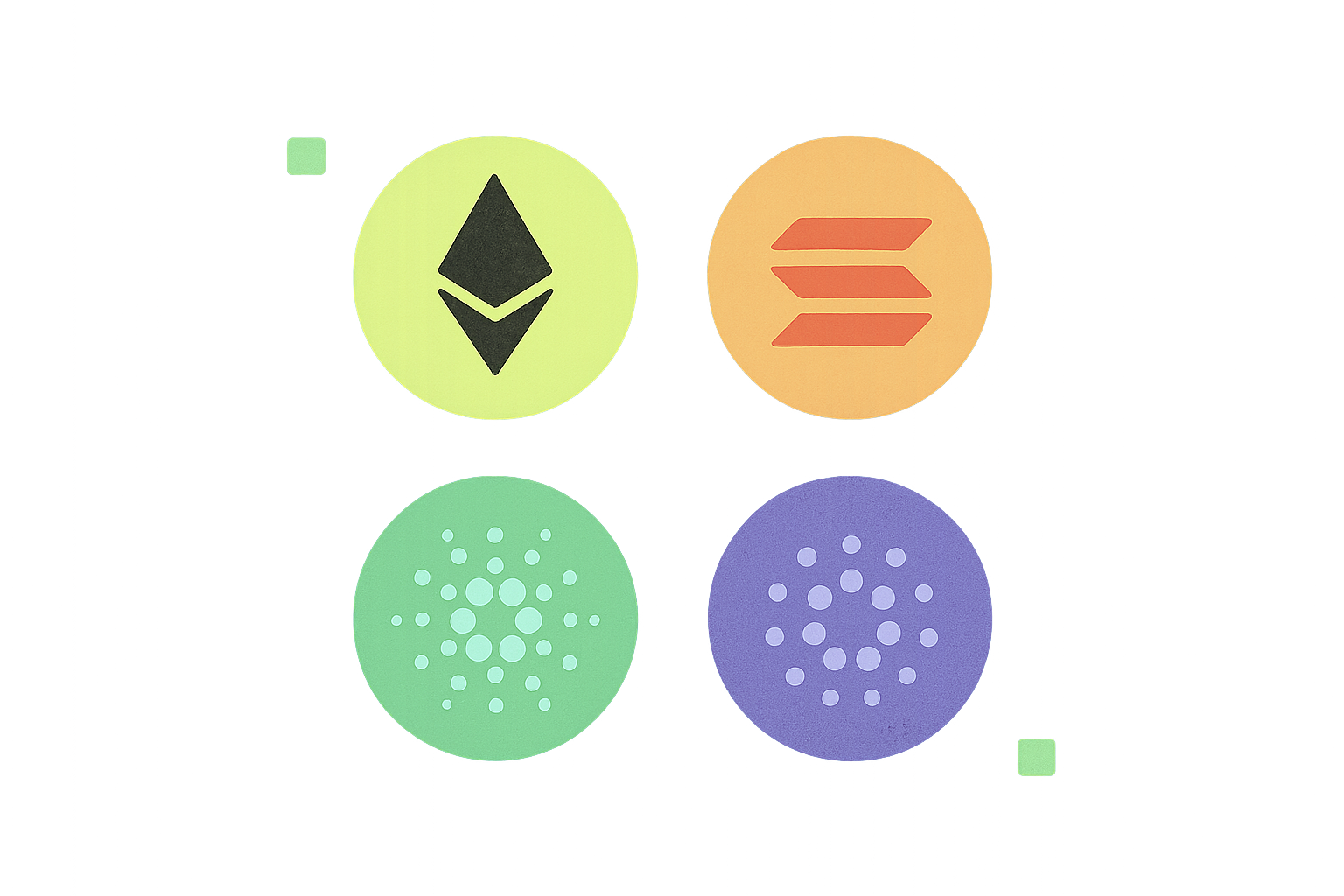
This article explores twelve leading blockchain platforms critical for cryptocurrency development, presenting an extensive guide for developers in selecting the best network for their projects. It addresses the diverse needs of speed, cost-efficiency, security, and scalability. The content systematically analyzes each platform's strengths, like Ethereum’s smart contract capabilities, Solana's transaction speed, and Cardano's security. The structured guide aids developers in making informed decisions aligned with project goals and technical requirements. Key topics include interoperability, institution-grade security, and network suitability for specific cryptocurrencies. This concise yet comprehensive overview is essential for both experienced developers and new entrants aiming for successful crypto ventures.
Top 12 Blockchain Networks for Building Your Own Crypto
Introduction
The cryptocurrency landscape has experienced remarkable growth, creating unprecedented opportunities for developers and entrepreneurs to launch their own digital assets. As the blockchain ecosystem continues to evolve, selecting the appropriate underlying network has become a critical decision that can significantly impact the success of any cryptocurrency project. This comprehensive guide examines twelve prominent blockchain networks that offer robust foundations for creating and deploying custom cryptocurrencies. Understanding what network you should use for crypto depends on various factors including speed, cost-efficiency, security, and scalability. Each platform presents unique advantages, catering to diverse project requirements and development objectives.
Ethereum (#ETH)
Ethereum stands as the pioneering and most established platform for decentralized application development and token creation. When considering what network you should use for crypto development, Ethereum remains the industry standard, primarily due to its comprehensive smart contract functionality that enables developers to program complex business logic directly onto the blockchain. The platform benefits from an extensive and vibrant developer community, providing abundant resources, libraries, and documentation that significantly reduce development time and complexity. Ethereum's ERC-20 and ERC-721 token standards have become the foundation for thousands of projects, from DeFi protocols to NFT marketplaces. Despite higher transaction fees during network congestion, Ethereum's established transition to Ethereum 2.0 has delivered improved scalability and energy efficiency, ensuring its continued relevance for future crypto ventures.
Major centralized exchange platforms have launched high-performance blockchain networks that provide developers with efficient alternatives for building decentralized applications. These networks distinguish themselves through exceptionally fast transaction processing and substantially lower fees compared to Ethereum, making them particularly attractive for projects requiring frequent user interactions. These platforms achieve efficiency through Proof of Staked Authority consensus mechanisms, which trade some degree of decentralization for enhanced performance. When evaluating what network you should use for crypto projects with high transaction volumes, these exchange-backed chains maintain compatibility with Ethereum's development tools and smart contracts, allowing developers to easily port existing projects or deploy across multiple networks. For entrepreneurs seeking to minimize operational costs while maintaining access to large user bases through established exchange ecosystems, these networks offer compelling development environments.
Solana (#SOL)
Solana has emerged as a formidable competitor in the blockchain space, distinguished by its extraordinary transaction throughput capabilities that can process thousands of transactions per second. This remarkable performance stems from its innovative Proof of History consensus mechanism, which timestamps transactions to improve network efficiency. When determining what network you should use for crypto applications requiring high speed, Solana's architecture addresses one of the most pressing challenges in blockchain technology: scalability without compromising decentralization. The platform's low transaction costs, often measured in fractions of a cent, make it economically viable for high-frequency applications such as trading platforms and gaming protocols. Additionally, Solana's compatibility with Solidity, Ethereum's programming language, facilitates easier migration for developers familiar with Ethereum's ecosystem. These characteristics have made Solana particularly popular for DeFi protocols and NFT marketplaces that require rapid transaction finality and minimal costs.
Cardano (#ADA)
Cardano distinguishes itself through a research-driven approach to blockchain development, emphasizing peer-reviewed academic research and formal verification methods. The platform's architecture prioritizes three fundamental pillars: sustainability, security, and scalability. When considering what network you should use for crypto projects requiring proven security, Cardano's Ouroboros proof-of-stake consensus protocol has been mathematically proven to be secure, providing developers with confidence in the platform's foundational security. The network's layered architecture separates the settlement layer from the computation layer, enabling greater flexibility and easier upgrades without disrupting the entire system. Cardano's commitment to energy efficiency and environmental sustainability appeals to projects conscious of their ecological impact. For developers building long-term cryptocurrency projects that require robust security guarantees and sustainable operation, Cardano offers a methodical and scientifically rigorous platform.
Polkadot (#DOT)
Polkadot introduces a revolutionary multi-chain architecture that addresses blockchain interoperability challenges through its unique relay chain and parachain structure. The platform enables different blockchains to communicate and transfer data seamlessly, creating an interconnected ecosystem of specialized blockchains. When exploring what network you should use for crypto projects requiring cross-chain functionality, developers can create custom parachains optimized for specific use cases while benefiting from the shared security provided by Polkadot's relay chain. This architecture allows projects to focus on their unique value propositions without sacrificing security or interoperability. Polkadot's governance model empowers token holders to participate in network decisions, ensuring democratic evolution of the platform. For cryptocurrency projects that envision cross-chain functionality or require specialized blockchain features, Polkadot provides an innovative framework that balances customization with security.
Avalanche (#AVAX)
Avalanche has gained prominence through its exceptional transaction finality speed, achieving confirmation in under one second while maintaining high security standards. The platform employs a novel consensus protocol that combines the benefits of classical consensus algorithms with the decentralization of blockchain technology. When determining what network you should use for crypto applications requiring instant finality, Avalanche's architecture supports the creation of custom blockchain networks, called subnets, which can implement their own rules and virtual machines while maintaining interoperability with the broader ecosystem. This flexibility makes Avalanche suitable for enterprises requiring private blockchains alongside public network connectivity. The platform's high throughput, capable of processing thousands of transactions per second, combined with low latency, makes it ideal for applications requiring real-time settlement, such as payment systems and decentralized trading platforms. Avalanche's compatibility with Ethereum tools further reduces the barrier to entry for developers.
Arbitrum Network (#ARB)
Arbitrum represents the next evolution in Ethereum scaling solutions, functioning as a Layer 2 network that inherits Ethereum's security while dramatically improving transaction throughput and reducing costs. The platform utilizes optimistic rollup technology, which processes transactions off the main Ethereum chain before periodically submitting compressed transaction data back to Ethereum for final settlement. When considering what network you should use for crypto projects that need Ethereum compatibility with better performance, Arbitrum offers near-instant transaction confirmation at a fraction of Ethereum's mainnet costs while maintaining full compatibility with existing Ethereum smart contracts and development tools. For developers already invested in the Ethereum ecosystem, Arbitrum provides a seamless migration path that preserves security guarantees while delivering superior user experiences. The platform's growing adoption by major DeFi protocols demonstrates its viability for production-grade applications requiring both security and performance.
Base Protocol (#BASE)
Base Protocol introduces an innovative approach to cryptocurrency creation by tethering digital asset values to real-world assets such as commodities, market indices, or other tangible references. This unique mechanism addresses one of the primary criticisms of cryptocurrencies: extreme volatility. When evaluating what network you should use for crypto projects requiring stability mechanisms, Base Protocol establishes algorithmic relationships with external assets, creating cryptocurrencies that can maintain more stable and predictable value propositions. This stability makes such tokens particularly attractive for applications requiring predictable pricing, such as payment systems or savings instruments. The protocol's rebase mechanism automatically adjusts token supply based on the target asset's value, maintaining the peg without requiring traditional collateralization. For projects seeking to bridge traditional finance with blockchain technology or create more accessible cryptocurrency products, Base Protocol offers a distinctive framework that could appeal to risk-averse investors and mainstream adoption.
Algorand (#ALGO)
Algorand delivers a pure proof-of-stake blockchain platform that prioritizes security, scalability, and decentralization without compromise. The network's consensus mechanism randomly selects validators for each block, ensuring true decentralization while achieving transaction finality in seconds. When considering what network you should use for crypto projects requiring institutional-grade infrastructure, Algorand's architecture eliminates the possibility of forking, providing absolute transaction certainty crucial for financial applications. The platform's high throughput capabilities, processing over a thousand transactions per second, combined with minimal transaction fees, make it economically viable for a wide spectrum of applications. Algorand's focus on financial infrastructure has attracted numerous partnerships with traditional financial institutions, positioning it as a bridge between conventional finance and blockchain innovation. The platform's Algorand Standard Assets (ASA) feature simplifies token creation, enabling developers to launch custom cryptocurrencies with just a few lines of code while benefiting from built-in security and compliance features.
Tezos (#XTZ)
Tezos distinguishes itself through on-chain governance and self-amendment capabilities that enable the protocol to evolve without contentious hard forks. This unique feature ensures long-term adaptability and reduces the risk of community splits that have plagued other blockchain networks. When exploring what network you should use for crypto projects requiring formal verification, the platform's formal verification capabilities allow developers to mathematically prove the correctness of smart contracts, significantly reducing the risk of bugs and vulnerabilities that have led to costly exploits in other ecosystems. Tezos uses a liquid proof-of-stake consensus mechanism that encourages broad participation in network validation while maintaining energy efficiency. The platform's focus on institutional adoption and regulatory compliance makes it attractive for projects requiring traditional financial sector integration. For developers building cryptocurrency projects intended for long-term operation and gradual evolution, Tezos provides a stable yet flexible foundation that can adapt to changing requirements without disruptive protocol upgrades.
Cosmos (#ATOM)
Cosmos has established itself as the "Internet of Blockchains," focusing on creating an ecosystem of interoperable and sovereign blockchains. The platform's Inter-Blockchain Communication (IBC) protocol enables different blockchains to transfer assets and data seamlessly, addressing one of blockchain technology's most significant limitations: isolated ecosystems. When determining what network you should use for crypto projects prioritizing interoperability, Cosmos SDK provides developers with a modular framework for building custom blockchains tailored to specific application requirements while maintaining interoperability with the broader Cosmos network. This architecture allows projects to optimize their blockchain's characteristics—such as consensus mechanism, block time, and governance structure—without sacrificing connectivity to other chains. The Tendermint consensus engine underlying Cosmos provides fast finality and Byzantine fault tolerance, ensuring security and performance. For cryptocurrency projects envisioning participation in a larger interconnected ecosystem or requiring specialized blockchain features, Cosmos offers unparalleled flexibility and interoperability.
TRON (#TRX)
TRON has carved out a significant niche in the blockchain ecosystem, particularly in entertainment, gaming, and content distribution applications. The platform achieves impressive transaction throughput, capable of processing thousands of transactions per second, while maintaining extremely low transaction fees. When considering what network you should use for crypto applications involving micropayments, this combination makes TRON particularly suitable for applications involving frequent user interactions, such as gaming rewards or content monetization. TRON's Delegated Proof of Stake consensus mechanism enables fast block production and transaction confirmation, typically within seconds. The platform's focus on decentralized content distribution has attracted a substantial user base, particularly in regions where traditional payment infrastructure may be limited. TRON's compatibility with Ethereum smart contracts facilitates easy migration for developers, while its established ecosystem provides immediate access to users and liquidity. For projects targeting high-volume, low-value transactions or entertainment-focused applications, TRON delivers the necessary performance characteristics at minimal cost.
Conclusion
The selection of an appropriate blockchain network represents a foundational decision that will significantly influence the trajectory and ultimate success of any cryptocurrency project. Understanding what network you should use for crypto depends entirely on your specific requirements and objectives. The twelve blockchain networks examined in this comprehensive guide each offer distinct advantages tailored to different use cases, technical requirements, and strategic objectives. Ethereum provides unmatched ecosystem maturity and developer resources, while exchange-backed smart chains and Solana prioritize speed and cost efficiency. Cardano emphasizes security and sustainability through academic rigor, whereas Polkadot and Cosmos focus on interoperability and cross-chain communication. Avalanche and Arbitrum deliver high-performance solutions for demanding applications, while Base Protocol introduces innovative value-stabilization mechanisms. Algorand and Tezos offer institutional-grade security and governance, and TRON specializes in high-throughput entertainment applications.
When evaluating what network you should use for crypto development, developers must carefully consider multiple factors including transaction speed, costs, security requirements, scalability needs, interoperability objectives, and ecosystem maturity. The ideal choice depends on your project's specific technical requirements, target audience, budget constraints, and long-term vision. Conducting thorough research, engaging with each platform's community, and potentially developing proof-of-concept implementations on multiple networks can provide valuable insights before committing to a final decision. As the blockchain landscape continues to evolve, remaining adaptable and informed about emerging technologies and platform developments will position your cryptocurrency project for sustained success in this dynamic and transformative industry.
FAQ
What crypto network should I use?
Choose based on your asset: Ethereum network (ETH/ERC20) for Ethereum, BNB Smart Chain (BSC/BEP20) for BNB tokens, Bitcoin network (BTC) for Bitcoin, and Polygon network (POL) for Polygon tokens. Always verify the network before confirming transactions.
Which network is best for crypto?
Ethereum leads with superior smart contracts and developer ecosystem. Binance Smart Chain, Solana, Avalanche, and Polkadot offer strong alternatives with lower fees and faster transactions depending on your needs.
Does it matter which crypto network I use?
Yes, it matters significantly. Using the wrong network can result in permanent loss of funds. Always match the network to your cryptocurrency type—for example, use Ethereum network for ETH, BNB Smart Chain for BSC tokens. Double-check before confirming every transaction.
How do I know which network to use when transferring crypto?
Match the network to your cryptocurrency type. For Ethereum, use ERC20 network. For BNB Smart Chain tokens, use BSC/BEP20. For Bitcoin, use BTC network. Always verify the network and receiving address before confirming the transaction.
* The information is not intended to be and does not constitute financial advice or any other recommendation of any sort offered or endorsed by Gate.