


CLND vs ETH: Comparing Two Blockchain Platforms for Decentralized Applications
Introduction: CLND vs ETH Investment Comparison
In the cryptocurrency market, the comparison between CLND and ETH has always been a topic that investors cannot ignore. The two not only have significant differences in market cap ranking, application scenarios, and price performance, but also represent different cryptocurrency asset positions.
Colend (CLND): Since its launch, it has gained market recognition as the premier decentralized lending protocol on Core Chain, the fastest-growing BTC sidechain.
Ethereum (ETH): Since 2015, it has been hailed as a decentralized, open-source blockchain platform that supports smart contracts and decentralized applications (DApps), and is one of the cryptocurrencies with the highest global trading volume and market capitalization.
This article will comprehensively analyze the investment value comparison between CLND and ETH, focusing on historical price trends, supply mechanisms, institutional adoption, technological ecosystems, and future predictions, and attempt to answer the question that investors care about most:
"Which is the better buy right now?"
I. Price History Comparison and Current Market Status
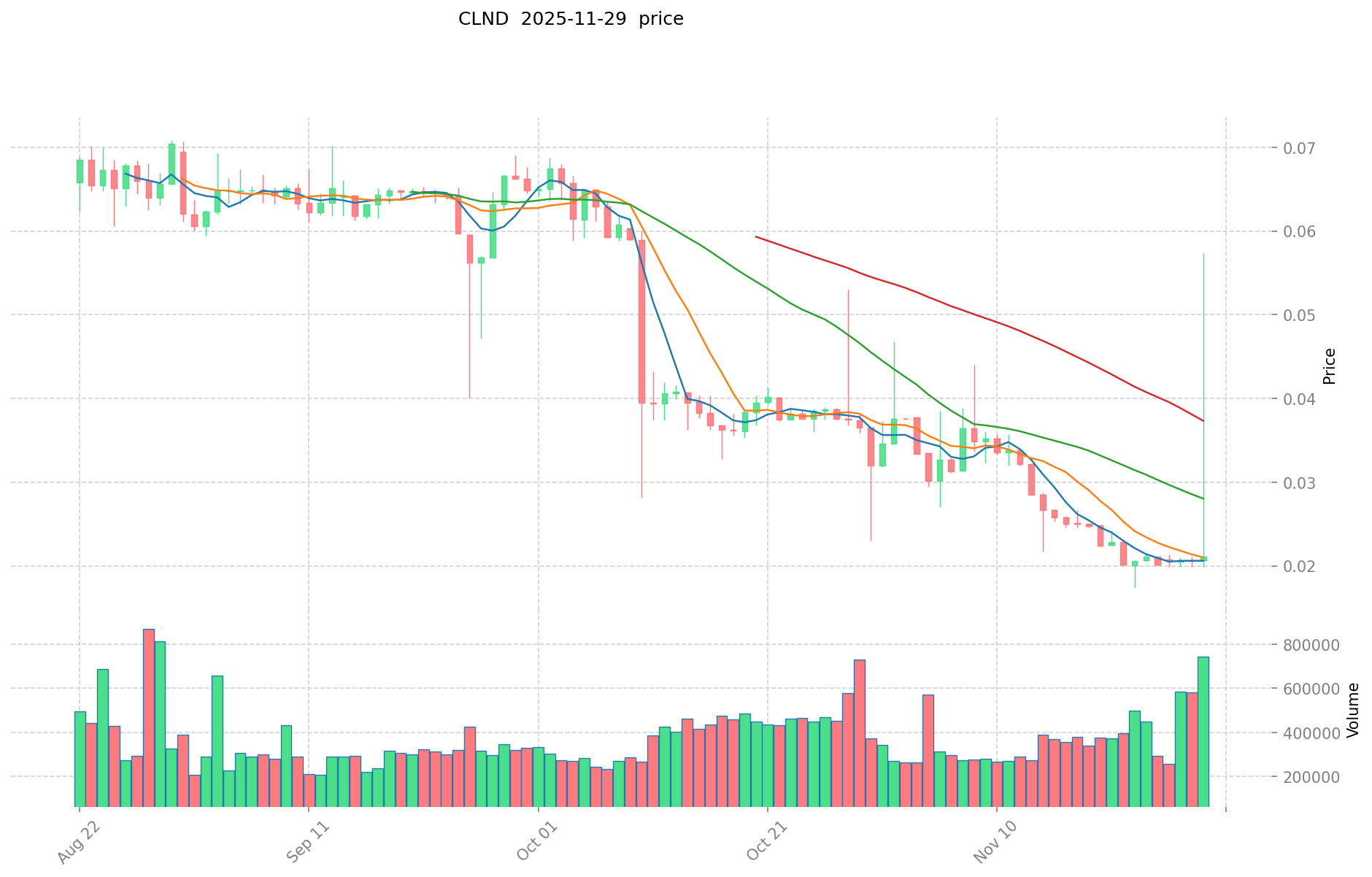
CLND and ETH Historical Price Trends
- 2024: CLND reached its all-time high of $0.33999 on November 30, 2024.
- 2025: ETH achieved its all-time high of $4,946.05 on August 25, 2025.
- Comparative analysis: CLND has experienced a significant decline from its all-time high, dropping to a low of $0.01739 on November 22, 2025. In contrast, ETH has shown more resilience, maintaining a higher price level despite market fluctuations.
Current Market Situation (2025-11-30)
- CLND current price: $0.02077
- ETH current price: $2,987.97
- 24-hour trading volume: CLND $13,913.81 vs ETH $271,177,536.84
- Market Sentiment Index (Fear & Greed Index): 28 (Fear)
Click to view real-time prices:
- Check CLND current price Market Price
- Check ETH current price Market Price
II. Project Overview and Technical Innovations
CLND (Colend)
- Project Description: Colend is the premier decentralized lending protocol on Core Chain, the fastest-growing BTC sidechain.
- Key Features:
- Enables BTCFi, transforming Bitcoin into a productive asset
- Allows holders to earn yield through lending and staking
- Supports Bitcoin's long-term security
- Technical Innovations:
- Unique ve(3,3) governance model
- Gives users substantial influence over reward distribution
ETH (Ethereum)
- Project Description: Ethereum is a decentralized, open-source blockchain platform that supports smart contracts and decentralized applications (DApps).
- Key Features:
- Operates using Ether (ETH)
- Facilitates the functioning of various cryptocurrencies
- Enables the execution of decentralized smart contracts
- Technical Innovations:
- Smart contract functionality
- Support for a wide range of decentralized applications
III. Market Performance Analysis
CLND Market Statistics
- Market Cap: $76,356.75
- Circulating Supply: 3,676,300 CLND
- Total Supply: 100,000,000 CLND
- All-Time High: $0.33999 (2024-11-30)
- All-Time Low: $0.01739 (2025-11-22)
ETH Market Statistics
- Market Cap: $360,634,595,584.75
- Circulating Supply: 120,695,520.90 ETH
- Total Supply: 120,695,520.90 ETH
- All-Time High: $4,946.05 (2025-08-25)
- All-Time Low: $0.432979 (2015-10-20)
Comparative Analysis
- Market Dominance: ETH 11.085% vs CLND 0.000063%
- Price Change (24h): CLND -1.93% vs ETH -1.9%
- Price Change (7d): CLND +9.71% vs ETH +8.61%
IV. Investment Considerations
Potential Opportunities
- CLND:
- Growing BTCFi market with potential for expansion
- Innovative governance model attracting user participation
- ETH:
- Established platform with a large ecosystem of DApps and tokens
- Ongoing development and upgrades to improve scalability and efficiency
Potential Risks
- CLND:
- High volatility and significant price decline from all-time high
- Limited trading volume compared to larger cryptocurrencies
- ETH:
- Increased competition from other smart contract platforms
- Potential regulatory challenges for the DeFi sector
Key Factors to Monitor
- Development progress and adoption of Core Chain
- Ethereum's transition to Ethereum 2.0 and its impact on scalability
- Overall market sentiment and regulatory environment for cryptocurrencies
V. Conclusion
Both CLND and ETH present unique value propositions in the cryptocurrency market. CLND offers exposure to the growing BTCFi sector on the Core Chain, while ETH remains a cornerstone of the broader cryptocurrency ecosystem. Investors should carefully consider their risk tolerance and conduct thorough research before making investment decisions in this highly volatile market.

II. Key Factors Affecting the Investment Value of CLND vs ETH
Supply Mechanism Comparison (Tokenomics)
- CLND: Limited supply of 10 billion tokens with a deflationary model through regular token burns
- ETH: Post-EIP-1559 implementation created a deflationary mechanism where part of transaction fees are burned
- 📌 Historical pattern: Deflationary tokens tend to appreciate in value over time if demand remains constant or increases. CLND's structured burning schedule provides predictable supply reduction, while ETH's burn rate varies with network activity.
Institutional Adoption and Market Applications
- Institutional holdings: ETH has stronger institutional backing with established ETFs and inclusion in major institutional portfolios
- Enterprise adoption: ETH leads in enterprise blockchain solutions through the Enterprise Ethereum Alliance, while CLND is primarily focused on DeFi applications
- Regulatory attitudes: ETH has clearer regulatory standing in most jurisdictions; CLND faces varying regulatory approaches as a newer asset
Technical Development and Ecosystem Building
- CLND technical upgrades: Focus on DeFi infrastructure and cross-chain integrations, with regular protocol improvements
- ETH technical development: Ongoing upgrades following The Merge, with focus on scaling solutions like sharding and Layer-2 networks
- Ecosystem comparison: ETH dominates in DeFi TVL, NFT marketplaces, and developer activity; CLND offers specialized DeFi services with growing but smaller ecosystem footprint
Macroeconomic and Market Cycles
- Performance in inflationary environments: ETH has demonstrated better resilience during inflation periods due to wider adoption
- Macroeconomic monetary policy: Both tokens show sensitivity to interest rate changes, with ETH typically showing stronger correlation with broader market movements
- Geopolitical factors: ETH has greater liquidity and global recognition during cross-border uncertainty, while CLND may benefit from specific regional adoption in emerging markets
III. 2025-2030 Price Prediction: CLND vs ETH
Short-term Forecast (2025)
- CLND: Conservative $0.0130851 - $0.02077 | Optimistic $0.02077 - $0.0303242
- ETH: Conservative $1879.8633 - $2983.91 | Optimistic $2983.91 - $4028.2785
Mid-term Forecast (2027)
- CLND may enter a growth phase, with projected prices of $0.02538359856 - $0.03641994576
- ETH may enter a bullish market, with projected prices of $3523.0988071125 - $5952.8221223625
- Key drivers: Institutional capital inflow, ETF, ecosystem development
Long-term Forecast (2030)
- CLND: Base scenario $0.04183906814388 - $0.060248258127187 | Optimistic scenario $0.060248258127187
- ETH: Base scenario $6051.303364060798593 - $8532.337743325726017 | Optimistic scenario $8532.337743325726017
Disclaimer: These predictions are based on historical data and market analysis. Cryptocurrency markets are highly volatile and subject to rapid changes. This information should not be considered as financial advice.
CLND:
| 年份 | 预测最高价 | 预测平均价格 | 预测最低价 | 涨跌幅 |
|---|---|---|---|---|
| 2025 | 0.0303242 | 0.02077 | 0.0130851 | 0 |
| 2026 | 0.029634636 | 0.0255471 | 0.015072789 | 23 |
| 2027 | 0.03641994576 | 0.027590868 | 0.02538359856 | 32 |
| 2028 | 0.0476880562512 | 0.03200540688 | 0.0163227575088 | 54 |
| 2029 | 0.04383140472216 | 0.0398467315656 | 0.038252862302976 | 91 |
| 2030 | 0.060248258127187 | 0.04183906814388 | 0.028450566337838 | 101 |
ETH:
| 年份 | 预测最高价 | 预测平均价格 | 预测最低价 | 涨跌幅 |
|---|---|---|---|---|
| 2025 | 4028.2785 | 2983.91 | 1879.8633 | 0 |
| 2026 | 4592.9834675 | 3506.09425 | 2278.9612625 | 17 |
| 2027 | 5952.8221223625 | 4049.53885875 | 3523.0988071125 | 35 |
| 2028 | 5951.4047837619375 | 5001.18049055625 | 3700.873563011625 | 67 |
| 2029 | 6626.314090962503437 | 5476.29263715909375 | 4216.745330612502187 | 83 |
| 2030 | 8532.337743325726017 | 6051.303364060798593 | 4417.451455764382973 | 102 |
IV. Investment Strategy Comparison: CLND vs ETH
Long-term vs Short-term Investment Strategies
- CLND: Suitable for investors focusing on DeFi potential and BTCFi growth
- ETH: Suitable for investors seeking ecosystem stability and long-term value preservation
Risk Management and Asset Allocation
- Conservative investors: CLND: 5% vs ETH: 95%
- Aggressive investors: CLND: 30% vs ETH: 70%
- Hedging tools: Stablecoin allocation, options, cross-currency combinations
V. Potential Risk Comparison
Market Risk
- CLND: High volatility, low liquidity, susceptible to market manipulation
- ETH: Correlation with broader crypto market, susceptibility to macro-economic factors
Technical Risk
- CLND: Scalability, network stability
- ETH: Network congestion, high gas fees during peak usage
Regulatory Risk
- Global regulatory policies may impact both differently, with ETH having a more established regulatory standing
VI. Conclusion: Which Is the Better Buy?
📌 Investment Value Summary:
- CLND advantages: Growth potential in BTCFi sector, innovative governance model
- ETH advantages: Established ecosystem, ongoing development, institutional adoption
✅ Investment Advice:
- New investors: Consider a small allocation to CLND for exposure to BTCFi, with a larger allocation to ETH for stability
- Experienced investors: Balanced portfolio with both assets, adjusting based on risk tolerance
- Institutional investors: Focus on ETH for liquidity and regulatory clarity, monitor CLND for potential future opportunities
⚠️ Risk Warning: The cryptocurrency market is highly volatile. This article does not constitute investment advice. None
VII. FAQ
Q1: What are the main differences between CLND and ETH? A: CLND is the premier decentralized lending protocol on Core Chain, focusing on BTCFi, while ETH is a well-established blockchain platform supporting smart contracts and DApps. ETH has a much larger market cap and ecosystem, whereas CLND offers specialized DeFi services on a Bitcoin sidechain.
Q2: Which has shown better price performance recently? A: ETH has shown more resilience in price performance. While CLND reached its all-time high of $0.33999 in 2024, it has since declined significantly. ETH, on the other hand, has maintained a higher price level despite market fluctuations, with its all-time high of $4,946.05 in 2025.
Q3: How do the supply mechanisms of CLND and ETH differ? A: CLND has a limited supply of 10 billion tokens with a deflationary model through regular token burns. ETH, after the EIP-1559 implementation, also has a deflationary mechanism where part of transaction fees are burned, but its burn rate varies with network activity.
Q4: Which cryptocurrency has better institutional adoption? A: ETH has stronger institutional backing with established ETFs and inclusion in major institutional portfolios. It also leads in enterprise blockchain solutions through the Enterprise Ethereum Alliance. CLND, being newer, has less institutional adoption and is primarily focused on DeFi applications.
Q5: What are the key factors to consider when choosing between CLND and ETH for investment? A: Key factors include risk tolerance, investment horizon, market cap, ecosystem development, institutional adoption, and technological innovations. ETH is generally considered more suitable for conservative, long-term investors, while CLND may appeal to those seeking exposure to the growing BTCFi sector and willing to accept higher risk.
Q6: What are the projected price ranges for CLND and ETH by 2030? A: Based on the provided forecasts, CLND's base scenario for 2030 is $0.04183906814388 - $0.060248258127187, with an optimistic scenario of $0.060248258127187. For ETH, the base scenario is $6051.303364060798593 - $8532.337743325726017, with an optimistic scenario of $8532.337743325726017. However, these are predictions and should not be considered financial advice.
Q7: What are the main risks associated with investing in CLND and ETH? A: For CLND, main risks include high volatility, low liquidity, and susceptibility to market manipulation. Technical risks involve scalability and network stability. For ETH, risks include correlation with the broader crypto market, network congestion, and high gas fees during peak usage. Both face regulatory risks, though ETH has a more established regulatory standing.
Share
Content
Introduction: CLND vs ETH Investment Comparison
I. Price History Comparison and Current Market Status
II. Project Overview and Technical Innovations
III. Market Performance Analysis
IV. Investment Considerations
V. Conclusion
II. Key Factors Affecting the Investment Value of CLND vs ETH
III. 2025-2030 Price Prediction: CLND vs ETH
IV. Investment Strategy Comparison: CLND vs ETH
V. Potential Risk Comparison
VI. Conclusion: Which Is the Better Buy?
VII. FAQ


