


CELB vs LTC: Comparing Two Approaches to Long-Term Care Insurance
Introduction: CELB vs LTC Investment Comparison
In the cryptocurrency market, the comparison between CeluvPlay (CELB) and Litecoin (LTC) has been an unavoidable topic for investors. The two not only show significant differences in market cap ranking, application scenarios, and price performance, but also represent different positions in the crypto asset space.
CeluvPlay (CELB): Since its launch, it has gained market recognition for its Web3 gaming and entertainment ecosystem.
Litecoin (LTC): Since its inception in 2011, it has been hailed as the "silver to Bitcoin's gold" and is one of the cryptocurrencies with the highest global trading volume and market capitalization.
This article will provide a comprehensive analysis of the investment value comparison between CELB and LTC, focusing on historical price trends, supply mechanisms, institutional adoption, technological ecosystems, and future predictions, attempting to answer the question investors care about most:
"Which is the better buy right now?"
I. Price History Comparison and Current Market Status
CELB (Coin A) and LTC (Coin B) Historical Price Trends
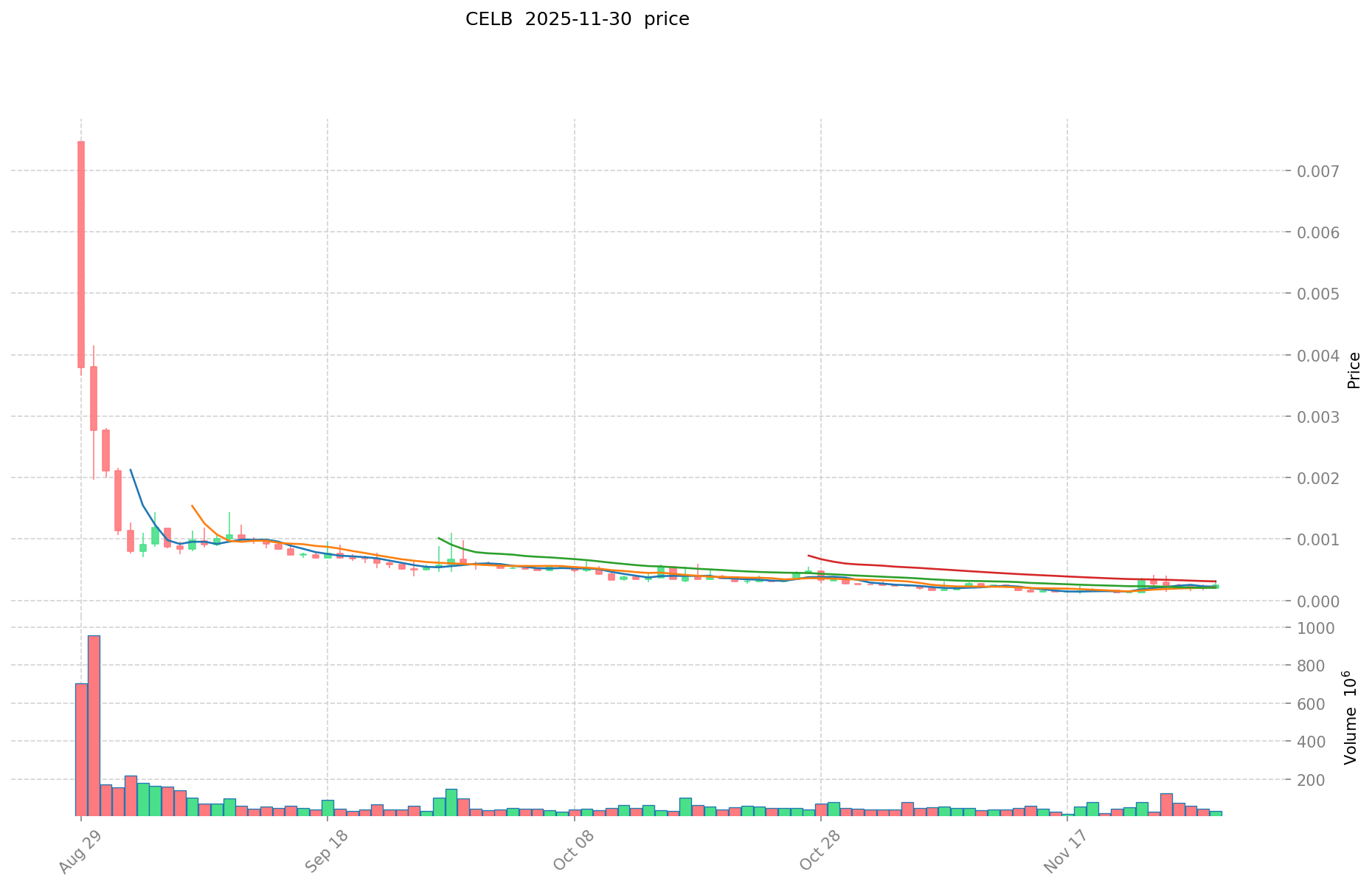
- 2025: CELB reached its all-time high of $0.00747 on August 29, 2025, and its all-time low of $0.0001 on November 18, 2025, showing significant volatility within a short period.
- 2021: LTC reached its all-time high of $410.26 on May 10, 2021, during the broader cryptocurrency bull market.
- Comparative analysis: In the recent market cycle, CELB experienced a dramatic drop from its high of $0.00747 to its current price of $0.0002313, a decrease of about 97%. LTC, on the other hand, has shown more stability, currently trading at $83.84, which is about 79.5% below its all-time high.
Current Market Situation (2025-11-30)
- CELB current price: $0.0002313
- LTC current price: $83.84
- 24-hour trading volume: CELB $9,245.04 vs LTC $2,380,390.63
- Market Sentiment Index (Fear & Greed Index): 28 (Fear)
Click to view real-time prices:
- View CELB current price Market Price
- View LTC current price Market Price

II. Core Factors Affecting Investment Value of CELB vs LTC
Supply Mechanism Comparison (Tokenomics)
- CELB: No information available about supply mechanism
- LTC: Deflationary model with halving mechanism similar to Bitcoin; total supply capped at 84 million coins
- 📌 Historical Pattern: Limited supply cryptocurrencies like LTC tend to experience price appreciation around halving events, creating cyclical price movements.
Institutional Adoption and Market Applications
- Institutional Holdings: LTC has established presence in institutional portfolios and is available on major institutional trading platforms
- Enterprise Adoption: LTC serves as a payment method for numerous merchants and has cross-border payment capabilities with lower fees compared to Bitcoin
- Regulatory Attitudes: LTC generally faces similar regulatory treatment as Bitcoin across jurisdictions, with established regulatory clarity in many markets
Technical Development and Ecosystem Building
- LTC Technical Development: Has implemented MWEB (Mimblewimble Extension Block) for enhanced privacy and scalability features
- Ecosystem Comparison: LTC has established payment infrastructure and merchant adoption, though limited presence in DeFi and smart contract applications compared to blockchain platforms like Ethereum
Macroeconomic Factors and Market Cycles
- Inflation Performance: LTC is often positioned as "digital silver" with potential store-of-value properties during inflationary periods
- Monetary Policy Impact: Both assets likely influenced by broader crypto market reactions to interest rate changes and dollar strength
- Geopolitical Factors: Cross-border payment capabilities may increase LTC utility in regions with currency controls or economic instability
III. 2025-2030 Price Prediction: CELB vs LTC
Short-term Prediction (2025)
- CELB: Conservative $0.000148032 - $0.0002313 | Optimistic $0.0002313 - $0.000344637
- LTC: Conservative $51.8816 - $83.68 | Optimistic $83.68 - $112.968
Mid-term Prediction (2027)
- CELB may enter a growth phase, with estimated prices $0.000310530831975 - $0.0003821917932
- LTC may enter a bullish market, with estimated prices $90.0254544 - $148.9706924
- Key drivers: Institutional fund inflows, ETF, ecosystem development
Long-term Prediction (2030)
- CELB: Base scenario $0.000374377335999 - $0.000404327522879 | Optimistic scenario $0.000404327522879 - $0.000473063201769
- LTC: Base scenario $96.85782011277585 - $164.165796801315 | Optimistic scenario $164.165796801315 - $210.1322199056832
Disclaimer: This information is for educational purposes only and should not be considered as financial advice. Cryptocurrency markets are highly volatile and unpredictable. Always conduct your own research before making any investment decisions.
CELB:
| 年份 | 预测最高价 | 预测平均价格 | 预测最低价 | 涨跌幅 |
|---|---|---|---|---|
| 2025 | 0.000344637 | 0.0002313 | 0.000148032 | 0 |
| 2026 | 0.000394516845 | 0.0002879685 | 0.000175660785 | 24 |
| 2027 | 0.0003821917932 | 0.0003412426725 | 0.000310530831975 | 47 |
| 2028 | 0.000387037439149 | 0.00036171723285 | 0.000231499029024 | 56 |
| 2029 | 0.000434277709759 | 0.000374377335999 | 0.000190932441359 | 61 |
| 2030 | 0.000473063201769 | 0.000404327522879 | 0.000347721669676 | 74 |
LTC:
| 年份 | 预测最高价 | 预测平均价格 | 预测最低价 | 涨跌幅 |
|---|---|---|---|---|
| 2025 | 112.968 | 83.68 | 51.8816 | 0 |
| 2026 | 116.02232 | 98.324 | 53.09496 | 17 |
| 2027 | 148.9706924 | 107.17316 | 90.0254544 | 27 |
| 2028 | 183.142854466 | 128.0719262 | 107.580418008 | 52 |
| 2029 | 172.72420326963 | 155.607390333 | 107.36909932977 | 85 |
| 2030 | 210.1322199056832 | 164.165796801315 | 96.85782011277585 | 95 |
IV. Investment Strategy Comparison: CELB vs LTC
Long-term vs Short-term Investment Strategy
- CELB: Suitable for investors focused on Web3 gaming and entertainment ecosystem potential
- LTC: Suitable for investors seeking stability and potential store of value properties
Risk Management and Asset Allocation
- Conservative investors: CELB: 5% vs LTC: 95%
- Aggressive investors: CELB: 20% vs LTC: 80%
- Hedging tools: Stablecoin allocation, options, cross-currency portfolios
V. Potential Risk Comparison
Market Risk
- CELB: High volatility, relatively new and unproven market position
- LTC: Subject to broader crypto market cycles, but with established trading history
Technical Risk
- CELB: Scalability, network stability
- LTC: Mining centralization, potential security vulnerabilities
Regulatory Risk
- Global regulatory policies may have different impacts on both assets
VI. Conclusion: Which Is the Better Buy?
📌 Investment Value Summary:
- CELB advantages: Potential growth in Web3 gaming and entertainment sector
- LTC advantages: Established history, wider adoption, and potential store of value properties
✅ Investment Advice:
- New investors: Consider LTC for its established history and lower volatility
- Experienced investors: Balanced portfolio with higher allocation to LTC, small position in CELB for potential growth
- Institutional investors: Focus on LTC for its regulatory clarity and established market presence
⚠️ Risk Warning: The cryptocurrency market is highly volatile. This article does not constitute investment advice. None
VII. FAQ
Q1: What are the key differences between CELB and LTC? A: CELB is focused on the Web3 gaming and entertainment ecosystem, while LTC is an established cryptocurrency often referred to as "digital silver". LTC has a longer history, wider adoption, and is seen as a more stable investment compared to CELB's higher volatility and growth potential.
Q2: Which coin has shown better price performance recently? A: LTC has shown more price stability compared to CELB. As of November 30, 2025, CELB has experienced a 97% decrease from its all-time high, while LTC is trading about 79.5% below its all-time high.
Q3: How do the supply mechanisms of CELB and LTC compare? A: LTC has a deflationary model with a halving mechanism and a total supply capped at 84 million coins. There is no available information about CELB's supply mechanism.
Q4: What are the institutional adoption levels for CELB and LTC? A: LTC has an established presence in institutional portfolios and is available on major institutional trading platforms. It also serves as a payment method for numerous merchants. There is limited information about CELB's institutional adoption.
Q5: What are the price predictions for CELB and LTC by 2030? A: For CELB, the base scenario predicts a range of $0.000374377335999 - $0.000404327522879, with an optimistic scenario of $0.000404327522879 - $0.000473063201769. For LTC, the base scenario predicts $96.85782011277585 - $164.165796801315, with an optimistic scenario of $164.165796801315 - $210.1322199056832.
Q6: How should investors allocate their portfolio between CELB and LTC? A: Conservative investors might consider allocating 5% to CELB and 95% to LTC, while more aggressive investors might allocate 20% to CELB and 80% to LTC. The exact allocation should depend on individual risk tolerance and investment goals.
Q7: What are the main risks associated with investing in CELB and LTC? A: CELB faces high volatility and is relatively new in the market. LTC is subject to broader crypto market cycles but has a more established trading history. Both face potential regulatory risks, while CELB may have additional technical risks related to scalability and network stability.
Share
Content
Introduction: CELB vs LTC Investment Comparison
I. Price History Comparison and Current Market Status
II. Core Factors Affecting Investment Value of CELB vs LTC
III. 2025-2030 Price Prediction: CELB vs LTC
IV. Investment Strategy Comparison: CELB vs LTC
V. Potential Risk Comparison
VI. Conclusion: Which Is the Better Buy?
VII. FAQ


