


BYN vs XTZ: Analyzing the Performance of Belarus Ruble and Tezos in Volatile Crypto Markets
Introduction: BYN vs XTZ Investment Comparison
In the cryptocurrency market, the comparison between NBX (BYN) and Tezos (XTZ) has been an unavoidable topic for investors. The two not only show significant differences in market cap ranking, application scenarios, and price performance but also represent different positions in the crypto asset landscape.
NBX (BYN): Since its launch, it has gained market recognition as a decentralized platform for creating and trading synthetic financial products.
Tezos (XTZ): Introduced in 2017, it has been hailed as a self-evolving blockchain platform, becoming one of the cryptocurrencies with significant global trading volume and market capitalization.
This article will comprehensively analyze the investment value comparison between NBX and Tezos, focusing on historical price trends, supply mechanisms, institutional adoption, technological ecosystems, and future predictions, attempting to answer the question investors care about most:
"Which is the better buy right now?"
I. Price History Comparison and Current Market Status
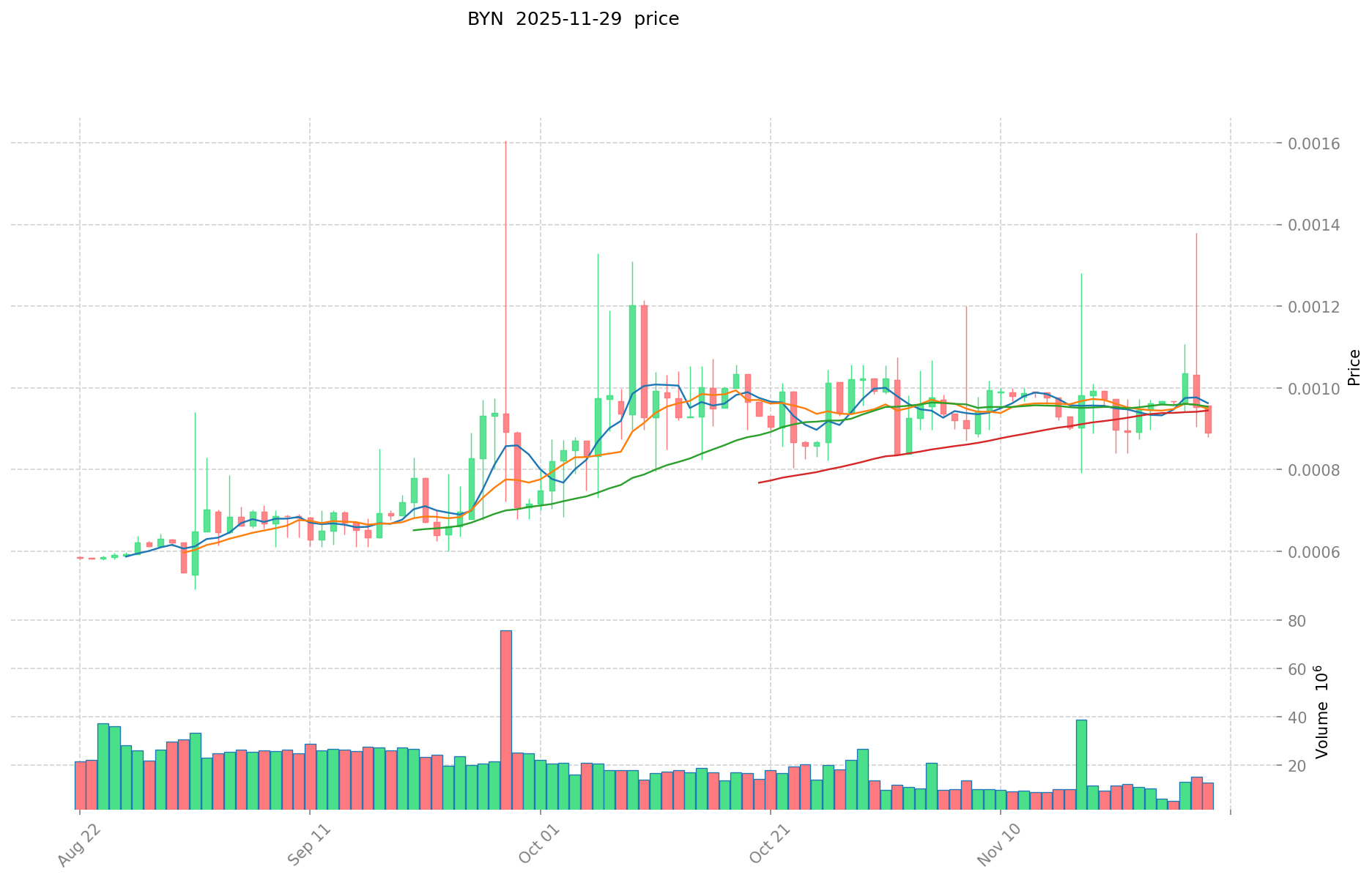
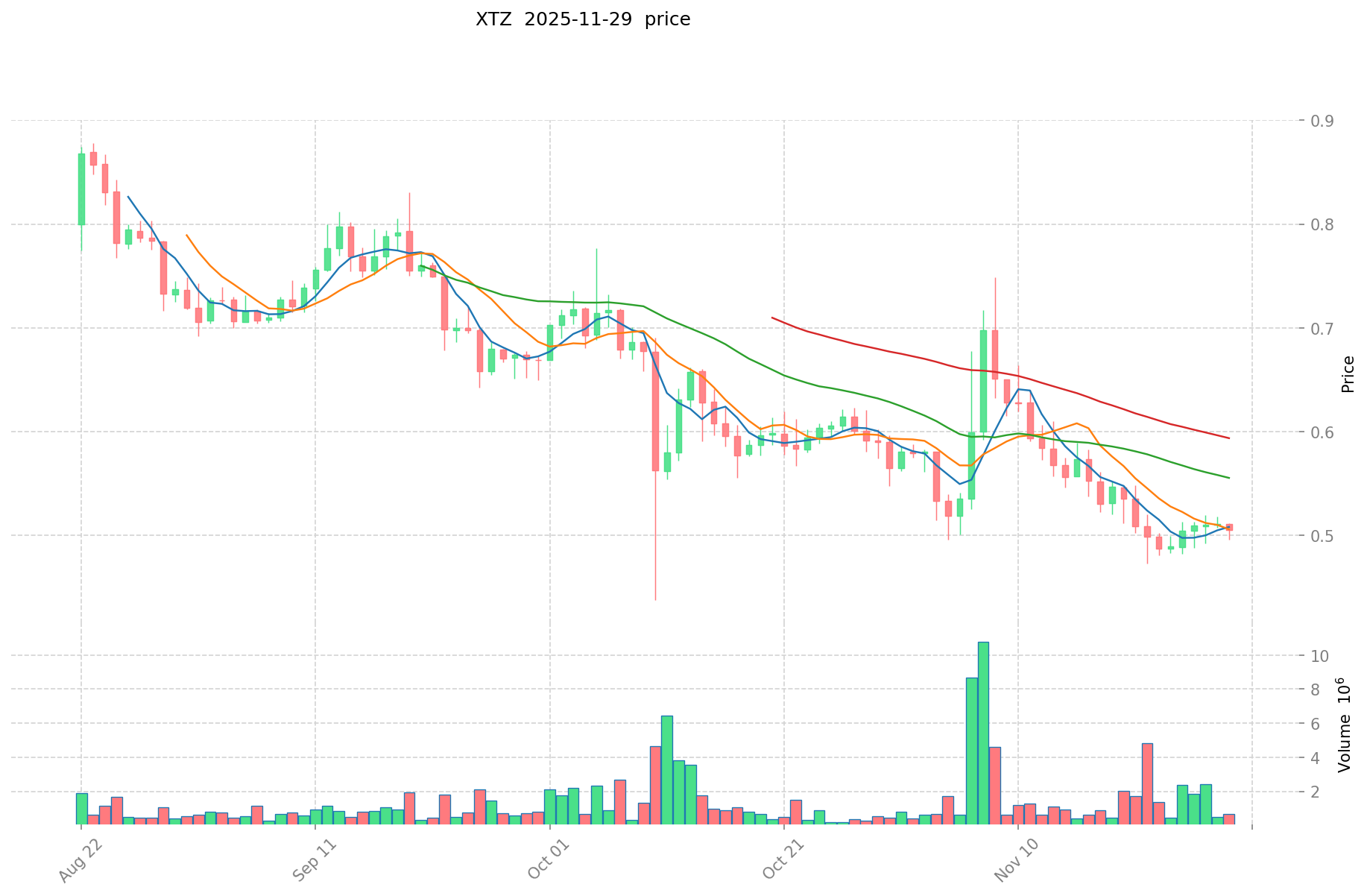
BYN and XTZ Historical Price Trends
- 2021: BYN reached its all-time high of $5.14 on April 14, 2021.
- 2021: XTZ hit its all-time high of $9.12 on October 4, 2021.
- Comparative analysis: BYN has fallen from its all-time high of $5.14 to a current price of $0.0010914, while XTZ has dropped from its peak of $9.12 to $0.4933.
Current Market Situation (2025-11-30)
- BYN current price: $0.0010914
- XTZ current price: $0.4933
- 24-hour trading volume: BYN $13,191.66 vs XTZ $584,185.77
- Market Sentiment Index (Fear & Greed Index): 28 (Fear)
Click to view real-time prices:
- Check BYN current price Market Price
- Check XTZ current price Market Price
II. Core Factors Affecting Investment Value of BNY vs XTZ
Supply Mechanism Comparison (Tokenomics)
- XTZ (Tezos): Inflationary model with no maximum supply cap; new tokens are created through baking (staking) at an annual inflation rate of approximately 5-6%
- BNY: Limited information available about supply mechanism
Institutional Adoption and Market Applications
- Institutional Holdings: Tezos has gained some institutional adoption with organizations like BTG Pactual (Brazil's investment bank) building security token offerings on its blockchain
- Enterprise Adoption: Tezos has been used for STO platforms, digital Euro experiments, and NFT marketplaces
- Regulatory Attitudes: Tezos has generally been viewed favorably by regulators in various jurisdictions due to its on-chain governance model and formal verification capabilities
Technical Development and Ecosystem Building
- XTZ Technical Upgrades: Tezos utilizes a self-amending blockchain allowing seamless protocol upgrades without hard forks; recent upgrades have improved transaction throughput and smart contract capabilities
- Ecosystem Comparison: Tezos has developed a growing ecosystem in DeFi, NFTs (particularly in the art sector), and enterprise applications; its formal verification approach helps secure smart contracts for financial applications
Macroeconomic Factors and Market Cycles
- Inflation Environment Performance: Tezos offers staking rewards that may partially offset inflation effects for holders
- Macroeconomic Monetary Policy: Like most digital assets, both are affected by broader market sentiment regarding risk assets and liquidity conditions
- Geopolitical Factors: Tezos has positioned itself as a more energy-efficient alternative to proof-of-work blockchains, potentially benefiting from environmental concerns
III. 2025-2030 Price Prediction: BYN vs XTZ
Short-term Prediction (2025)
- BYN: Conservative $0.000633476 - $0.0010922 | Optimistic $0.0010922 - $0.001540002
- XTZ: Conservative $0.34468 - $0.4924 | Optimistic $0.4924 - $0.610576
Mid-term Prediction (2027)
- BYN may enter a growth phase, with an estimated price range of $0.0010932851007 - $0.00149976289455
- XTZ may enter a bullish phase, with an estimated price range of $0.5332613216 - $0.835228576
- Key drivers: Institutional capital inflow, ETF, ecosystem development
Long-term Prediction (2030)
- BYN: Base scenario $0.001702678221134 - $0.001850737196885 | Optimistic scenario $0.001850737196885 - $0.002442973099888
- XTZ: Base scenario $0.5051281729158 - $0.85614944562 | Optimistic scenario $0.85614944562 - $1.0445023236564
Disclaimer: The information provided is for informational purposes only and should not be considered as financial advice. Cryptocurrency markets are highly volatile and unpredictable. Always conduct your own research before making any investment decisions.
BYN:
| 年份 | 预测最高价 | 预测平均价格 | 预测最低价 | 涨跌幅 |
|---|---|---|---|---|
| 2025 | 0.001540002 | 0.0010922 | 0.000633476 | 0 |
| 2026 | 0.00148719413 | 0.001316101 | 0.0007896606 | 20 |
| 2027 | 0.00149976289455 | 0.001401647565 | 0.0010932851007 | 28 |
| 2028 | 0.002074508478578 | 0.001450705229775 | 0.001015493660842 | 32 |
| 2029 | 0.001938867539594 | 0.001762606854176 | 0.001357207277715 | 61 |
| 2030 | 0.002442973099888 | 0.001850737196885 | 0.001702678221134 | 69 |
XTZ:
| 年份 | 预测最高价 | 预测平均价格 | 预测最低价 | 涨跌幅 |
|---|---|---|---|---|
| 2025 | 0.610576 | 0.4924 | 0.34468 | 0 |
| 2026 | 0.73347904 | 0.551488 | 0.41913088 | 11 |
| 2027 | 0.835228576 | 0.64248352 | 0.5332613216 | 30 |
| 2028 | 0.78318741088 | 0.738856048 | 0.41375938688 | 49 |
| 2029 | 0.9512771618 | 0.76102172944 | 0.418561951192 | 54 |
| 2030 | 1.0445023236564 | 0.85614944562 | 0.5051281729158 | 73 |
IV. Investment Strategy Comparison: BYN vs XTZ
Long-term vs Short-term Investment Strategies
- BYN: Suitable for investors focused on decentralized synthetic financial products
- XTZ: Suitable for investors interested in self-evolving blockchain platforms and institutional adoption
Risk Management and Asset Allocation
- Conservative investors: BYN: 20% vs XTZ: 80%
- Aggressive investors: BYN: 40% vs XTZ: 60%
- Hedging tools: Stablecoin allocation, options, cross-currency combinations
V. Potential Risk Comparison
Market Risks
- BYN: Limited market cap and trading volume may lead to higher volatility
- XTZ: Susceptible to broader cryptocurrency market trends and sentiment
Technical Risks
- BYN: Scalability, network stability
- XTZ: Smart contract vulnerabilities, potential issues with on-chain governance
Regulatory Risks
- Global regulatory policies may have different impacts on both, with XTZ potentially benefiting from its formal verification capabilities and energy-efficient consensus mechanism
VI. Conclusion: Which Is the Better Buy?
📌 Investment Value Summary:
- BYN advantages: Focused niche in synthetic financial products, potential for growth in DeFi sector
- XTZ advantages: Established ecosystem, institutional adoption, self-amending blockchain technology
✅ Investment Advice:
- New investors: Consider XTZ for its more established market presence and ecosystem
- Experienced investors: Diversify between both, with a larger allocation to XTZ
- Institutional investors: XTZ may be more attractive due to its formal verification capabilities and existing institutional adoption
⚠️ Risk Warning: The cryptocurrency market is highly volatile, and this article does not constitute investment advice. None
VII. FAQ
Q1: What are the main differences between BYN and XTZ? A: BYN is focused on decentralized synthetic financial products, while XTZ is a self-evolving blockchain platform. XTZ has a larger market cap, higher trading volume, and more institutional adoption compared to BYN.
Q2: Which cryptocurrency has performed better historically? A: Based on the available data, XTZ has shown better historical performance. It reached a higher all-time high of $9.12 in October 2021, compared to BYN's all-time high of $5.14 in April 2021.
Q3: What are the key factors affecting the investment value of BYN and XTZ? A: Key factors include supply mechanisms, institutional adoption, technical development, ecosystem building, and macroeconomic factors. XTZ has a more established ecosystem, institutional adoption, and a self-amending blockchain, while BYN focuses on synthetic financial products.
Q4: How do the long-term price predictions for BYN and XTZ compare? A: By 2030, the optimistic scenario predicts BYN could reach $0.002442973099888, while XTZ could reach $1.0445023236564. XTZ is projected to have a higher potential price and growth rate.
Q5: Which cryptocurrency is considered a better investment for different types of investors? A: For new investors, XTZ is recommended due to its more established market presence and ecosystem. Experienced investors might consider diversifying between both, with a larger allocation to XTZ. Institutional investors may find XTZ more attractive due to its formal verification capabilities and existing institutional adoption.
Q6: What are the main risks associated with investing in BYN and XTZ? A: Both face market risks related to cryptocurrency volatility. BYN has additional risks due to its limited market cap and trading volume. XTZ faces potential technical risks related to smart contract vulnerabilities and on-chain governance issues. Both are subject to regulatory risks, though XTZ may have some advantages in this area.
Share
Content
Introduction: BYN vs XTZ Investment Comparison
I. Price History Comparison and Current Market Status
II. Core Factors Affecting Investment Value of BNY vs XTZ
III. 2025-2030 Price Prediction: BYN vs XTZ
IV. Investment Strategy Comparison: BYN vs XTZ
V. Potential Risk Comparison
VI. Conclusion: Which Is the Better Buy?
VII. FAQ


