


BCDN vs OP: The Battle for Streaming Supremacy in the Digital Age
Introduction: BCDN vs OP Investment Comparison
In the cryptocurrency market, BlockCDN vs Optimism comparison has always been a topic that investors cannot avoid. The two not only have significant differences in market cap ranking, application scenarios, and price performance, but also represent different cryptocurrency asset positioning.
BlockCDN (BCDN): Since its launch in 2017, it has gained market recognition for its distributed CDN services based on Ethereum.
Optimism (OP): Since its inception in 2022, it has been hailed as a low-cost, lightning-fast Ethereum Layer 2 solution, and is one of the leading projects in the Ethereum scaling ecosystem.
This article will comprehensively analyze the investment value comparison between BCDN and OP, focusing on historical price trends, supply mechanisms, institutional adoption, technological ecosystems, and future predictions, and attempt to answer the question that investors care about most:
"Which is the better buy right now?"
I. Price History Comparison and Current Market Status
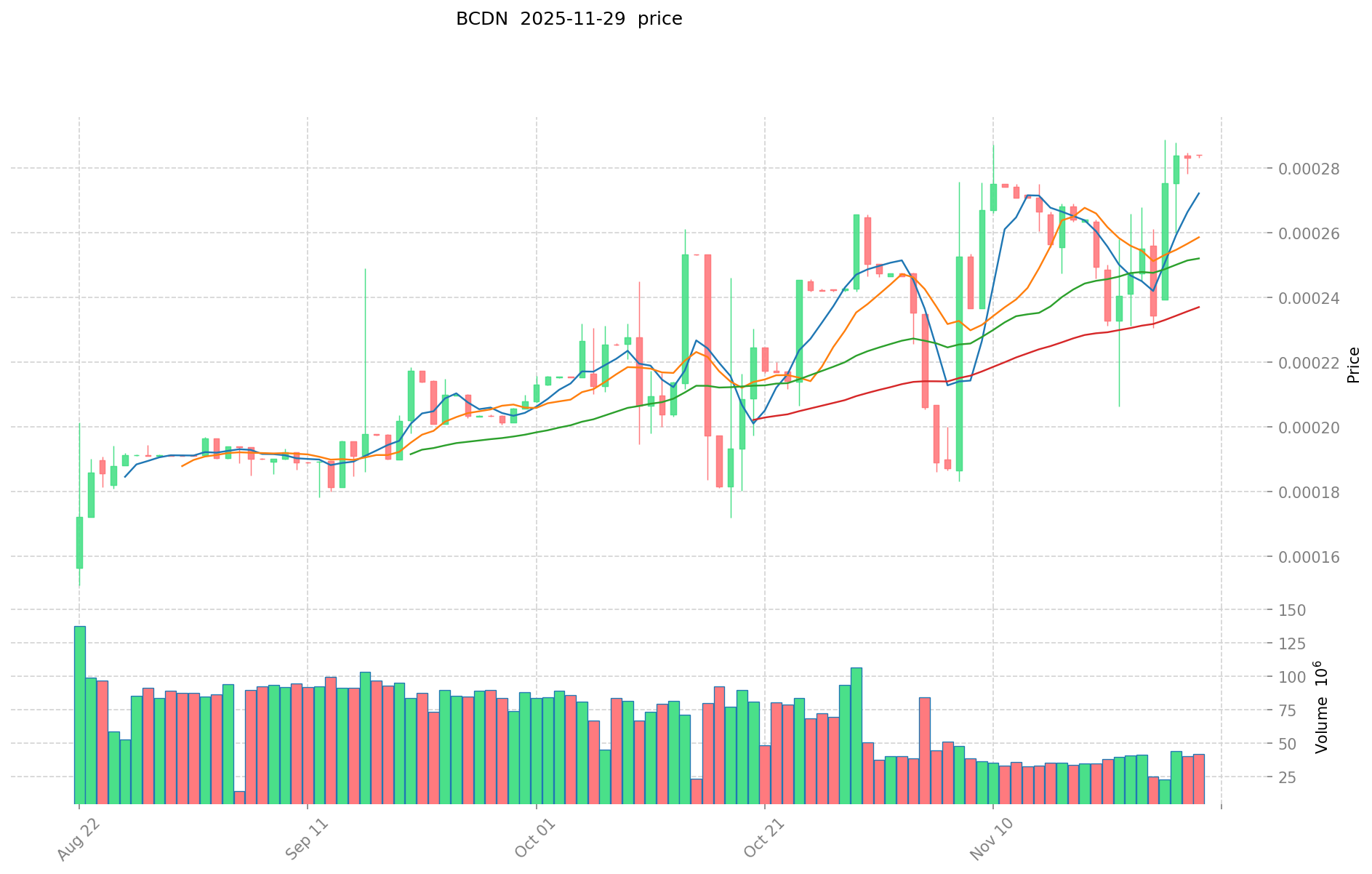
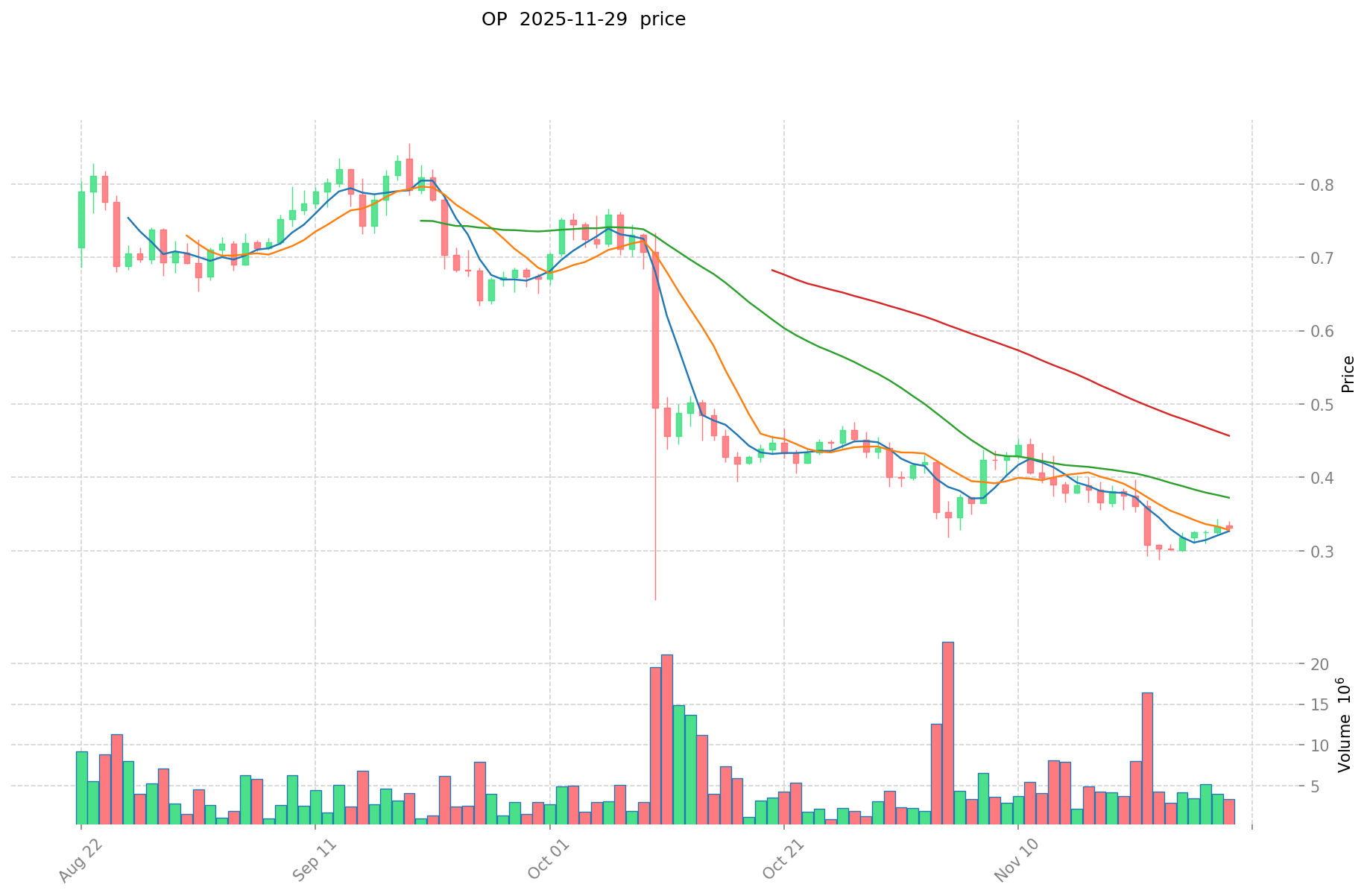
BlockCDN (BCDN) and Optimism (OP) Historical Price Trends
- 2022: BCDN reached its all-time low of $0.00008231 on May 13, 2022.
- 2024: OP hit its all-time high of $4.84 on March 6, 2024.
- Comparative analysis: BCDN has seen a significant increase from its all-time low, while OP has experienced a substantial decline from its all-time high.
Current Market Situation (2025-11-29)
- BCDN current price: $0.0002832
- OP current price: $0.3276
- 24-hour trading volume: BCDN $11,951.06 vs OP $915,085.14
- Market Sentiment Index (Fear & Greed Index): 28 (Fear)
Click to view real-time prices:
- View BCDN current price Market Price
- View OP current price Market Price
II. Key Factors Affecting BCDN vs OP Investment Value
Supply Mechanism Comparison (Tokenomics)
-
BCDN: Fixed supply with a maximum cap of 210 million tokens
-
OP: Inflationary tokenomics with ongoing emissions for governance and incentives
-
📌 Historical Pattern: Limited supply assets like BCDN tend to experience stronger price appreciation during bull markets, while OP's ongoing emissions may create selling pressure.
Institutional Adoption and Market Applications
- Institutional Holdings: BCDN has attracted more institutional capital with several investment funds and corporate treasuries holding it as a reserve asset
- Enterprise Adoption: BCDN leads in payment settlement and treasury applications, while OP sees more adoption in dApp development and Layer 2 infrastructure
- Regulatory Attitudes: BCDN faces stricter scrutiny from regulators concerned about monetary sovereignty, while OP generally faces fewer direct regulatory challenges
Technical Development and Ecosystem Building
- BCDN Technical Upgrades: Lightning Network implementation improving transaction capacity and reducing fees
- OP Technical Development: Rollup technology enhancements improving throughput and compatibility with Ethereum ecosystem
- Ecosystem Comparison: OP has stronger DeFi and NFT infrastructure due to Ethereum compatibility, while BCDN excels in payment solutions and store of value applications
Macroeconomic Factors and Market Cycles
- Inflation Performance: BCDN has demonstrated stronger anti-inflation properties due to its fixed supply mechanism
- Monetary Policy Impact: Both assets show negative correlation with rising interest rates, with BCDN typically more sensitive to Federal Reserve policy shifts
- Geopolitical Factors: BCDN benefits from capital flight during currency crises, while OP is less directly impacted by these events
III. 2025-2030 Price Prediction: BCDN vs OP
Short-term Prediction (2025)
- BCDN: Conservative $0.000223728 - $0.0002832 | Optimistic $0.0002832 - $0.000385152
- OP: Conservative $0.26568 - $0.328 | Optimistic $0.328 - $0.37392
Mid-term Prediction (2027)
- BCDN may enter a growth phase, with prices expected in the range of $0.0002772324096 - $0.0004443872448
- OP may enter a steady growth phase, with prices expected in the range of $0.2921742 - $0.412939536
- Key drivers: Institutional capital inflow, ETF developments, ecosystem growth
Long-term Prediction (2030)
- BCDN: Base scenario $0.000564898389588 - $0.000706122986985 | Optimistic scenario $0.000706122986985+
- OP: Base scenario $0.5729585731614 - $0.618795259014312 | Optimistic scenario $0.618795259014312+
Disclaimer: These predictions are based on current market data and trends. Cryptocurrency markets are highly volatile and subject to rapid changes. This information should not be considered as financial advice.
BCDN:
| 年份 | 预测最高价 | 预测平均价格 | 预测最低价 | 涨跌幅 |
|---|---|---|---|---|
| 2025 | 0.000385152 | 0.0002832 | 0.000223728 | 0 |
| 2026 | 0.00048121344 | 0.000334176 | 0.00025397376 | 18 |
| 2027 | 0.0004443872448 | 0.00040769472 | 0.0002772324096 | 43 |
| 2028 | 0.000634801063776 | 0.0004260409824 | 0.000264145409088 | 50 |
| 2029 | 0.000599375756089 | 0.000530421023088 | 0.000450857869624 | 87 |
| 2030 | 0.000706122986985 | 0.000564898389588 | 0.000519706518421 | 99 |
OP:
| 年份 | 预测最高价 | 预测平均价格 | 预测最低价 | 涨跌幅 |
|---|---|---|---|---|
| 2025 | 0.37392 | 0.328 | 0.26568 | 0 |
| 2026 | 0.4281712 | 0.35096 | 0.2386528 | 7 |
| 2027 | 0.412939536 | 0.3895656 | 0.2921742 | 18 |
| 2028 | 0.54971601816 | 0.401252568 | 0.37316488824 | 22 |
| 2029 | 0.6704328532428 | 0.47548429308 | 0.4422003925644 | 45 |
| 2030 | 0.618795259014312 | 0.5729585731614 | 0.48701478718719 | 74 |
IV. Investment Strategy Comparison: BCDN vs OP
Long-term vs Short-term Investment Strategy
- BCDN: Suitable for investors focused on payment scenarios and store of value properties
- OP: Suitable for investors interested in ecosystem potential and Layer 2 scaling solutions
Risk Management and Asset Allocation
- Conservative investors: BCDN: 30% vs OP: 70%
- Aggressive investors: BCDN: 60% vs OP: 40%
- Hedging tools: Stablecoin allocation, options, cross-currency portfolio
V. Potential Risk Comparison
Market Risk
- BCDN: Higher volatility due to lower market cap and trading volume
- OP: Potential oversupply due to inflationary tokenomics
Technical Risk
- BCDN: Scalability, network stability
- OP: Smart contract vulnerabilities, reliance on Ethereum network
Regulatory Risk
- Global regulatory policies may have different impacts on both assets, with BCDN potentially facing stricter scrutiny
VI. Conclusion: Which Is the Better Buy?
📌 Investment Value Summary:
- BCDN advantages: Fixed supply, potential for significant price appreciation, strong anti-inflation properties
- OP advantages: Strong ecosystem growth, Ethereum compatibility, Layer 2 scaling solution
✅ Investment Advice:
- New investors: Consider a balanced approach with a slight bias towards OP due to its ecosystem potential
- Experienced investors: Evaluate personal risk tolerance and market outlook, potentially favoring BCDN for higher risk-reward
- Institutional investors: Consider BCDN for treasury diversification and OP for long-term ecosystem exposure
⚠️ Risk Warning: The cryptocurrency market is highly volatile, and this article does not constitute investment advice. None
VII. FAQ
Q1: What are the main differences between BCDN and OP? A: BCDN is a distributed CDN service based on Ethereum with a fixed supply, while OP is an Ethereum Layer 2 scaling solution with inflationary tokenomics. BCDN focuses on payment scenarios and store of value, while OP emphasizes ecosystem development and scalability.
Q2: Which asset has shown better price performance recently? A: Based on the current market data, BCDN has seen a significant increase from its all-time low, while OP has experienced a substantial decline from its all-time high. However, OP still maintains a higher trading volume.
Q3: How do their supply mechanisms differ? A: BCDN has a fixed supply with a maximum cap of 210 million tokens, while OP has inflationary tokenomics with ongoing emissions for governance and incentives.
Q4: Which asset is more suitable for long-term investment? A: Both assets have their merits for long-term investment. BCDN may be more suitable for investors focused on payment scenarios and store of value properties, while OP may be better for those interested in ecosystem potential and Layer 2 scaling solutions.
Q5: What are the main risks associated with investing in BCDN and OP? A: For BCDN, risks include higher volatility due to lower market cap and trading volume, scalability issues, and potential regulatory scrutiny. For OP, risks include potential oversupply due to inflationary tokenomics, smart contract vulnerabilities, and reliance on the Ethereum network.
Q6: How might institutional adoption affect these assets? A: BCDN has attracted more institutional capital for reserve asset holdings, while OP sees more adoption in dApp development and Layer 2 infrastructure. Increased institutional adoption could potentially drive up demand and prices for both assets.
Q7: What factors should be considered when choosing between BCDN and OP for investment? A: Investors should consider their risk tolerance, investment horizon, market outlook, and interest in specific use cases (e.g., payments vs. ecosystem development). Additionally, factors such as supply mechanisms, institutional adoption, technical development, and regulatory environment should be taken into account.
Share
Content
Introduction: BCDN vs OP Investment Comparison
I. Price History Comparison and Current Market Status
II. Key Factors Affecting BCDN vs OP Investment Value
III. 2025-2030 Price Prediction: BCDN vs OP
IV. Investment Strategy Comparison: BCDN vs OP
V. Potential Risk Comparison
VI. Conclusion: Which Is the Better Buy?
VII. FAQ


