


ANDR vs FLOW: The Battle for Blockchain Supremacy in Gaming and NFTs
Introduction: Investment Comparison between ANDR and FLOW
In the cryptocurrency market, the comparison between Andromeda (ANDR) vs Flow (FLOW) has always been a topic that investors cannot avoid. The two not only show significant differences in market cap ranking, application scenarios, and price performance, but also represent different positioning in crypto assets.
Andromeda (ANDR): Since its launch, it has gained market recognition for its positioning as the first true 100% on-chain, IBC-enabled, decentralized web3 Operating System (OS).
Flow (FLOW): Since its inception in 2020, it has been hailed as a platform for next-generation games, applications, and digital assets, becoming one of the cryptocurrencies with high global trading volume and market capitalization.
This article will comprehensively analyze the investment value comparison between ANDR and FLOW, focusing on historical price trends, supply mechanisms, institutional adoption, technological ecosystems, and future predictions, and attempt to answer the question that investors care about most:
"Which is the better buy right now?"
I. Price History Comparison and Current Market Status
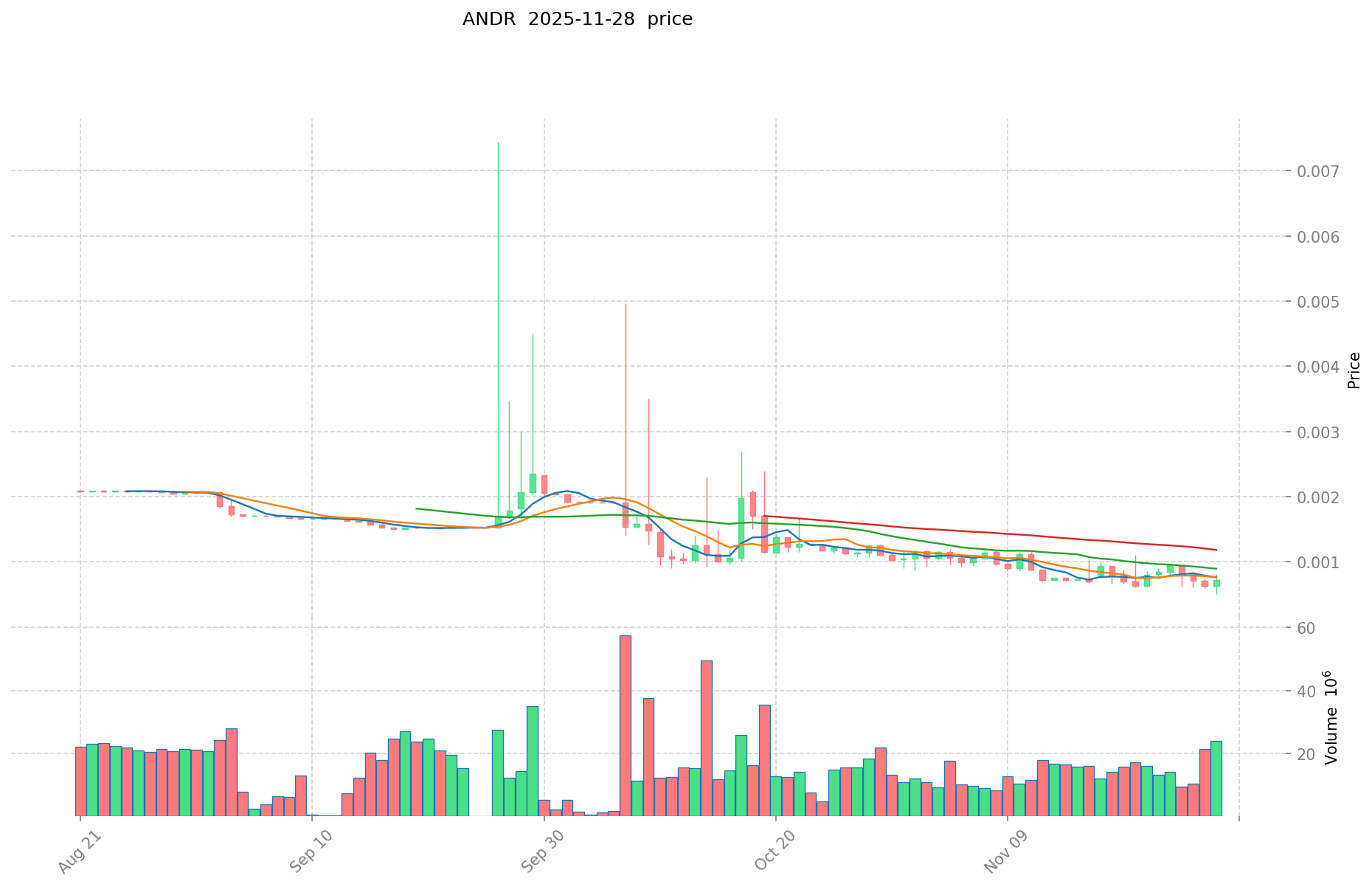
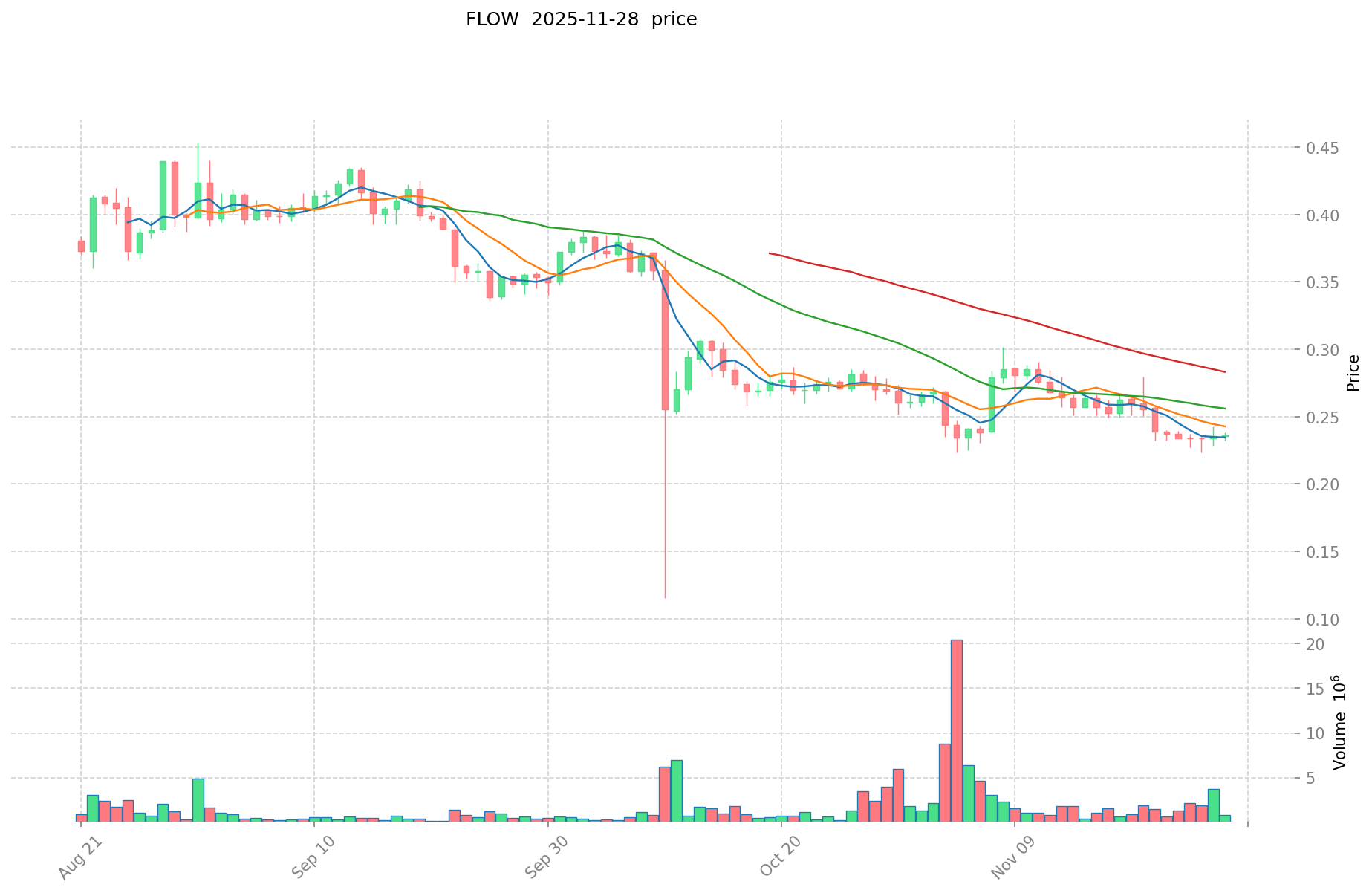
ANDR (Coin A) and FLOW (Coin B) Historical Price Trends
- 2024: ANDR reached its all-time high of $0.5869 on May 6, 2024.
- 2021: FLOW hit its all-time high of $42.4 on April 5, 2021.
- Comparative analysis: In the current market cycle, ANDR has fallen from its high of $0.5869 to a low of $0.0005, while FLOW has dropped from its peak of $42.4 to a low of $0.156967.
Current Market Situation (2025-11-28)
- ANDR current price: $0.0007986
- FLOW current price: $0.2369
- 24-hour trading volume: ANDR $16,399.12 vs FLOW $255,731.99
- Market Sentiment Index (Fear & Greed Index): 25 (Extreme Fear)
Click to view real-time prices:
- View ANDR current price Market Price
- View FLOW current price Market Price
II. Key Factors Affecting Investment Value of ANDR vs FLOW
Supply Mechanisms Comparison (Tokenomics)
- ANDR: Maximum supply of 10 billion tokens, with a circulating supply of approximately 1.94 billion tokens
- FLOW: Maximum supply of 1.39 billion tokens, with a circulating supply of approximately 1.04 billion tokens
- 📌 Historical Pattern: FLOW has already distributed about 75% of its maximum supply, while ANDR has only distributed about 19%, suggesting ANDR may have less supply-side selling pressure in the future.
Institutional Adoption and Market Applications
- Institutional Holdings: FLOW has attracted partnerships with major brands like NBA, NFL, UFC, and Samsung, showing stronger institutional adoption
- Enterprise Adoption: FLOW has demonstrated practical applications in NFTs and gaming with significant partnerships, while ANDR is focusing on gaming but with less established partnerships
- Regulatory Stance: Both tokens operate in similar regulatory environments as utility tokens focused on gaming and NFTs
Technical Development and Ecosystem Building
- ANDR Technical Development: Building an incentivized gaming ecosystem with a focus on mobile gaming, leveraging Web3 gaming infrastructure
- FLOW Technical Development: Established blockchain specifically designed for NFTs and gaming applications, with a proven track record in supporting high-profile projects
- Ecosystem Comparison: FLOW has a more mature ecosystem with demonstrated success in NFTs and gaming applications, while ANDR's ecosystem is still in earlier development stages focusing on mobile gaming integration
Macroeconomic Factors and Market Cycles
- Performance in Inflationary Environments: Neither token has specifically positioned itself as an inflation hedge
- Macroeconomic Monetary Policy: Both tokens are likely to be affected by broader crypto market trends related to monetary policy
- Geopolitical Factors: Both tokens are primarily focused on gaming and NFT applications rather than cross-border transactions or remittances
III. 2025-2030 Price Prediction: ANDR vs FLOW
Short-term Prediction (2025)
- ANDR: Conservative $0.000703404 - $0.0008684 | Optimistic $0.0008684 - $0.001154972
- FLOW: Conservative $0.125875 - $0.2375 | Optimistic $0.2375 - $0.266
Mid-term Prediction (2027)
- ANDR may enter a growth phase, with estimated prices ranging from $0.0006774249456 to $0.0015555683936
- FLOW may enter a steady growth phase, with estimated prices ranging from $0.173732675 to $0.386360725
- Key drivers: Institutional capital inflow, ETF, ecosystem development
Long-term Prediction (2030)
- ANDR: Base scenario $0.001661113709105 - $0.001786143773232 | Optimistic scenario $0.001786143773232 - $0.002375571218398
- FLOW: Base scenario $0.266886911751328 - $0.386792625726562 | Optimistic scenario $0.386792625726562 - $0.49509456093
Disclaimer
ANDR:
| 年份 | 预测最高价 | 预测平均价格 | 预测最低价 | 涨跌幅 |
|---|---|---|---|---|
| 2025 | 0.001154972 | 0.0008684 | 0.000703404 | 8 |
| 2026 | 0.00149729528 | 0.001011686 | 0.00052607672 | 26 |
| 2027 | 0.0015555683936 | 0.00125449064 | 0.0006774249456 | 57 |
| 2028 | 0.001770337191168 | 0.0014050295168 | 0.00077276623424 | 75 |
| 2029 | 0.00198460419248 | 0.001587683353984 | 0.001428915018585 | 98 |
| 2030 | 0.002375571218398 | 0.001786143773232 | 0.001661113709105 | 123 |
FLOW:
| 年份 | 预测最高价 | 预测平均价格 | 预测最低价 | 涨跌幅 |
|---|---|---|---|---|
| 2025 | 0.266 | 0.2375 | 0.125875 | 0 |
| 2026 | 0.266855 | 0.25175 | 0.156085 | 6 |
| 2027 | 0.386360725 | 0.2593025 | 0.173732675 | 9 |
| 2028 | 0.403539515625 | 0.3228316125 | 0.27763518675 | 36 |
| 2029 | 0.410399687390625 | 0.3631855640625 | 0.185224637671875 | 53 |
| 2030 | 0.49509456093 | 0.386792625726562 | 0.266886911751328 | 63 |
IV. Investment Strategy Comparison: ANDR vs FLOW
Long-term vs Short-term Investment Strategies
- ANDR: Suitable for investors focused on emerging gaming ecosystems and Web3 infrastructure potential
- FLOW: Suitable for investors looking for established NFT and gaming platforms with proven partnerships
Risk Management and Asset Allocation
- Conservative investors: ANDR: 20% vs FLOW: 80%
- Aggressive investors: ANDR: 60% vs FLOW: 40%
- Hedging tools: Stablecoin allocation, options, cross-currency portfolio
V. Potential Risk Comparison
Market Risks
- ANDR: Higher volatility due to lower market cap and trading volume
- FLOW: Potential market saturation in NFT and gaming sectors
Technical Risks
- ANDR: Scalability, network stability in early development stages
- FLOW: Potential security vulnerabilities, ecosystem dependence on major partnerships
Regulatory Risks
- Global regulatory policies may impact both tokens, with FLOW potentially facing more scrutiny due to its higher profile and established partnerships
VI. Conclusion: Which Is the Better Buy?
📌 Investment Value Summary:
- ANDR advantages: Early-stage potential in Web3 gaming, lower circulating supply
- FLOW advantages: Established ecosystem, strong institutional partnerships, proven track record in NFTs and gaming
✅ Investment Advice:
- Novice investors: Consider a higher allocation to FLOW for its established market presence
- Experienced investors: Balanced approach with both tokens, higher risk tolerance for ANDR
- Institutional investors: Evaluate FLOW for immediate integration opportunities, monitor ANDR for long-term potential
⚠️ Risk Warning: The cryptocurrency market is highly volatile, and this article does not constitute investment advice. None
VII. FAQ
Q1: What are the main differences between ANDR and FLOW? A: ANDR is positioned as a 100% on-chain, IBC-enabled, decentralized web3 Operating System, focusing on mobile gaming. FLOW is an established platform for next-generation games, applications, and digital assets, with a proven track record in NFTs and gaming.
Q2: Which token has a higher current market cap and trading volume? A: FLOW has a significantly higher market cap and 24-hour trading volume compared to ANDR. As of 2025-11-28, FLOW's 24-hour trading volume was $255,731.99, while ANDR's was $16,399.12.
Q3: How do the supply mechanisms of ANDR and FLOW compare? A: ANDR has a maximum supply of 10 billion tokens with about 19% in circulation, while FLOW has a maximum supply of 1.39 billion tokens with about 75% in circulation. This suggests ANDR may have less supply-side selling pressure in the future.
Q4: Which token has stronger institutional adoption? A: FLOW has demonstrated stronger institutional adoption, with partnerships with major brands like NBA, NFL, UFC, and Samsung. ANDR is still in earlier stages of ecosystem development and partnerships.
Q5: What are the key factors to consider when choosing between ANDR and FLOW for investment? A: Key factors include risk tolerance, investment horizon, belief in the potential of Web3 gaming (ANDR) versus established NFT and gaming platforms (FLOW), and assessment of each project's ecosystem development and partnerships.
Q6: How do the long-term price predictions for ANDR and FLOW compare? A: By 2030, ANDR's optimistic scenario predicts a price range of $0.001786143773232 - $0.002375571218398, while FLOW's optimistic scenario predicts $0.386792625726562 - $0.49509456093. However, these predictions are speculative and subject to market conditions.
Q7: What are the main risks associated with investing in ANDR and FLOW? A: ANDR faces higher volatility due to lower market cap and trading volume, as well as potential scalability and network stability issues. FLOW risks include potential market saturation in NFT and gaming sectors and ecosystem dependence on major partnerships. Both face regulatory risks.
Q8: How might a conservative investor allocate between ANDR and FLOW? A: A conservative investment strategy might allocate 20% to ANDR and 80% to FLOW, considering FLOW's more established market presence and partnerships.
Share
Content
Introduction: Investment Comparison between ANDR and FLOW
I. Price History Comparison and Current Market Status
II. Key Factors Affecting Investment Value of ANDR vs FLOW
III. 2025-2030 Price Prediction: ANDR vs FLOW
IV. Investment Strategy Comparison: ANDR vs FLOW
V. Potential Risk Comparison
VI. Conclusion: Which Is the Better Buy?
VII. FAQ


