Comprehensive Guide to Depth Charts for Crypto Assets: Comparing Order Books and Assessing Market Impact
2026-01-08 15:47:19
Crypto Insights
Crypto Trading
Crypto Tutorial
Spot Trading
Trading Bots
Article Rating : 4
67 ratings
A beginner-friendly guide to interpreting and using depth charts. You’ll learn how to read order books, analyze buying and selling pressure, and evaluate market liquidity. Depth chart analysis on Gate helps you avoid slippage and build effective trading strategies for cryptocurrency trading.
Comprehensive Guide to Depth Charts for Crypto Assets: Comparing Order Books and Assessing Market Impact

What Is a Depth Chart?

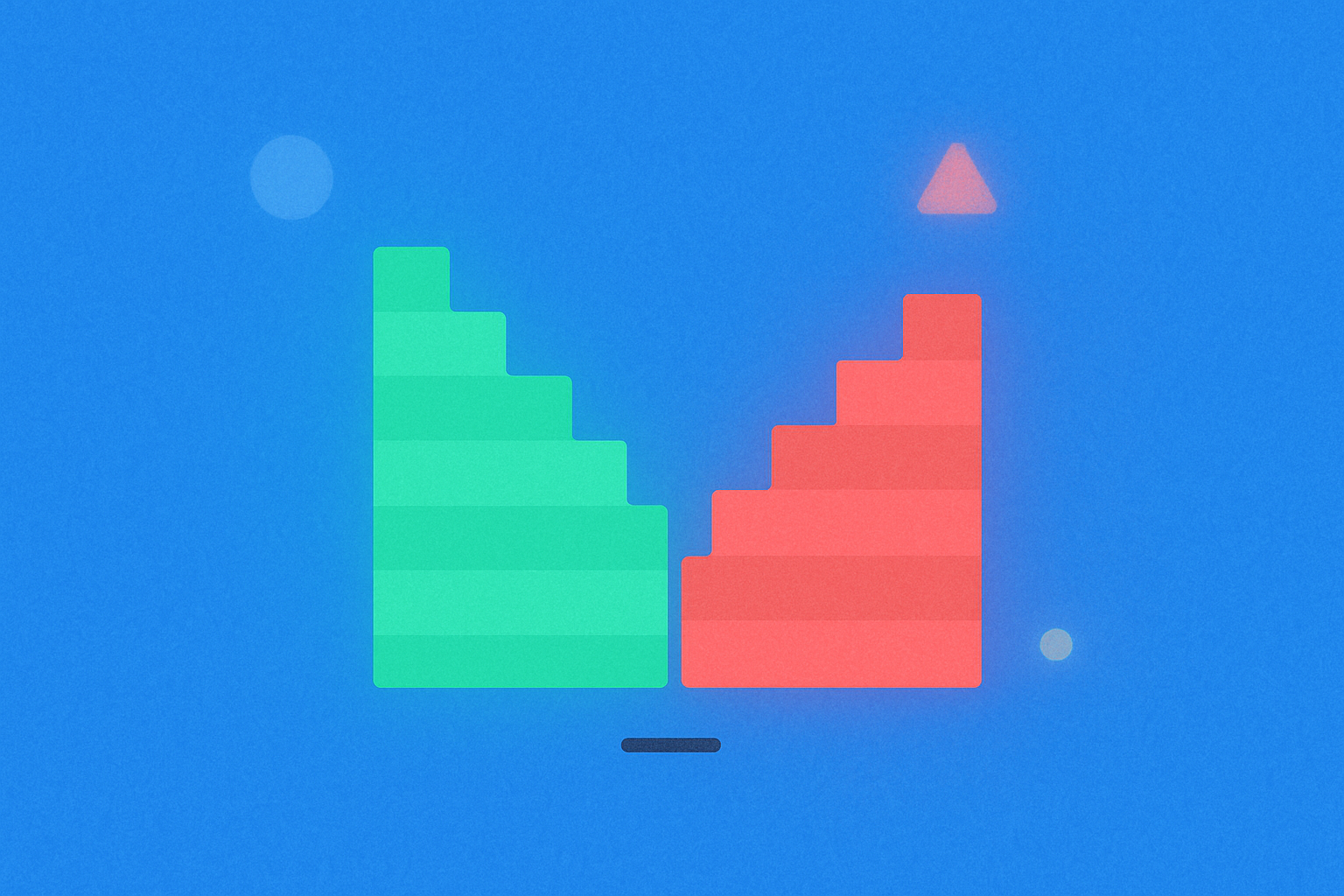
A depth chart visually displays the order book in cryptocurrency markets. This tool enables traders to quickly understand the distribution of buy and sell orders in the market at a glance.

Exchanges that provide order book data commonly use depth charts, which reflect both trading intent and capital flow among market participants. Specifically, the chart shows the volume of orders stacked at each price level, making market depth (liquidity thickness) visible. When market depth is robust, traders can execute large orders with minimal impact on price, which makes depth charts a key decision-making tool.

Depth charts also reflect active user behavior and trading volume on exchanges, serving as an indicator for overall market health. In highly liquid markets, the depth chart’s order book is thick, resulting in smoother trade execution.

Key Components of a Depth Chart

Understanding the elements of a depth chart is essential for accurate interpretation. The following explains the chart’s main components in detail.

The X-axis (horizontal axis) represents order prices, increasing from left to right. This axis allows users to see where orders are concentrated across price levels.

The Y-axis (vertical axis) displays order quantities, representing the cumulative volume of buy or sell orders at each price point. Greater Y-axis values indicate higher order volumes at those levels.

The green area shows buy orders (bids). A wider and thicker green area signals strong buying pressure in the market. Substantial buy-side accumulation suggests support for prices against decline.

The red area shows sell orders (asks). A wider and thicker red area signals strong selling pressure. Heavy sell-side presence may suppress price increases.

The intersection point is where buying and selling pressure balance, indicating the current market price. Movement of this point offers clues about future price trends.

The price range displays the range of traded prices and helps identify the spread (the difference between bid and ask prices). A narrower spread signals higher market liquidity.

How to Read a Depth Chart

To use a depth chart effectively, traders must accurately assess market depth and the balance between buying and selling pressure.

For evaluating market depth, a thick order book and tight spread mean buy and sell orders are densely layered across price levels, reflecting strong market depth. In this environment, large trades have limited price impact, enabling stable execution. Conversely, a thin order book and wide spread indicate shallow depth, increasing the risk of slippage—the gap between expected and actual execution price.

For assessing the balance of buying and selling pressure, a large green area means buying pressure dominates and may suggest an uptrend, as buyers support higher prices. A dominant red area indicates strong selling pressure and a potential downtrend, with price increases likely constrained. When red and green areas are roughly equal, buyers and sellers are balanced, and the market is often consolidating. In this scenario, prices tend to move sideways as traders await the next trend shift.

Key Benefits of Understanding Depth Charts

Accurately interpreting a depth chart offers traders several distinct advantages.

In reducing trading costs, strong market depth allows trades to execute near the current market price, minimizing costs. High-liquidity markets have narrow spreads and rapid order fills, reducing unnecessary expenses. For large trades especially, confirming market depth helps avoid poor executions.

In avoiding slippage, depth chart analysis lets traders anticipate liquidity and avoid executing trades in conditions with high slippage risk. By steering clear of thin periods or price bands, traders can minimize unexpected losses. When sharp price moves are likely, the depth chart helps with precise timing decisions.

In developing trading strategies, combining depth chart readings with assessments of buying and selling pressure enables more precise strategies. For instance, strong buying pressure may favor a buy-the-dip approach, while strong selling pressure may suit sell-the-rally tactics. Using the depth chart gives traders an objective view of market sentiment for rational, emotion-free decision-making.

Summary

Mastering depth chart analysis allows traders to better gauge market depth and order flow dynamics, empowering them to build more accurate strategies, reduce costs, and trade efficiently.

The depth chart is more than a visual aid; it’s a critical analysis tool reflecting liquidity and market sentiment. By evaluating order book thickness, spread, and the balance of buy and sell pressure, traders can make better-timed decisions.

Effectively using depth charts also helps avoid slippage and poor execution, minimizing trading costs. In volatile crypto markets, depth chart analysis is a key factor for trading success.

However, cryptocurrency trading carries significant risks, including price volatility, liquidity risk, and system risk. The depth chart is only one input and should be used alongside other technical and fundamental analysis. Investors must fully understand these risks and make decisions with caution.

FAQ

What Is a Depth Chart (Market Depth Chart)? How Is It Used in Cryptocurrency Trading?

A depth chart visually displays market buy and sell orders. In crypto trading, it shows trading volume and order depth at each price point, helping traders gauge liquidity and anticipate price movement. It’s essential for reading market sentiment.

How Do You Read an Order Book? What Do Bid and Ask Mean?

To read an order book, review the bid and ask prices. The bid is the price buyers offer, and the ask is the price sellers demand. The spread between them indicates market liquidity.

How Can You Assess Market Liquidity from a Depth Chart?

A depth chart displays the quantity of buy and sell orders at each price. Higher volumes mean stronger liquidity and more stable prices. Areas with concentrated orders mark support and resistance levels, helping assess market strength or weakness.

Why Do Depth Charts Differ Across Exchanges?

Each exchange has different liquidity levels and order book structures. Variations in trade volume and participant counts lead to differences in market depth and price precision.

Can a Depth Chart Be Used to Identify Support and Resistance Levels?

Yes. Because depth charts make bid and ask “walls” visible, they’re highly effective for identifying support and resistance. Traders can pinpoint price zones with concentrated orders and accurately identify key levels.

How Are Large Orders (“Whale Orders”) Displayed on a Depth Chart?

Large orders show up as prominent peaks in the depth chart. Buy orders are shown in red, sell orders in green, and these “whale” orders are especially visible as tall spikes on either side.

What Trading Strategies Use Depth Chart Analysis?

Depth chart analysis strategies include judging market direction by comparing buy and sell pressure, identifying support and resistance, and spotting large orders to anticipate price shifts. These methods help traders precisely time entries and exits.

* The information is not intended to be and does not constitute financial advice or any other recommendation of any sort offered or endorsed by Gate.
Related Articles
Trading Simulator: The Complete Guide to Paper, Backtests, and Live Drills

Trading Simulator: The Complete Guide to Paper, Backtests, and Live Drills

Before risking real funds, smart traders pressure-test their edge in a simulator. Here’s how to choose one, set it up properly, and use it to turn ideas into a repeatable, data-driven playbook.
2025-08-28 04:52:30
What Does TP Mean in Crypto Trading Slang?

What Does TP Mean in Crypto Trading Slang?

This article delves into the crypto slang "TP," or "Take Profit," crucial for risk management in volatile markets. Key topics include TP and SL comparison for trading success, advanced order types on Gate, and sophisticated TP techniques utilized by Web3 traders. The piece emphasizes mastering TP placement through technical analysis and market psychology, aiding traders in maximizing potential gains. Ideal for crypto traders seeking disciplined practices and enhanced analytic strategies, it addresses implementing actionable TP strategies for optimized profit-taking in cryptocurrency trading.
2025-08-22 01:44:02
PNL in Crypto: A Complete Guide to Calculating Profit and Loss

PNL in Crypto: A Complete Guide to Calculating Profit and Loss

The article serves as a comprehensive guide to understanding and calculating Profit and Loss (PNL) in crypto trading, highlighting the criticality of PNL in evaluating investment performance. It addresses key distinctions between realized and unrealized PNL, essential calculation formulas, and advanced tracking strategies to optimize trading efficiency. Targeted at cryptocurrency traders, it helps enhance decision-making processes, risk management, and portfolio health. The logical flow begins with defining PNL, followed by differentiating realized from unrealized PNL, presenting calculation methods, and concluding with advanced tracking strategies.
2025-09-25 19:05:56
What does POI mean in trading?

What does POI mean in trading?

This article reveals the concept of Points of Interest (POI) in crypto trading, emphasizing its role in defining significant price levels where notable market activity occurs. The article is aimed at Gate traders, highlighting how POI identification can transform trading strategies by providing strategic entry and exit points with an excellent risk-reward ratio. The discussion covers mastering POI identification through technical analysis, combining it with market sentiment and structural analysis, and the benefits in risk management. It offers a step-by-step guide from beginners to professionals, tailored for traders looking to enhance accuracy and profitability in volatile markets.
2025-11-11 03:38:51
Timeframe Alignment Strategies for Beginner Traders | Essential Trading Guide
Timeframe Alignment Strategies for Beginner Traders | Essential Trading Guide

Explore effective timeframe alignment strategies designed for novice traders in the cryptocurrency market. Find out how to select the optimal timeframe, grasp the significance of HTF compared to LTF, and boost your chances of success. This guide empowers new and intermediate traders to optimize their trading performance and achieve superior results using proven methods.
2025-12-23 20:54:10
Understanding Key Candlestick Patterns in Crypto Trading

Understanding Key Candlestick Patterns in Crypto Trading

The article "Understanding Key Candlestick Patterns in Crypto Trading" provides comprehensive insights into candlestick chart analysis, focusing on identifying patterns that help traders forecast market movements. It equips readers with the knowledge to interpret various bullish, bearish, and continuation patterns, enhancing decision-making in trading strategies. Suitable for crypto traders aiming to bolster their technical analysis skills, the content stresses the importance of integrating candlestick patterns with other indicators and risk management practices. By discussing practical implementation techniques across multiple timeframes, the piece ensures traders can harness candlestick insights effectively.
2025-12-23 07:49:49
Recommended for You
Kalshi Users Predict 83% Probability of Fed Rate Cut in Upcoming Policy Meeting

Kalshi Users Predict 83% Probability of Fed Rate Cut in Upcoming Policy Meeting

This article explores the Kalshi prediction market platform's assessment of a 83% probability for a December Federal Reserve 25 basis point rate cut, reflecting strong market consensus on monetary policy direction. The piece examines how prediction markets aggregate trader expectations through real-money stakes, providing valuable forecasting tools superior to traditional polling. It outlines the Fed's dual mandate framework and economic factors driving rate-cut expectations. The analysis covers market implications across equities, bonds, and currencies, explaining how lower rates reduce borrowing costs and stimulate economic activity. The comprehensive FAQ section addresses platform mechanics, rate-cut impacts on various asset classes, and investor portfolio adjustment strategies, making it essential reading for traders, investors, and finance professionals seeking data-driven insights into Fed policy expectations.
2026-01-09 12:51:33
China's Central Bank Reaffirms Cryptocurrency Ban and Targets Stablecoins

China's Central Bank Reaffirms Cryptocurrency Ban and Targets Stablecoins

This article examines China's comprehensive cryptocurrency ban and the People's Bank of China's intensified regulatory focus on stablecoins. The PBOC maintains strict prohibition on cryptocurrency trading, mining, and related services to safeguard financial stability, prevent capital flight, and protect consumers. Stablecoins face particular scrutiny due to their potential to facilitate cross-border transactions and circumvent capital controls. The regulatory framework serves strategic purposes including protecting monetary sovereignty and promoting the digital yuan. The article analyzes regulatory rationale, domestic and international implications, and clarifies key distinctions between cryptocurrencies and stablecoins. Through comprehensive FAQ sections, readers gain insights into China's stance on cryptocurrency holdings, the mechanisms behind stablecoin restrictions, and broader global market impacts of these policies.
2026-01-09 12:47:27
China's Central Bank Confirms Cryptocurrency Ban, Targets Stablecoins

China's Central Bank Confirms Cryptocurrency Ban, Targets Stablecoins

This article examines China's evolving cryptocurrency policy and its 2024 market impact. The People's Bank of China reaffirms its comprehensive ban on cryptocurrency trading, mining, and related services, maintaining strict financial oversight while developing its digital yuan initiative. A critical focus targets stablecoins, viewed as risks to monetary sovereignty and capital control. The policy prohibits all crypto transactions as illegal financial activities, with enforcement extending to financial institutions and payment providers. These regulatory measures create significant implications for both domestic participants facing legal consequences and the global crypto ecosystem. The article explores compliance requirements, market volatility triggered by regulatory divergence between major economies, and comparative analysis of China's stricter approach versus permissive jurisdictions, providing essential guidance for understanding digital asset landscape shifts in 2024.
2026-01-09 12:45:53
SEC's Hester Peirce Predicts Upcoming Years as Key Period for U.S. Crypto Regulation
SEC's Hester Peirce Predicts Upcoming Years as Key Period for U.S. Crypto Regulation

This article explores the SEC's transformative vision for U.S. cryptocurrency regulation, highlighting a strategic shift from enforcement-driven approaches to a comprehensive, structured framework. Designed for industry participants and investors seeking regulatory clarity, the article outlines how the proposed framework establishes consistent rules for token issuance, exchange operations, and asset classification. A key innovation involves dividing oversight responsibilities between the SEC and CFTC, with the CFTC governing spot tokens as commodities while the SEC maintains jurisdiction over securities-classified digital assets. The framework emphasizes protecting self-custody rights and financial privacy while maintaining regulatory oversight. Through phased implementation beginning with foundational definitions and progressing to full operational requirements, regulators aim to create a predictable environment on Gate that fosters innovation. Full implementation is anticipated by 2026, providing market par
2026-01-09 12:44:14
Former Goldman Sachs Banker Tim Leissner Sentenced in 1MDB Scandal

Former Goldman Sachs Banker Tim Leissner Sentenced in 1MDB Scandal

This article examines the sentencing of former Goldman Sachs banker Tim Leissner to two years in prison for his pivotal role in the 1MDB scandal, one of history's largest financial fraud schemes involving $4.5 billion in misappropriated funds. The comprehensive overview covers the scandal's background, Leissner's facilitation of fraudulent bond sales, his guilty plea, and resulting legal consequences including $44 million in asset forfeiture. The article details how funds were laundered through shell companies and offshore accounts for luxury purchases and corrupt payments across multiple jurisdictions. It also addresses the impact on Goldman Sachs, which faced billions in penalties, and discusses broader implications for international financial regulation, enhanced compliance standards, and strengthened anti-corruption measures in banking institutions globally.
2026-01-09 12:42:39
Neobank Web3 Is Transforming Financial Transactions Through DeFi Integration

Neobank Web3 Is Transforming Financial Transactions Through DeFi Integration

A complete guide to choosing and comparing DeFi Web3 Neobank platforms for the decentralized finance revolution. Discover blockchain integration, self-custody wallets, stablecoins, and how Gate streamlines global transactions without intermediaries while providing top-level security.
2026-01-09 12:41:29