WCT Airdrop Recap: Season 1 Claim Guide and User Data Analysis

Beginner
Quick Reads
Last Updated 2026-04-03 19:53:03
Reading Time: 1m
Season 1 of the WCT Airdrop concluded on January 3, 2025. In this article, we’ll provide a comprehensive recap of the event, guide you through the claiming process, and analyze community participation—so you can get a head start on the next airdrop.

What is WCT?

WCT, or WalletConnect Token, is the native token of the WalletConnect protocol. WalletConnect is an open standard for connecting decentralized wallets and DApps, widely adopted throughout the Web3 ecosystem. As the ecosystem’s governance token, WCT will serve crucial functions in protocol governance, rewards distribution, and fee rebates going forward.

WCT Airdrop Season 1 Recap

WCT Airdrop Season 1 launched in late 2024 and ended on January 3, 2025, targeting users who engaged with the WalletConnect protocol. The project team analyzed on-chain data, including user activity, connection frequency, and transaction history. They conducted a snapshot and distributed tokens based on a points-based rewards system.

The event’s key highlights included:

  • Support for multiple wallet types, including MetaMask, Trust Wallet, Rainbow, and others
  • Compatibility with multiple blockchains, such as Ethereum, Polygon, BNB Chain, and more
  • Use of time-based snapshots and several claim windows

Airdrop Claim Steps Recap

  1. Visit the official WCT airdrop page (only via authorized channels)
  2. Connect your supported wallet using WalletConnect
  3. The system automatically verifies eligibility and points based on snapshots
  4. Sign to confirm and claim your WCT
  5. Choose to lock your tokens or withdraw them to your wallet

You do not need to enter your private key at any stage; only wallet signatures are required. The entire process is streamlined and intuitive, providing a smooth user experience.

Community Participation and User Feedback

According to available data, the first round of the WCT Airdrop attracted over 350,000 eligible addresses, with more than 100 million tokens distributed. Community response was enthusiastic. Many users indicated they intend to hold WCT long-term and support WalletConnect’s future development.

However, some users reported challenges such as:

  • Missing the airdrop due to not connecting their wallet
  • New wallets were not included in the snapshot list
  • Missing the claim window because of missed deadlines

How to Prepare for the Next WCT Airdrop?

  1. Keep your wallet active: Regularly use the WalletConnect protocol and supported DApps to optimize your snapshot points
  2. Link social accounts: Some rewards require connecting your Telegram, X (formerly Twitter), or other social profiles
  3. Subscribe to official announcements: Stay up to date with launch notifications and instructions for Season 2.
  4. Engage in community activities: Translate documentation, develop plugins, or participate in Q&A sessions to enhance your influence and reward tier

WCT Now Trading on Gate.com Spot Market
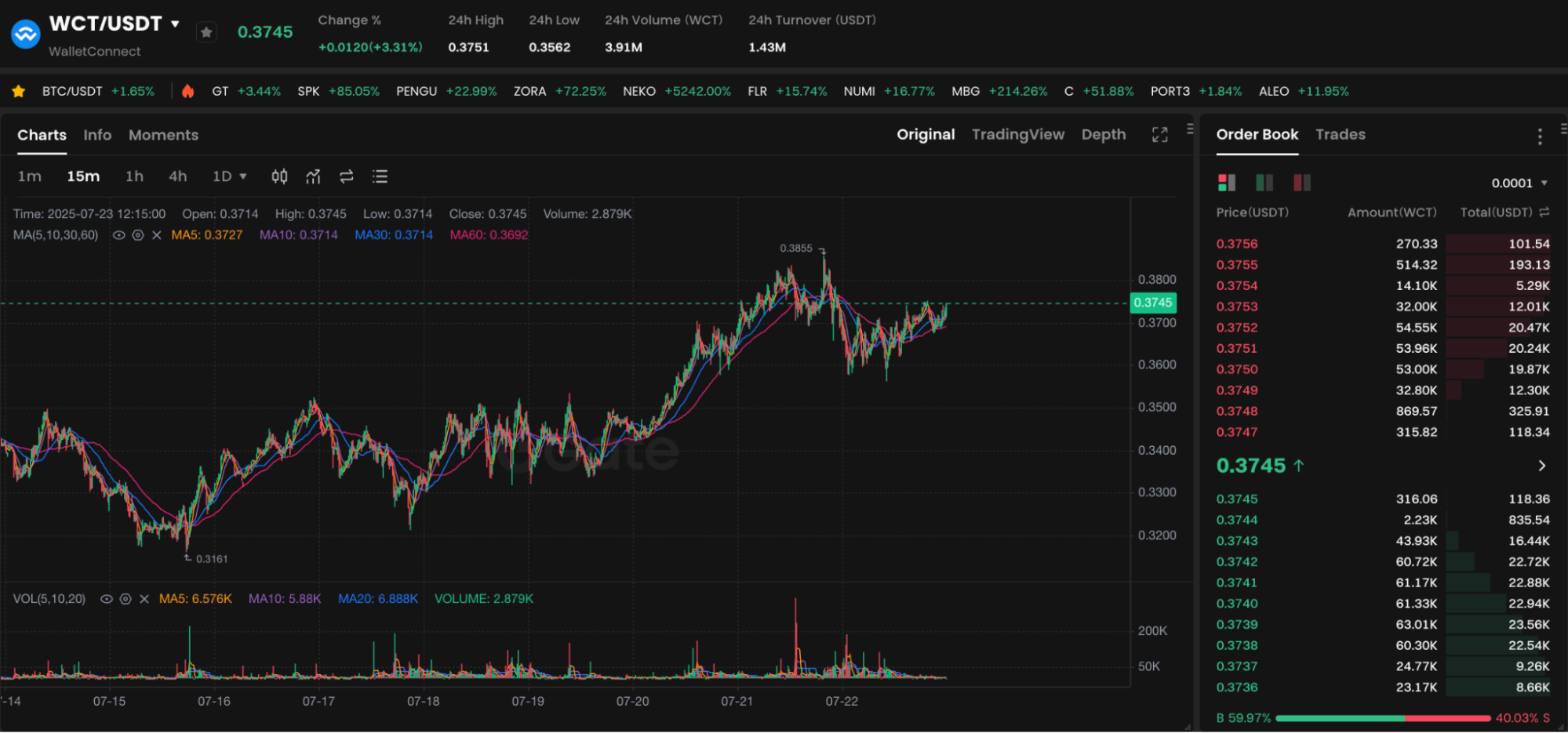

Image: https://www.gate.com/trade/WCT_USDT

WCT is now available for spot trading on Gate.com. Users can access the trading page via the link above.

Author: Max
Disclaimer
* The information is not intended to be and does not constitute financial advice or any other recommendation of any sort offered or endorsed by Gate.
* This article may not be reproduced, transmitted or copied without referencing Gate. Contravention is an infringement of Copyright Act and may be subject to legal action.

Related Articles

Gold Price Forecast for the Next Five Years: 2026–2030 Trend Outlook and Investment Implications, Could It Reach $6,000?
Beginner

Gold Price Forecast for the Next Five Years: 2026–2030 Trend Outlook and Investment Implications, Could It Reach $6,000?

Analyze current gold price trends alongside authoritative five-year forecasts, integrating an evaluation of market risks and opportunities. This gives investors insight into the potential trajectory of gold prices and the main drivers expected to shape the market over the next five years.
2026-03-25 18:13:30
AI-Native Settlement Layers: How United Stables Is Building the Next Financial Rail
Beginner

AI-Native Settlement Layers: How United Stables Is Building the Next Financial Rail

Stablecoins were originally designed as dollar substitutes within exchanges, primarily used for asset pricing and trade settlement. As on-chain financial ecosystems have matured, their role has expanded beyond simple payments to include collateral assets, cross-chain liquidity mediums, and unified settlement units. In particular, as AI systems and automated agents begin to participate directly in economic activity, demand has risen sharply for programmable value units capable of instant settlement. This shift is pushing stablecoins toward the role of foundational financial infrastructure.
2026-03-25 03:16:17
Aster vs Hyperliquid: Which Perp DEX Will Prevail?
Beginner

Aster vs Hyperliquid: Which Perp DEX Will Prevail?

Aster and Hyperliquid are the two representative protocols of the "purpose-built L1 path" within the current decentralized perpetual exchange (Perp DEX) sector. As a pioneer in the field, Hyperliquid has built a deep liquidity moat through its highly mature order book architecture and strong community consensus. Conversely, Aster, as a rising challenger, seeks to leapfrog the competition in high-performance trading through more aggressive multi-chain aggregation logic, private transaction modules, and an underlying execution environment optimized for 2026 market demands.
2026-03-24 11:58:33
DePIN Identity Network and Real World Applications: How Humanity Protocol Brings on-chain Identity Into the Physical World
Beginner

DePIN Identity Network and Real World Applications: How Humanity Protocol Brings on-chain Identity Into the Physical World

Most Web3 identity systems remain confined to on-chain environments and struggle to achieve meaningful adoption in real world settings. Through a DePIN architecture and physical verification hardware, Humanity Protocol aims to bring decentralized identity into access control systems, hospitality, public services, and offline events, allowing on-chain identity to function not just as a digital credential, but as foundational infrastructure for real world access.
2026-03-25 07:40:53
Aerodrome Tokenomics: How ve(3,3) Powers Base's Most Profitable DEX
Beginner

Aerodrome Tokenomics: How ve(3,3) Powers Base's Most Profitable DEX

AERO is the native token of Aerodrome Finance, a core decentralized exchange and liquidity protocol in the Base ecosystem. It is primarily used for liquidity incentives and ecosystem operations. veAERO is a governance NFT that users receive by locking AERO, representing both voting power and the right to share protocol revenue. Through a dual track structure of AERO as a utility token and veAERO as a governance credential, Aerodrome separates liquidity usage value from long term governance power, allowing participants to act as liquidity providers, governance decision makers, and revenue sharers within the same system.
2026-03-25 06:40:31
How Does Kite Work? An In-Depth Look at Kite's Identity and Programmable Permission Architecture
Beginner

How Does Kite Work? An In-Depth Look at Kite's Identity and Programmable Permission Architecture

Kite is an EVM compatible Layer 1 blockchain network that runs on proof of stake. It is designed to give AI agents verifiable identity, programmable permissions, and real time settlement in an on-chain execution environment. In Kite's design, AI is no longer only a tool that follows instructions. It becomes an economic participant with independent on-chain identity and direct control over assets. Within secure and auditable infrastructure, an AI agent can complete payments, call services, and coordinate tasks autonomously, making Kite a foundational layer for the emerging agent economy.
2026-03-25 06:02:34