What Is Sapien?

(Source: JoinSapien)
Sapien is more than a data collaboration platform—it’s an open protocol built around trust and quality. Using the $SAPIEN token, anyone can help shape AI, verify data integrity, and earn rewards based on real performance. Sapien’s design philosophy is straightforward yet profound: it converts data quality into economic value, allowing trust to be built through code instead of intermediaries.
Sapien’s Core Vision
Traditionally, AI development relies on centralized teams for data annotation and quality control—a model plagued by inefficiency, lack of transparency, and weak incentives for top contributors. Sapien is transforming this structure by introducing a decentralized, verifiable, and incentive-driven collaboration mechanism, where code enforces quality automatically instead of manual review.
At the heart of Sapien is its Proof of Quality protocol, a trust system built on behavior, reputation, and economic alignment. Each participant builds credibility through staking, validation, and performance, allowing the network’s data quality to sustain itself without a central authority.
Four Core Protocol Systems
(Source: docs.sapien)
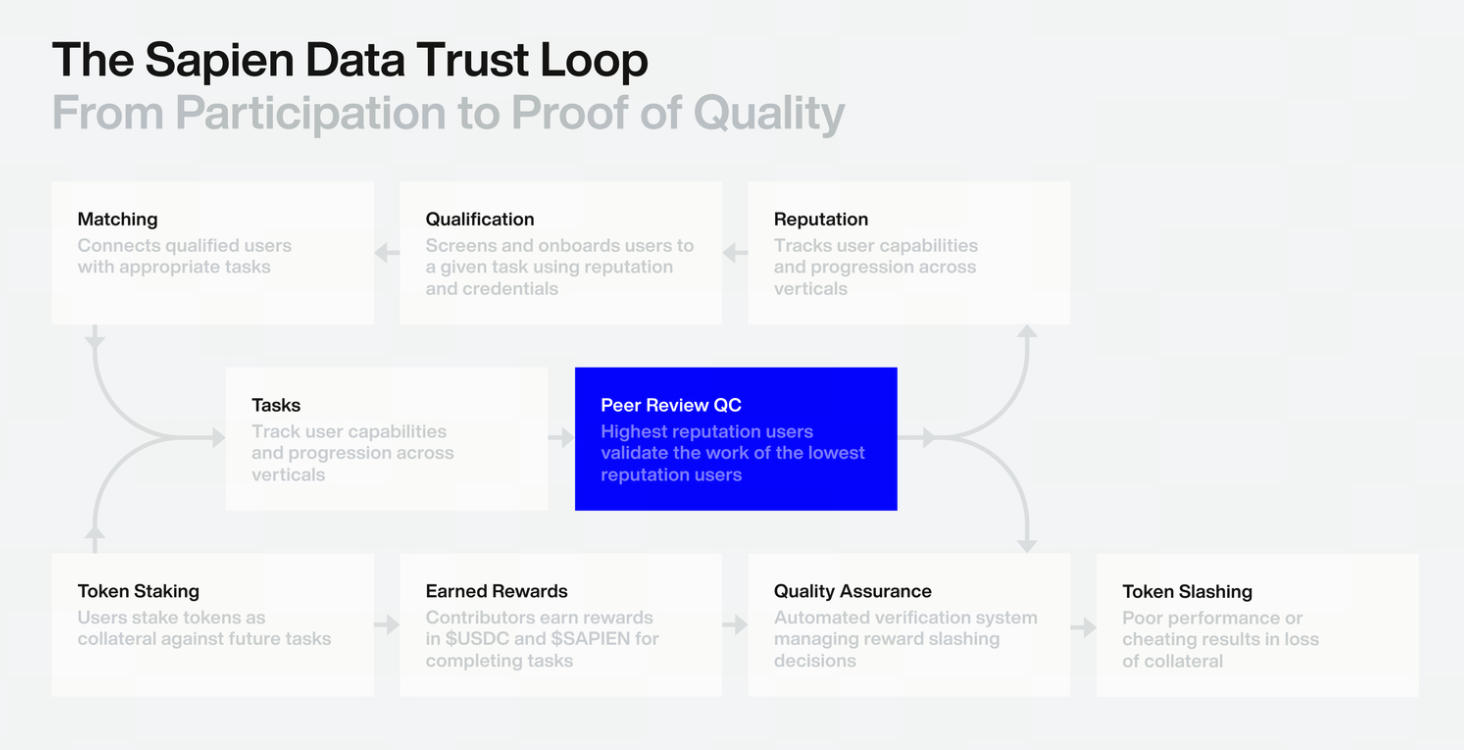
Sapien operates through four core modules that together create a self-regulating quality economy.
1. Staking: Trust Guaranteed by Collateral
Before performing tasks, participants must stake $SAPIEN tokens as collateral—the higher the stake, the higher the task level and potential rewards. If outcomes don’t meet standards, a portion is slashed, ensuring everyone is accountable for quality.
- Validation: Peer Review Over Centralized Audits
Completed tasks are reviewed by higher-level contributors. Accurate assessments earn rewards, while misjudgments or approval of low-quality work are penalized. This decentralized process replaces traditional QA teams, delivering true distributed quality assurance. - Reputation: On-Chain Metrics as Personal Capital
Every contributor’s performance—accuracy, task volume, and historical ratings—is recorded on-chain, forming a transparent reputation score. This score determines access to higher-value tasks, eligibility as a validator, and reward multipliers. In Sapien, reputation is not just honor—it’s economic capital. - Incentives: Performance-Based Rewards
Sapien’s incentive model factors in task difficulty, peer performance, and staking duration. Top performers earn a higher share of $SAPIEN rewards; those who underperform face reduced earnings and possible token slashing for poor contributions.
This structure fosters a virtuous cycle of competition, continually raising the quality bar across the network.
A New Standard: Trust Proven by Results
Traditionally, trust comes from credentials, resumes, or connections. In Sapien, trust is built on actions and economic signals. Proof of Quality isn’t just a technical mechanism—it’s a cultural shift. Every validation, stake, and contribution leaves an on-chain record, creating a trust network anchored in real achievements.
With this model, Sapien turns the $SAPIEN token from a speculative asset into productive capital: contributors must stake tokens to participate, and only sustained high-quality output leads to greater returns. This economic cycle transforms quality into the network’s core consensus.
Tokenomics
Sapien’s native token, $SAPIEN, powers the ecosystem through staking, rewards, validation, and governance. The total supply is capped at 1 billion (1,000,000,000 SAPIEN), with allocations designed for long-term incentives and sustainable growth, balancing early builders’ and future community contributors’ interests.
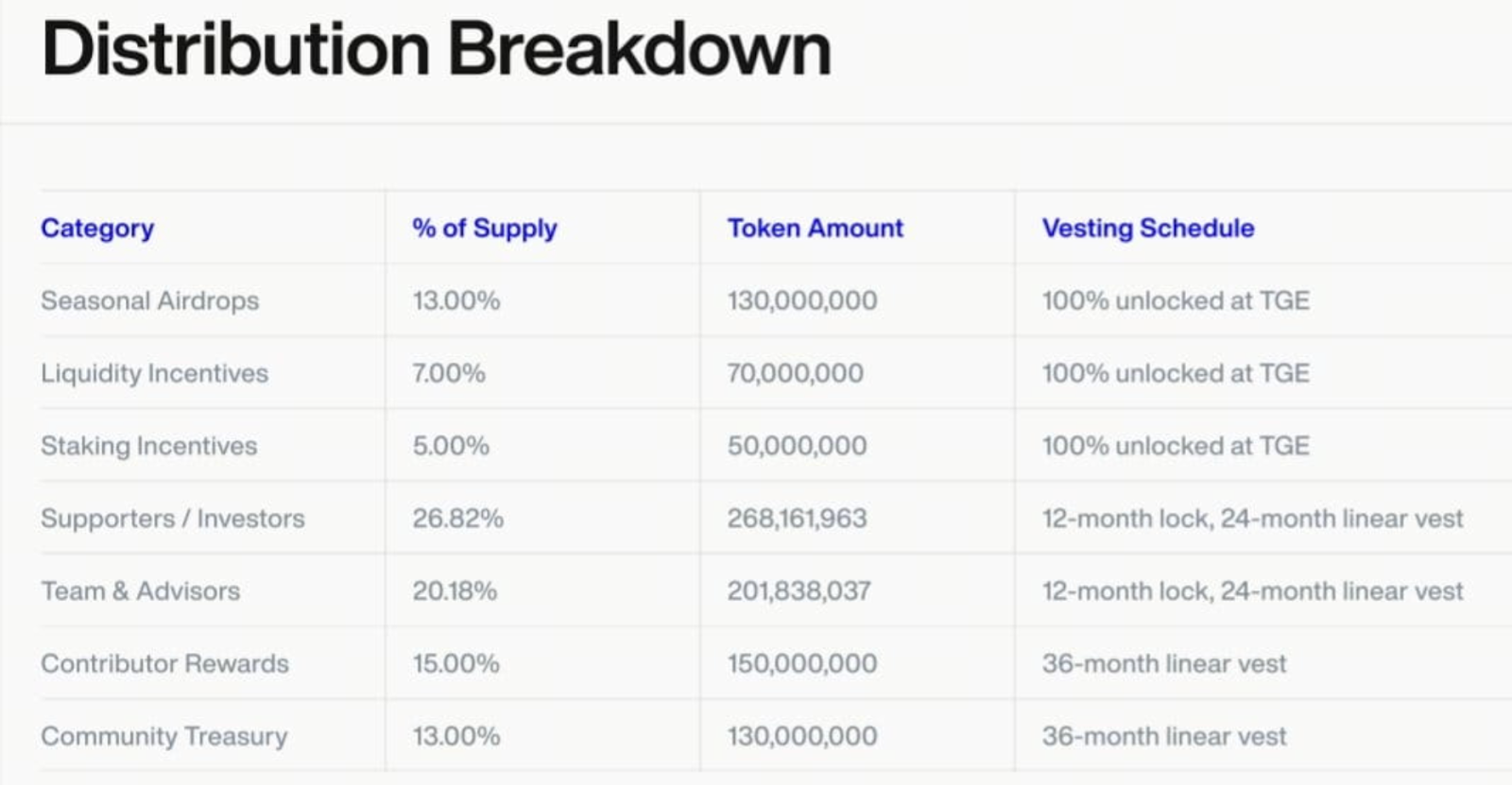
The token distribution breaks down into two main categories:
- 47% for early protocol participants (contributors, builders, and supporters) to reward technical and ecosystem development;
- 53% for ongoing community and ecosystem incentives, including task rewards, liquidity incentives, and treasury funding.
Detailed allocation:
- Seasonal Airdrop (13%): 130 million tokens, fully released at TGE to reward early participants and community supporters.
- Liquidity Incentives (7%): 70 million tokens, unlocked at TGE to boost market activity and trading depth.
- Staking Incentives (5%): 50 million tokens, released at TGE to encourage protocol staking and task validation.
- Supporters & Investors (26.82%): About 268 million tokens, 12-month lockup, then linear release over 24 months to align capital and project growth.
- Team & Advisors (20.18%): About 201 million tokens, same 12-month lockup with 24-month linear release, securing long-term contributor interest and stability.
- Contributor Rewards (15%): 150 million tokens, released linearly over 36 months to incentivize ongoing, high-quality participation.
- Community Treasury (13%): 130 million tokens, released linearly over 36 months for governance and ecosystem project support.
(Source: Sapien)
This approach ensures Sapien maintains stable incentives over time, limiting short-term sell-offs and supporting sustained engagement.
Sapien’s Investors and Ecosystem Partners
Sapien’s promise is evident both in its design and its high-profile backers. The project has secured $10.5 million in seed funding from leading investors including Variant, Primitive Ventures, Animoca Brands, Yield Guild Games, and Orange DAO.
Sapien is also partnering with Airtm, GIG, Intract, KGen, Mises, Recall, Veera, Worldcoin, and others to build an open, trustworthy AI collaboration network. These alliances bring capital and technical support, demonstrating industry-wide belief in decentralized AI.
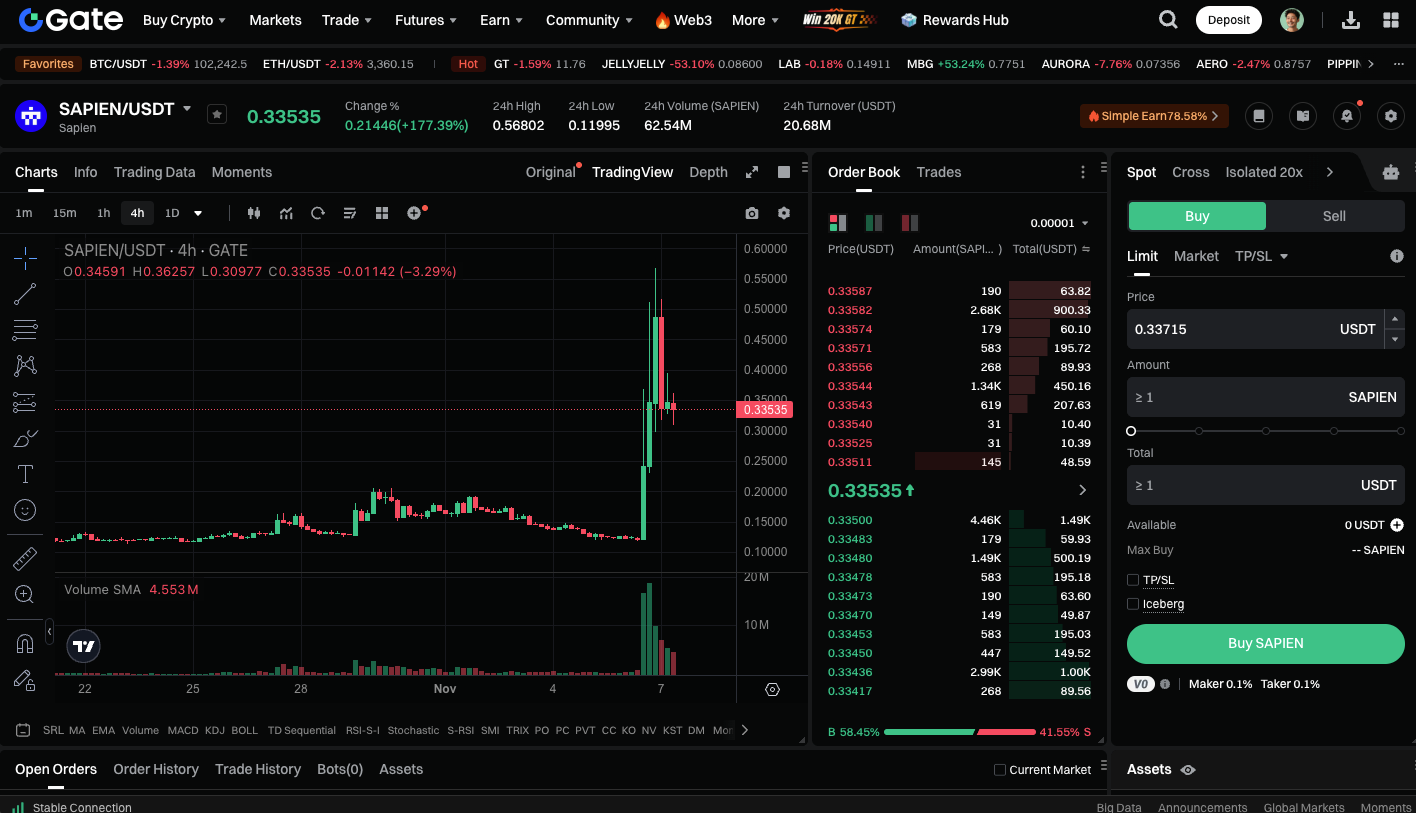
Trade SAPIEN spot instantly at: https://www.gate.com/trade/SAPIEN_USDT
Conclusion
Sapien introduces a new paradigm for collaboration, where quality is upheld by collective intelligence and financial incentives instead of authority. Human expertise becomes a measurable, on-chain asset—every contribution is recognized, validated, and rewarded. In an era defined by AI’s reach, Sapien’s Proof of Quality is both a technological breakthrough and a revolution in trust. The future of AI will be shaped not just by machine learning, but by humanity’s shared trust and accountability.