Monad’s MON Token Stumbles on First Trading Day: A Cold Start Under High Expectations

Beginner
Quick Reads
Last Updated 2026-03-27 11:32:14
Reading Time: 1m
Monad’s MON token debuted on the mainnet at a price lower than its issuance price. Trading volume reached only about $50 million, leading the market to question both the token’s token distribution and insufficient demand.

Monad Mainnet Official Launch and MON Token Circulation

On November 24, 2025, the highly anticipated Monad mainnet officially went live, debuting its native token, MON. According to official sources, MON has a total supply of 100 billion tokens. Of these, about 10.8% (roughly 10.83 billion tokens) were unlocked and entered circulation on the launch day.

In the initial circulating supply, the team released some tokens to the market via Coinbase’s public sale, while another portion went out through an airdrop. Specifically, 7.5% was set aside for the public sale and 3.3% for the airdrop, aiming to give market participants and early community supporters direct access to MON.

Slow MON Public Sale Raises Concerns

Unlike many recent tokens that sold out rapidly during their public sale phases, MON’s public sale on Coinbase progressed at a noticeably slower pace. The project adopted a “broad distribution” model, focusing on widespread user participation rather than quick fundraising. Co-founder Keone Hon stressed that they chose Coinbase’s allocation algorithm specifically to prevent token concentration among a small group of large investors.

The team noted that any unsold tokens at the end of the public sale would be reallocated to the ecosystem development pool, supporting network growth and community initiatives.

First Trading Day: Weak Performance in Price, Volume, and Market Cap
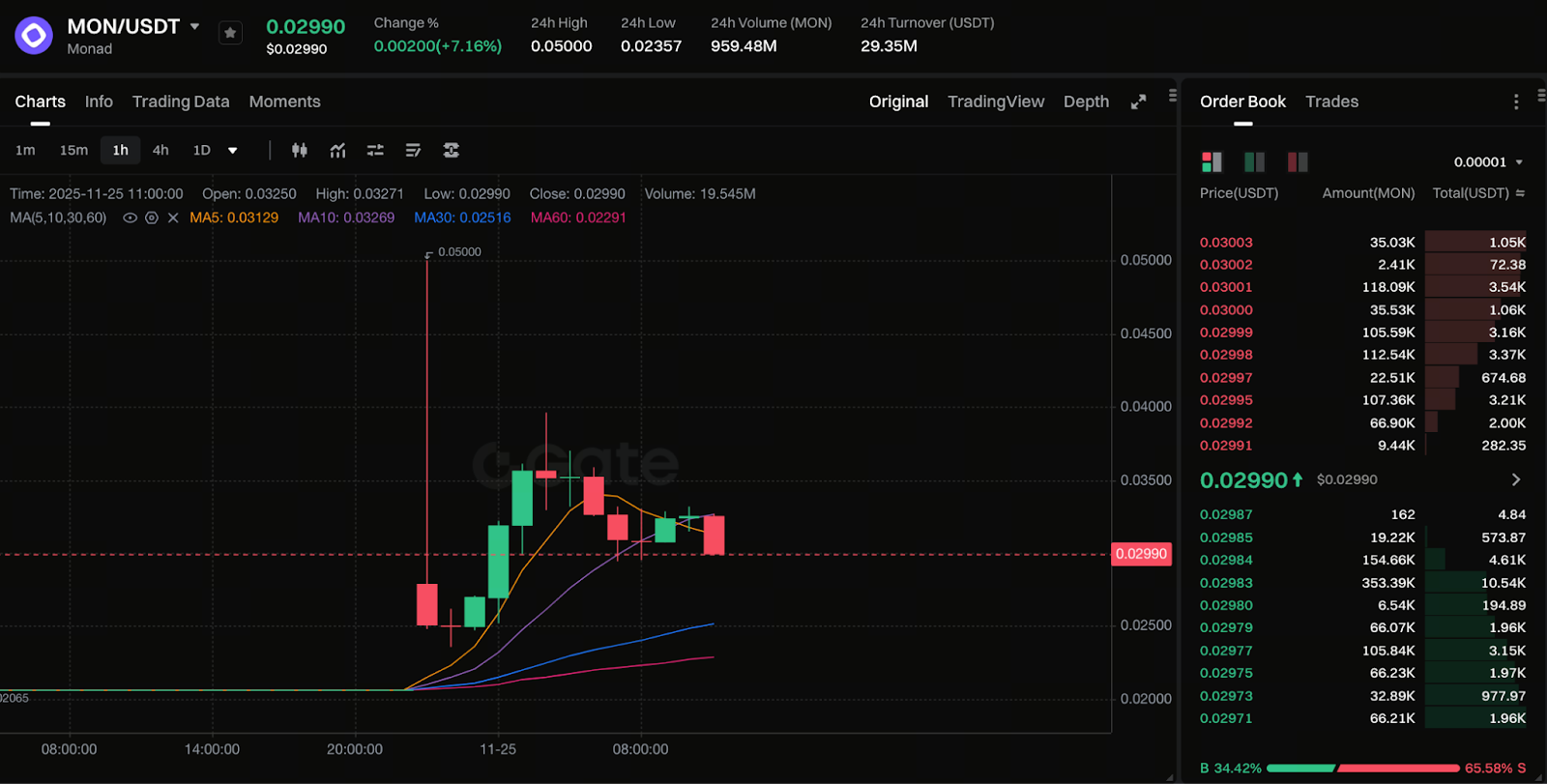

Chart: https://www.gate.com/trade/MON_USDT

On its first day of trading, MON was priced at about $0.02417, slightly below its $0.025 public sale price. Trading activity was low: just $50 million in volume was recorded within the first 100 minutes after launch—a modest figure for a highly anticipated Layer-1 chain.

Based on the first-day circulating supply, MON’s opening market cap was approximately $262 million. Overall, market enthusiasm for the token launch and mainnet debut hasn’t fully appeared, with both capital and sentiment staying cautious. The price later surged to a peak of around $0.34 in the early hours of the 25th.

Tokenomics Debate: Team Allocation Draws Criticism

MON’s token allocation structure has recently sparked discussion in both the industry and the community. The official initial allocation is as follows:

  • 27% to the Monad team
  • 19.7% to investors
  • 4% to the Labs treasury
  • 38.5% for ecosystem development

The team’s 27% share is notably high for a newly launched Layer-1 mainnet. Some market observers warn that such a large team allocation could create significant sell pressure when tokens unlock. This may hurt confidence in MON’s value over the medium and long term.

Co-Founder Response and Strategic Adjustments

Addressing the slow uptake in the public sale, Monad co-founder Keone Hon reaffirmed the team’s commitment to Coinbase’s allocation model, emphasizing fair and broad participation over short-term fundraising speed.

The team will use unsold tokens to boost ecosystem development—providing developer incentives, marketing, and building strategic partnerships. This move should help strengthen the project’s long-term community value.

Overall, the team is actively prioritizing sustainable growth and a robust ecosystem. Whether this can ease cautious early market sentiment is unclear and will depend on trading performance over time.

Market Outlook and Investor Considerations

In the short term, MON’s first trading day was disappointing—its price dipped below the public sale price, liquidity was limited, and the allocation structure heavily favored the team. These factors may continue to weigh on market sentiment. Still, over the medium and long term, Monad could increase its network value if it attracts developers, fosters ecosystem applications, and uses unsold tokens to inject further momentum. The key challenges ahead are the pace of ecosystem growth, how quickly tokens unlock, and whether the project builds community trust.

Investors should remain cautious. If you hold or trade MON, keep an eye on its technical development, watch for the project to deliver on ecosystem promises, and monitor whether it maintains a healthy token vesting schedule.

Author: Max
Disclaimer
* The information is not intended to be and does not constitute financial advice or any other recommendation of any sort offered or endorsed by Gate.
* This article may not be reproduced, transmitted or copied without referencing Gate. Contravention is an infringement of Copyright Act and may be subject to legal action.

Related Articles

What is Fartcoin? All You Need to Know About FARTCOIN
Intermediate

What is Fartcoin? All You Need to Know About FARTCOIN

Fartcoin (FARTCOIN) is a representative meme coin within the Solana ecosystem based on an AI-driven narrative. Its core concept originated from an experiment aimed at exploring the "boundaries between AI Agents and humor." More than just a digital asset with social attributes, the project deeply couples absurd humor culture with on-chain financial logic by integrating autonomous AI interaction models.
2026-04-04 22:01:19
Gold Price Forecast for the Next Five Years: 2026–2030 Trend Outlook and Investment Implications, Could It Reach $6,000?
Beginner

Gold Price Forecast for the Next Five Years: 2026–2030 Trend Outlook and Investment Implications, Could It Reach $6,000?

Analyze current gold price trends alongside authoritative five-year forecasts, integrating an evaluation of market risks and opportunities. This gives investors insight into the potential trajectory of gold prices and the main drivers expected to shape the market over the next five years.
2026-03-25 18:13:30
AI-Native Settlement Layers: How United Stables Is Building the Next Financial Rail
Beginner

AI-Native Settlement Layers: How United Stables Is Building the Next Financial Rail

Stablecoins were originally designed as dollar substitutes within exchanges, primarily used for asset pricing and trade settlement. As on-chain financial ecosystems have matured, their role has expanded beyond simple payments to include collateral assets, cross-chain liquidity mediums, and unified settlement units. In particular, as AI systems and automated agents begin to participate directly in economic activity, demand has risen sharply for programmable value units capable of instant settlement. This shift is pushing stablecoins toward the role of foundational financial infrastructure.
2026-03-25 03:16:17
Aster vs Hyperliquid: Which Perp DEX Will Prevail?
Beginner

Aster vs Hyperliquid: Which Perp DEX Will Prevail?

Aster and Hyperliquid are the two representative protocols of the "purpose-built L1 path" within the current decentralized perpetual exchange (Perp DEX) sector. As a pioneer in the field, Hyperliquid has built a deep liquidity moat through its highly mature order book architecture and strong community consensus. Conversely, Aster, as a rising challenger, seeks to leapfrog the competition in high-performance trading through more aggressive multi-chain aggregation logic, private transaction modules, and an underlying execution environment optimized for 2026 market demands.
2026-03-24 11:58:33
How Does Kite Work? An In-Depth Look at Kite's Identity and Programmable Permission Architecture
Beginner

How Does Kite Work? An In-Depth Look at Kite's Identity and Programmable Permission Architecture

Kite is an EVM compatible Layer 1 blockchain network that runs on proof of stake. It is designed to give AI agents verifiable identity, programmable permissions, and real time settlement in an on-chain execution environment. In Kite's design, AI is no longer only a tool that follows instructions. It becomes an economic participant with independent on-chain identity and direct control over assets. Within secure and auditable infrastructure, an AI agent can complete payments, call services, and coordinate tasks autonomously, making Kite a foundational layer for the emerging agent economy.
2026-03-25 06:02:34
Aerodrome Tokenomics: How ve(3,3) Powers Base's Most Profitable DEX
Beginner

Aerodrome Tokenomics: How ve(3,3) Powers Base's Most Profitable DEX

AERO is the native token of Aerodrome Finance, a core decentralized exchange and liquidity protocol in the Base ecosystem. It is primarily used for liquidity incentives and ecosystem operations. veAERO is a governance NFT that users receive by locking AERO, representing both voting power and the right to share protocol revenue. Through a dual track structure of AERO as a utility token and veAERO as a governance credential, Aerodrome separates liquidity usage value from long term governance power, allowing participants to act as liquidity providers, governance decision makers, and revenue sharers within the same system.
2026-03-25 06:40:31