Liquidation Heatmap Analysis: A Key Indicator of Liquidation Risk

Beginner
Quick Reads
Last Updated 2026-03-28 00:13:00
Reading Time: 1m
Master the liquidation heat map to identify market liquidation risks and key price levels. This clear, accessible guide is perfect for newcomers exploring derivatives for the first time.

In cryptocurrency derivatives trading, liquidation occurs when a leveraged position is forcibly closed because the price moves against you and your margin falls short. For newcomers, the liquidation heat map is an invaluable visualization tool—it instantly shows where risk clusters and where liquidations are likely to concentrate. This article provides a step-by-step overview of the tool.

What Is a Liquidation Heat Map?


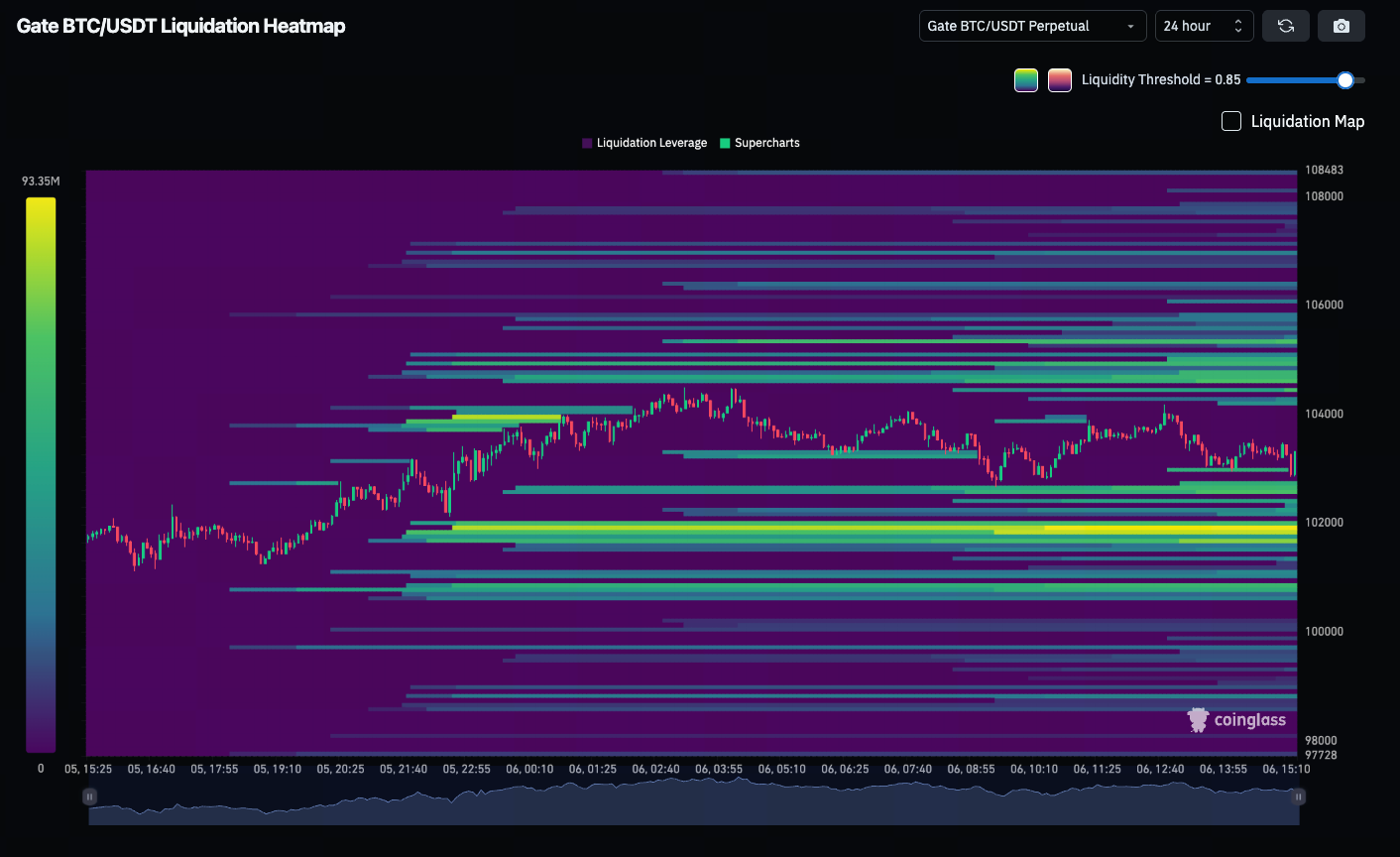
Source: https://www.coinglass.com/pro/futures/LiquidationHeatMap?coin=BTC

Liquidation heat maps, provided by platforms like Coinglass and CoinAnk, display where long and short positions are most vulnerable to forced closure at specific price levels and over varying timeframes. The map uses color gradients—shifting from light to dark or cool to hot (green → yellow → red)—to indicate position density. The hotter the zone, the greater the concentration of at-risk positions, making those price points more likely to be subject to market-driven liquidations.

Why Does It Matter for Traders?

  • Spotting Potential Risk Zones: As prices approach a hot zone, many positions may be liquidated, which can cause sharp market swings. When prices enter these densely packed areas, expect strong liquidation events and intense volatility.
  • Supporting Reversal and Breakout Judgments: The heat map reveals where long positions are weak and where shorts are concentrated, helping traders anticipate short squeezes or long sweeps.
  • Risk Management: Focusing only on fundamentals or technicals without considering leverage exposure is risky. The heat map flags hidden risks, helping you sidestep major losses.

Latest Market Signals: Where Is Liquidation Risk Clustered Now?

In early November 2025, total market liquidations once again exceeded hundreds of millions of dollars. Bitcoin (BTC) and Ethereum (ETH) led the pack with approximately $400 million in forced liquidations. Meanwhile, Dogecoin (DOGE) saw its long liquidation metric surge to 1564.8% during a specific hourly window. Exceptionally bright spots on the heat map—particularly where positions are rapidly stacking up near price—mark danger zones that traders should closely monitor.

How Can Beginners Use Liquidation Heat Maps to Avoid Getting Swept Out?

  • Start with Larger Timeframes: Use 24-hour or 12-hour heat maps rather than 5-minute windows; the data is more stable and less prone to traps—ideal for beginners.
  • Watch for Color Shifts Near Price: If the current price is close to a zone with high liquidation risk, the market may soon sweep into that area, triggering forced liquidations.
  • Integrate Support/Resistance Analysis: The heat map isn’t a standalone predictor; combine it with chart support and resistance. If a liquidation hot spot sits below the current price, a breakdown could accelerate declines—and vice versa.
  • Manage Leverage and Set Stop-Losses: Even the best tool can’t replace sound risk control. The heat map highlights possible liquidation points, but doesn’t guarantee direction. Always set stop-losses.
  • Entering a position where long positions are accumulating may expose traders to sweep zones. Traders should wait for confirmed breakouts before entering positions.

Summary: Key Points

  • Liquidation heat maps visualize position density by price and color, pinpointing where liquidation risk clusters.
  • They’re especially valuable for traders using leverage—crucial for beginners.
  • Recent data show multiple nine-figure liquidations have occurred, and heat map signals are growing stronger.
  • Beginners should combine heat map insights with price structure and solid risk management, not just chase signals.
  • Exercise caution near high-risk zones and consider breakout opportunities.
Author: Max
Disclaimer
* The information is not intended to be and does not constitute financial advice or any other recommendation of any sort offered or endorsed by Gate.
* This article may not be reproduced, transmitted or copied without referencing Gate. Contravention is an infringement of Copyright Act and may be subject to legal action.

Related Articles

What is Fartcoin? All You Need to Know About FARTCOIN
Intermediate

What is Fartcoin? All You Need to Know About FARTCOIN

Fartcoin (FARTCOIN) is a representative meme coin within the Solana ecosystem based on an AI-driven narrative. Its core concept originated from an experiment aimed at exploring the "boundaries between AI Agents and humor." More than just a digital asset with social attributes, the project deeply couples absurd humor culture with on-chain financial logic by integrating autonomous AI interaction models.
2026-04-04 22:01:19
Gold Price Forecast for the Next Five Years: 2026–2030 Trend Outlook and Investment Implications, Could It Reach $6,000?
Beginner

Gold Price Forecast for the Next Five Years: 2026–2030 Trend Outlook and Investment Implications, Could It Reach $6,000?

Analyze current gold price trends alongside authoritative five-year forecasts, integrating an evaluation of market risks and opportunities. This gives investors insight into the potential trajectory of gold prices and the main drivers expected to shape the market over the next five years.
2026-03-25 18:13:30
Aster vs Hyperliquid: Which Perp DEX Will Prevail?
Beginner

Aster vs Hyperliquid: Which Perp DEX Will Prevail?

Aster and Hyperliquid are the two representative protocols of the "purpose-built L1 path" within the current decentralized perpetual exchange (Perp DEX) sector. As a pioneer in the field, Hyperliquid has built a deep liquidity moat through its highly mature order book architecture and strong community consensus. Conversely, Aster, as a rising challenger, seeks to leapfrog the competition in high-performance trading through more aggressive multi-chain aggregation logic, private transaction modules, and an underlying execution environment optimized for 2026 market demands.
2026-03-24 11:58:33
AI-Native Settlement Layers: How United Stables Is Building the Next Financial Rail
Beginner

AI-Native Settlement Layers: How United Stables Is Building the Next Financial Rail

Stablecoins were originally designed as dollar substitutes within exchanges, primarily used for asset pricing and trade settlement. As on-chain financial ecosystems have matured, their role has expanded beyond simple payments to include collateral assets, cross-chain liquidity mediums, and unified settlement units. In particular, as AI systems and automated agents begin to participate directly in economic activity, demand has risen sharply for programmable value units capable of instant settlement. This shift is pushing stablecoins toward the role of foundational financial infrastructure.
2026-03-25 03:16:17
Aerodrome Tokenomics: How ve(3,3) Powers Base's Most Profitable DEX
Beginner

Aerodrome Tokenomics: How ve(3,3) Powers Base's Most Profitable DEX

AERO is the native token of Aerodrome Finance, a core decentralized exchange and liquidity protocol in the Base ecosystem. It is primarily used for liquidity incentives and ecosystem operations. veAERO is a governance NFT that users receive by locking AERO, representing both voting power and the right to share protocol revenue. Through a dual track structure of AERO as a utility token and veAERO as a governance credential, Aerodrome separates liquidity usage value from long term governance power, allowing participants to act as liquidity providers, governance decision makers, and revenue sharers within the same system.
2026-03-25 06:40:31
Hybrid Collateral Stablecoins: Inside United Stables' Stability and Yield Architecture
Beginner

Hybrid Collateral Stablecoins: Inside United Stables' Stability and Yield Architecture

In the early stages of the crypto market, traditional stablecoins mainly relied on single-reserve or single-collateral models. Their primary focus was price stability and payment convenience, which allowed them to become foundational tools for on-chain trading and capital flows. As the market has entered a more mature financial phase, however, this structure has begun to reveal limitations, including high concentration risk and the difficulty of balancing liquidity with yield. These constraints have driven the evolution toward multi-layer collateral and portfolio-based designs, such as the dual-layer hybrid collateral architecture proposed by United Stables, which seeks to redefine the underlying logic of stable assets.
2026-03-25 03:17:39