What Is Arc?

(Source: arc)
Arc is more than just a public blockchain—it’s an open, Layer-1 financial infrastructure purpose-built for the global economy, with the ambition to become an Economic OS for the internet era. Arc brings together programmable money and on-chain financial innovation. It provides a foundational platform for developers, financial institutions, and issuers worldwide to build applications spanning lending, foreign exchange, capital markets, payments, and more.
Core Principles
Arc’s architecture supports large-scale financial operations on blockchain and is anchored by four core principles:
- Stable Fee Model: Uses USDC as gas, delivering predictable, low-volatility, USD-denominated transaction fees.
- Deterministic Finality: Every transaction settles in under one second and is irreversible, ensuring financial-grade trust.
- Opt-in Privacy: Supports optional encryption and permissioned viewing, balancing user confidentiality with regulatory compliance.
- Enterprise-Grade Usability: Integrates Circle’s platform tools and APIs, so developers can easily access stablecoin liquidity and payment services.
Arc is designed not only for DeFi, but serves as an on-ramp for Web2 financial institutions, enterprises, and developers to enter Web3.
Stable Fee Design
On most blockchains, gas fees are tethered to the native token (like ETH on Ethereum), leading to significant cost fluctuations with market volatility. Arc takes a different path—using USDC as both the unit and medium of payment, it keeps transaction costs stable at about 1 cent (≈$0.01) per transaction. This approach ensures:
- Users can accurately predict transaction costs, eliminating the need to budget for token price swings.
- Corporate finance and accounting processes are streamlined, since all costs and payments use dollar-pegged stablecoins.
- Developers don’t need to build extra fee estimation logic—Arc’s smoothing mechanism automatically manages rates.
Fee Smoothing Mechanism
Arc’s fee adjustment is based on Ethereum’s EIP-1559 model, and is enhanced with an Exponentially Weighted Moving Average (EWMA) algorithm. This enables Arc to adjust gas fees gradually based on block utilization. It avoids per-block volatility and ensures long-term fee stability. Looking ahead, Arc will support payments in multiple stablecoins (like EURC, USDT, MXNB). It will also introduce Paymaster functionality so applications can cover user fees—lowering the barrier for adoption.
Financial-Grade Settlement with Deterministic Finality
Arc uses its proprietary Malachite consensus engine—a high-performance implementation of Byzantine Fault Tolerance (BFT)—for sub-second block finalization. On many PoW or PoS chains, transactions must receive multiple confirmations before they’re considered final, and can still face reorgs.
With Arc’s deterministic finality, there is no uncertainty: transactions are either “pending” or “permanently confirmed.” Developers no longer need to account for possible reorgs or retry logic; Arc’s finality ensures smart contracts execute instantly and reliably.
Balancing Commercial Confidentiality and Compliance Transparency
Arc’s privacy architecture uses an opt-in model, letting developers and enterprises protect sensitive information while maintaining audit transparency as needed.
Phase 1: Confidential Transfers
- Transaction amounts can be encrypted and accessed only by authorized parties.
- Sender and receiver addresses remain public, supporting traceability and analytics.
- All transactions maintain the same finality and speed as public transactions.
Phase 2: View Keys
Users will be able to grant auditors or compliance teams selective access to transaction data, providing both privacy protection and regulatory transparency.
System Architecture
Arc’s architecture features a Consensus Layer and an Execution Layer that work together to deliver core capabilities: stable fees, instant finality, and programmable privacy.
Consensus Layer — Malachite BFT
- Employs an enhanced Tendermint BFT protocol to guarantee transaction irreversibility and high fault tolerance.
- Security is managed by authorized validators under a Proof-of-Authority (PoA) model.
- Sub-second block confirmations deliver enterprise-grade reliability and performance.
Execution Layer — Reth (Rust-based Ethereum Execution Layer)
- Fully EVM-compatible, supporting direct use of Solidity, Foundry, Hardhat, and related tools.
- Includes built-in modules—Fee Manager, Privacy Module, and Stablecoin Services—for stablecoin payments, FX conversion, and on-chain financial settlement.
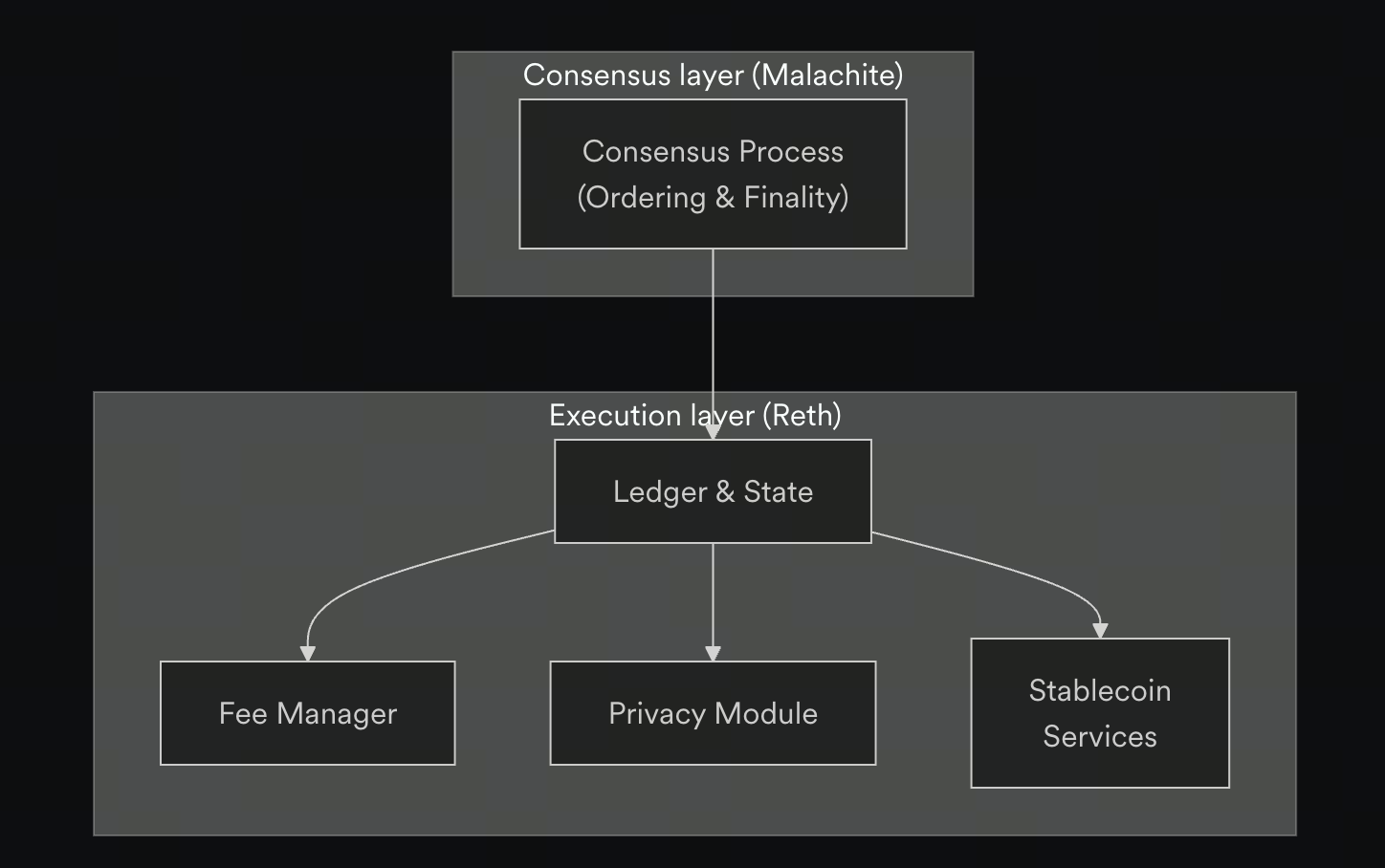
(Source: docs.arc.network)
This design enables Arc to maintain openness while delivering enterprise-level security, low latency, and auditability for financial operations.
EVM Compatibility
Arc offers full EVM compatibility, allowing developers to deploy smart contracts, launch DApps, or integrate APIs using established Ethereum tools and frameworks. Key features include:
- USDC as the native gas token, streamlining cost management and accounting.
- Deterministic finality for transactions—no need for multiple confirmations.
- Real-time block timestamps replace the traditional epoch system.
- The Permissioned Validator model ensures consistent transaction processing and strong security.
Additionally, Arc’s USDC ERC20 interface supports the six-decimal standard, ensuring seamless compatibility with USDC implementations across other blockchains.
Arc’s Vision
Arc’s vision is not limited to building a faster or cheaper blockchain; its goal is to deliver a global Financial OS that bridges real-world finance and on-chain innovation. With a predictable fee structure, sub-second finality, and compliance-ready privacy architecture, Arc empowers enterprises, banks, stablecoin issuers, and developers with a truly operational on-chain financial ecosystem.
If you want to learn more about Web3, you can register here: https://www.gate.com/
Summary
Arc is a comprehensive, open financial base layer that enables stablecoins, privacy, compliance, and performance to work seamlessly within one framework. In tomorrow’s multi-chain financial landscape, Arc will serve not only as the backbone for transactions, but also as the central hub linking global capital markets, payment networks, and the digital asset economy.







