Background of Gate Layer’s Creation
As blockchain technology continues its transition into mainstream adoption, the need for scalable, high-performance, and low-cost Web3 infrastructure has become increasingly urgent. Traditional public blockchains often struggle with high gas fees, low TPS, and complex development processes—challenges that hinder large-scale application deployment and degrade user experience. To address these limitations, Gate introduced Gate Layer, a Layer 2 solution designed to balance performance, security, and ecosystem compatibility. Gate Layer is not merely a technical upgrade; it represents a strategic milestone in Gate’s long-term plan for building a sustainable decentralized ecosystem.
The core objectives of Gate Layer are:
- Make blockchain technology more usable: Lower the barrier to entry so both developers and users can onboard easily.
- Make blockchain more scalable: Use modular architecture to support high-concurrency applications and enable rapid ecosystem growth.
- Make blockchain more affordable: Reduce transaction and deployment costs to stimulate innovation and accelerate adoption.
Technical Architecture and Core Advantages
Gate Layer adopts a modular, multi-layer architecture (based on OP Stack and GateChain):
- Modular design: The execution layer, settlement layer, and data availability (DA) layer operate independently, allowing each component to be optimized for throughput, security, and flexibility.
- High-throughput performance: With an average block time of just 1 second and a TPS capacity of up to 5,700, Gate Layer supports the concurrency requirements of a wide range of DApps.
- Low-cost gas model: Transaction and deployment costs are significantly reduced. Executing 1 million transactions requires only about $30, making on-chain activity accessible for users and developers.
- Cross-chain compatibility: Integrated with LayerZero, Gate Layer enables seamless interoperability across multiple networks, including Ethereum, BSC, and Polygon, facilitating free asset movement across ecosystems.
In addition, Gate Layer provides full EVM compatibility, allowing developers to deploy DApps using familiar tools such as MetaMask, Remix, and Hardhat. This greatly reduces friction for development and migration.
Lowering Costs to Unleash Innovation Momentum
Completing 1 million transactions on Gate Layer costs only around $30, offering a highly attractive environment for Web3 developers. Whether for DeFi protocols, GameFi titles, or RWA (Real-World Asset) tokenization projects, Gate Layer provides a stable, low-friction infrastructure layer that supports rapid iteration and deployment.
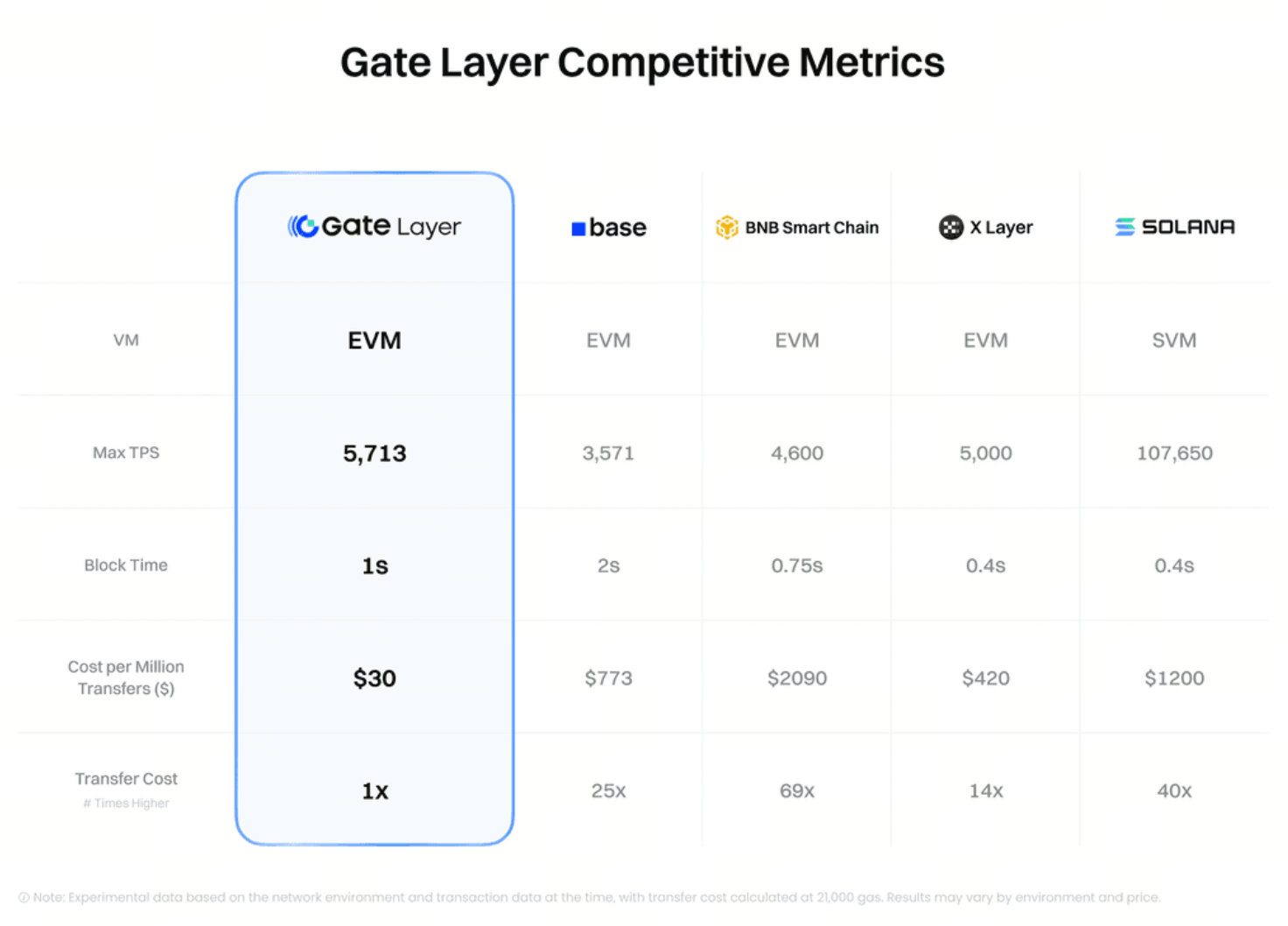
Such low costs, combined with high scalability, not only help projects go live faster but also accelerate the commercialization and mass adoption of Web3 applications.
Significance of Gate Layer for the Ecosystem
Gate Layer is not just an underlying chain upgrade. It is an infrastructure that enhances efficiency, flexibility, and inclusiveness across the entire ecosystem:
- From a developer’s perspective: Enables rapid deployment of DeFi protocols, NFT marketplaces, GameFi projects, and RWA applications while reducing costs and accelerating on-chain execution.
- From a user’s perspective: Provides faster transactions, lower fees, and a Web2-like operational experience, lowering the barrier for new users entering Web3.
- From an ecosystem perspective: Its modular architecture and cross-chain interoperability support seamless collaboration between applications and chains, promoting a more interconnected and thriving ecosystem.
Gate Layer’s Application Ecosystem and GT Token
Gate Layer functions not only as a technical platform but also as an open ecosystem built to incubate innovation:
Through the GT token, Gate Layer not only fulfills essential technical roles but also forms a comprehensive economic incentive system that supports long-term sustainable ecosystem development.
The emergence of Gate Layer represents a new phase in Web3 infrastructure development. With its high performance, low cost, and cross-chain interoperability, Gate Layer provides developers with greater creative flexibility and offers users a smoother, more accessible Web3 experience. As the GT token economic model and application ecosystem continue to mature, Gate Layer is set to evolve from a technical platform into a core engine powering the next wave of decentralized innovation, laying the groundwork for the future of Web3 application deployment.