Litecoin (LTC), one of the earliest mainstream cryptocurrencies, has an economic model similar to Bitcoin’s, using both a fixed supply cap and a periodic halving mechanism. Halving is one of Litecoin’s core designs for maintaining scarcity and is also a major event watched closely by the market. Each halving reduces the amount of newly issued coins miners receive, lowering the new supply entering the market and shaping price expectations for LTC.
In the crypto market, halving is often seen as an important factor affecting an asset’s long term supply and demand relationship. For Litecoin, halving is tied not only to miner revenue and the pace of network issuance, but also to market sentiment and investor behavior.
What Is Litecoin Halving?
Litecoin halving occurs after every 840,000 blocks are produced on the Litecoin network, reducing the block reward received by miners by half. For example, Litecoin’s initial block reward was 50 LTC. After the first halving, it fell to 25 LTC. After the second halving, it dropped to 12.5 LTC, and so on. Since Litecoin produces a block roughly every 2.5 minutes on average, halving takes place about once every four years.
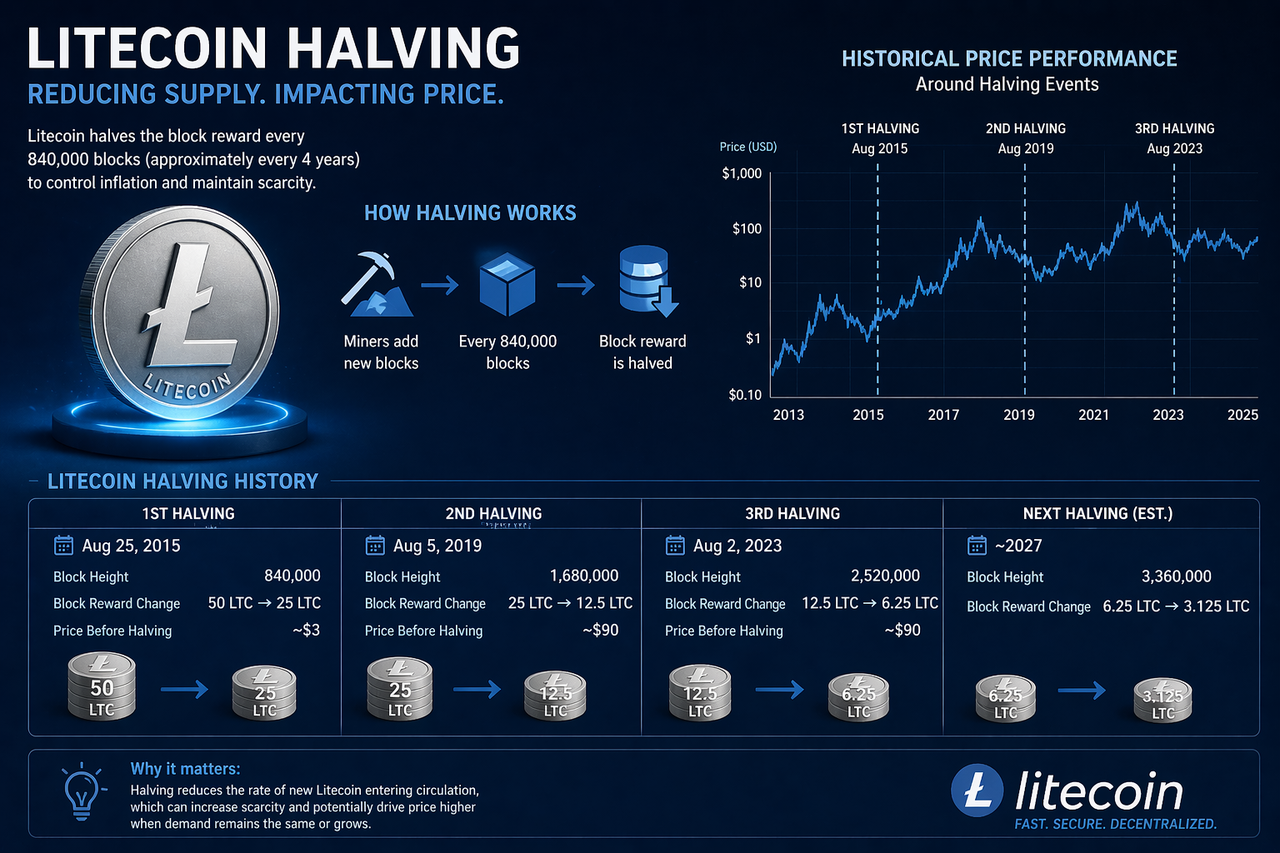
The main purpose of this mechanism is to control the pace of new coin issuance and gradually slow the growth of LTC supply. By reducing new supply over time, Litecoin can maintain a degree of long term scarcity, which is an important part of its economic model.
Why Does Litecoin Have a Halving Mechanism?
The core purpose of Litecoin’s halving mechanism is to control inflation and strengthen asset scarcity. If block rewards remained unchanged forever, the supply of LTC in the market would continue growing rapidly, weakening its ability to function as a store of value. Through regular halvings, Litecoin gradually reduces new supply and allows the circulating amount to move closer to its maximum supply cap of 84 million coins.
Halving also affects market expectations. When investors expect future new supply to decline, they often become more aware of LTC’s scarcity, which can increase market attention. As a result, halving is not only a technical issuance mechanism, but also an important factor influencing market sentiment.
Litecoin has gone through several halvings since its launch, and each one has affected the market’s supply and demand relationship. Although halving usually creates expectations of price increases, actual price performance has varied across different cycles because of changing market conditions.
Summary of Previous LTC Halving Data
| Halving Event |
Halving Date |
Block Reward Change |
Price Before Halving, Approx. |
Price Performance After Halving |
Market Impact |
| First Halving |
August 2015 |
50 LTC → 25 LTC |
~$3 |
Pulled back after a short term rise |
The market began paying attention to LTC scarcity, and halving expectations pushed the price higher |
| Second Halving |
August 2019 |
25 LTC → 12.5 LTC |
~$90 |
Clear correction after halving |
The market had priced in the positive news in advance, leading to a “buy the rumor, sell the news” reaction |
| Third Halving |
August 2023 |
12.5 LTC → 6.25 LTC |
~$90 |
Volatile, then range bound |
As the market became more mature, the impact of halving became more rational |
Historical data shows that Litecoin halvings are usually accompanied by expectations of price increases before the event, but the price does not necessarily continue rising afterward. As the market has matured, the stimulus effect of halving on LTC’s price has weakened, with investors paying more attention to the broader liquidity environment and changes in demand.
How Does Litecoin Halving Affect Price?
Litecoin halving affects price mainly through changes in supply and demand. When the block reward is cut in half, the amount of new LTC miners receive each day decreases, which means new selling pressure in the market may also decline. If market demand remains stable or increases, the reduction in supply may help push prices higher.
However, price is not determined by supply alone. Market sentiment, capital liquidity, and the overall trend of the crypto market also influence price performance after a halving. For this reason, halving can improve the supply and demand structure, but it does not guarantee a price increase. Historically, LTC has often risen before a halving and then corrected afterward, reflecting the tendency for market expectations to be priced in ahead of time.
How Does LTC Halving Affect Miners?
After a halving, the block rewards miners receive are reduced, which directly affects miner revenue. If the LTC price does not rise at the same time, miners’ profit margins will shrink, and some miners with higher operating costs may leave the network, which could affect network hashrate.
Over the long term, however, the halving mechanism helps increase LTC scarcity. If price appreciation can offset the decline in rewards, miner revenue may still be maintained. For miners, halving is both a source of short term pressure and an important point for long term value reassessment.
Will Litecoin’s Price Definitely Rise After Halving?
Halving does not mean the price will definitely rise. Although lower new supply is theoretically positive for price, market performance still depends on whether demand grows at the same time. If demand is weak, the price may fail to rise or may even fall despite the reduction in supply.
In addition, halvings are often anticipated by the market in advance. Investors may buy before the event, which can lead to profit taking after the halving occurs. For this reason, halving is better understood as a long term positive factor rather than a guarantee of short term price gains.
Summary
Litecoin halving is a key mechanism in LTC’s economic model. By regularly reducing block rewards, it slows new supply and strengthens asset scarcity. Historically, halving has usually created expectations of price increases, but actual post halving price performance is still affected by market conditions and changes in demand. For investors, halving is an important reference point for evaluating LTC’s long term supply and demand structure, but it should not be treated simply as a price increase signal. Understanding how halving works can help investors judge LTC’s long term value more rationally.
FAQs
How often does Litecoin halve?
Litecoin halves once every 840,000 blocks, which happens about once every four years on average.
Will Litecoin’s price definitely rise after halving?
Not necessarily. Halving reduces new supply, but price still depends on market demand and overall market conditions.
How many times has Litecoin halved?
So far, Litecoin has completed three halvings, with the most recent one occurring in 2023.
Why is Litecoin halving important?
Halving is important because it slows the rate of new LTC issuance, strengthens scarcity, and may affect the market’s supply and demand relationship.
How does Litecoin halving affect miners?
Halving reduces miners’ block rewards and can compress earnings in the short term, but price increases may help offset the loss.







