How Gate GTETH Turns ETH Staking from a Niche Strategy into a Liquid Asset Allocation Option

Beginner
Quick Reads
Last Updated 2026-03-26 14:33:36
Reading Time: 1m
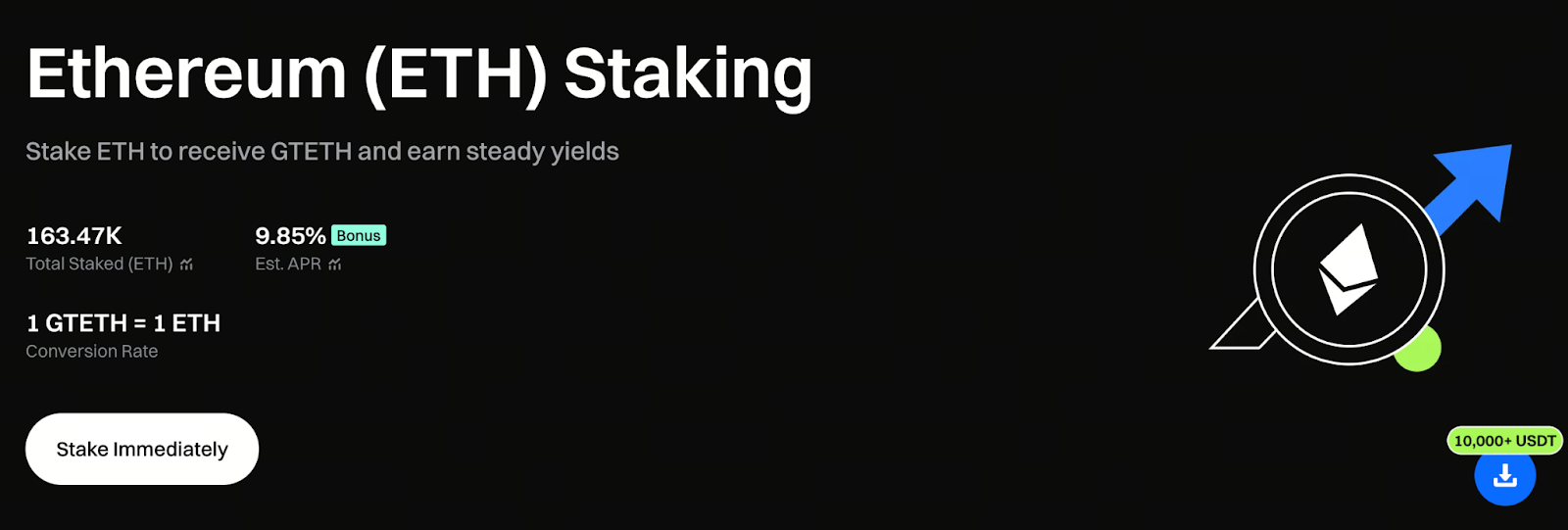
Staking on Ethereum saw limited adoption after the PoS upgrade, mainly because of technical complexities and lock-up constraints. GTETH streamlines this by offering seamless one-click conversion to ETH, with the system handling node operations and reward accumulation automatically. There are no lock-up periods—users can trade or redeem at any time.

Staking Has Become Infrastructure, But Not a Daily Routine
Following Ethereum’s PoS upgrade, staking should have seamlessly integrated into everyday asset management—just like transfers. Yet, the reality is quite the opposite. Most users, even those who understand the value of PoS, remain on the sidelines. The issue isn’t about belief in the system; it’s about the operational burden.

Running a node requires technical expertise, and once assets are staked, users lose flexibility for a significant period. Reward calculations and claiming procedures are far from intuitive. As a result, staking feels like a specialized task rather than a standard part of asset allocation. While PoS now powers the network, staking activity remains concentrated among a select few.

The Role of GTETH

GTETH doesn’t just lower the learning curve—it removes the need to understand PoS mechanics altogether. For users, participation is as simple as converting ETH to GTETH.

From there, the system handles node operations, reward accumulation, and distribution. Users don’t need to worry about technical details or process management. Staking shifts from a task requiring ongoing oversight to a one-time asset allocation decision, making participation far more intuitive for modern investors.

Rewards Are No Longer a One-Way Street

Unlike traditional models that require users to claim rewards periodically, GTETH employs a value-accrual design. Daily ETH staking rewards, along with Gate’s extra incentives, are reflected directly in GTETH’s value.

There’s no need to track payout schedules or decide on reinvestment—just hold GTETH and watch its value grow over time. All reward sources and fund flows remain fully transparent and verifiable on-chain, ensuring clarity while streamlining the user experience.

Liquidity Is No Longer the Price of Staking

Unlike traditional staking, GTETH eliminates the notion that staking equals a lock-up. While holding GTETH, assets remain liquid at all times. Whether you redeem for ETH or trade GTETH on the open market, there are no fixed unlock periods.

This means you don’t have to choose between earning rewards and maintaining flexibility. Staking now fits naturally into dynamic asset allocation, instead of being a position locked away for the long term.

Zero Lock-Up: A Strategic Shift

Removing lock-up restrictions impacts more than convenience—it fundamentally increases strategic flexibility. In volatile markets, you can adjust your positions instantly. When new opportunities arise, you can reallocate capital without delay. In this model, GTETH is more than a passive yield tool; it’s a strategic asset designed for flexible, real-time portfolio management—ideal for users who need to adapt their allocations as markets evolve.

Stable, Transparent Yield Sources

GTETH yields come from two clear sources, making the structure straightforward:

First, staking rewards from Ethereum’s PoS system, with an annualized rate around 2.85%.

Second, extra GT incentives from Gate, with an annualized rate of about 7%, further boosting the overall APR.

When you redeem ETH, both portions of the yield are settled and reflected in your final payout—no extra steps or waiting required.

Start staking ETH with Gate and unlock your on-chain yield mining journey: https://www.gate.com/staking/ETH?ch=ann46659

How VIP Tiers Affect Long-Term Returns

GTETH’s fee structure is tied to your VIP level. The base fee is 6%, but as your VIP tier increases, you receive deeper discounts—effectively raising your net annual yield.

  • VIP 5 – 7: 20% fee discount
  • VIP 8 – 11: 40% fee discount
  • VIP 12 – 14: 60% fee discount

For long-term holders, these differences add up over time, making a real impact on overall returns.

GTETH vs. Mainstream LSTs: A Different Approach

Most liquid staking tokens function mainly as lock-up certificates. GTETH, on the other hand, serves as a true asset management tool. It’s not just a representation of a staked position—it allows real-time entry and exit, daily value updates, and balances yield with liquidity. Staking isn’t just a single-purpose yield product anymore; it becomes a natural part of your overall portfolio and strategy management.

Conclusion

GTETH doesn’t just make staking easier—it redefines the role of ETH staking within asset allocation. It removes the capital and psychological burden of long-term lock-ups while preserving PoS yield potential and building trust through on-chain transparency. With PoS at the core of Ethereum’s operation, staking no longer needs to be a rigid, long-term commitment. Instead, it becomes a flexible tool for dynamic portfolio and strategy management. For users seeking both liquidity and stable returns, GTETH offers a path that aligns with modern Web3 asset management practices.

Author: Allen
Disclaimer
* The information is not intended to be and does not constitute financial advice or any other recommendation of any sort offered or endorsed by Gate.
* This article may not be reproduced, transmitted or copied without referencing Gate. Contravention is an infringement of Copyright Act and may be subject to legal action.

Related Articles

AI-Native Settlement Layers: How United Stables Is Building the Next Financial Rail
Beginner

AI-Native Settlement Layers: How United Stables Is Building the Next Financial Rail

Stablecoins were originally designed as dollar substitutes within exchanges, primarily used for asset pricing and trade settlement. As on-chain financial ecosystems have matured, their role has expanded beyond simple payments to include collateral assets, cross-chain liquidity mediums, and unified settlement units. In particular, as AI systems and automated agents begin to participate directly in economic activity, demand has risen sharply for programmable value units capable of instant settlement. This shift is pushing stablecoins toward the role of foundational financial infrastructure.
2026-03-25 03:16:17
DePIN Identity Network and Real World Applications: How Humanity Protocol Brings on-chain Identity Into the Physical World
Beginner

DePIN Identity Network and Real World Applications: How Humanity Protocol Brings on-chain Identity Into the Physical World

Most Web3 identity systems remain confined to on-chain environments and struggle to achieve meaningful adoption in real world settings. Through a DePIN architecture and physical verification hardware, Humanity Protocol aims to bring decentralized identity into access control systems, hospitality, public services, and offline events, allowing on-chain identity to function not just as a digital credential, but as foundational infrastructure for real world access.
2026-03-25 07:40:53
Gold Price Forecast for the Next Five Years: 2026–2030 Trend Outlook and Investment Implications, Could It Reach $6,000?
Beginner

Gold Price Forecast for the Next Five Years: 2026–2030 Trend Outlook and Investment Implications, Could It Reach $6,000?

Analyze current gold price trends alongside authoritative five-year forecasts, integrating an evaluation of market risks and opportunities. This gives investors insight into the potential trajectory of gold prices and the main drivers expected to shape the market over the next five years.
2026-03-25 18:13:30
Aster vs Hyperliquid: Which Perp DEX Will Prevail?
Beginner

Aster vs Hyperliquid: Which Perp DEX Will Prevail?

Aster and Hyperliquid are the two representative protocols of the "purpose-built L1 path" within the current decentralized perpetual exchange (Perp DEX) sector. As a pioneer in the field, Hyperliquid has built a deep liquidity moat through its highly mature order book architecture and strong community consensus. Conversely, Aster, as a rising challenger, seeks to leapfrog the competition in high-performance trading through more aggressive multi-chain aggregation logic, private transaction modules, and an underlying execution environment optimized for 2026 market demands.
2026-03-24 11:58:33
Aerodrome Tokenomics: How ve(3,3) Powers Base's Most Profitable DEX
Beginner

Aerodrome Tokenomics: How ve(3,3) Powers Base's Most Profitable DEX

AERO is the native token of Aerodrome Finance, a core decentralized exchange and liquidity protocol in the Base ecosystem. It is primarily used for liquidity incentives and ecosystem operations. veAERO is a governance NFT that users receive by locking AERO, representing both voting power and the right to share protocol revenue. Through a dual track structure of AERO as a utility token and veAERO as a governance credential, Aerodrome separates liquidity usage value from long term governance power, allowing participants to act as liquidity providers, governance decision makers, and revenue sharers within the same system.
2026-03-25 06:40:31
The ve(3,3) Flywheel Explained: How AERO Tokenomics Powers Aerodrome’s DeFi Economy
Beginner

The ve(3,3) Flywheel Explained: How AERO Tokenomics Powers Aerodrome’s DeFi Economy

In the competition for DeFi liquidity, high-inflation mining alone is no longer enough to build lasting advantages. Aerodrome applies the ve(3,3) economic model to redesign token emissions, voting mechanisms, and revenue distribution, creating a liquidity flywheel centered on governance and cash flow. This article examines AERO tokenomics, the veAERO locking mechanism, and protocol revenue models to explain how Aerodrome builds a sustainable DeFi economic system.
2026-03-25 06:41:58





