From a market perspective, DAO projects have entered the phase where governance quality is the key competitive factor. Merely promoting decentralization is no longer sufficient to sustain long-term value; platforms that can translate governance outcomes into tangible business results are best positioned to remain resilient through market cycles. Recently, RAVE has seen concurrent increases in trading activity, interest in derivatives, and community discussion, making governance effectiveness a critical lens for external observers evaluating project quality.
Viewed through the lens of blockchain and digital asset industry evolution, RaveDAO offers value beyond the entertainment sector itself—it serves as a “scenario-driven governance model”: offline channels drive user reach, on-chain mechanisms map responsibilities, and the token system coordinates incentives. The following analysis covers five dimensions: governance structure, participation pathways, strengths and challenges, innovation stimulation, and future directions.
RaveDAO Governance Structure and Decision Mechanism
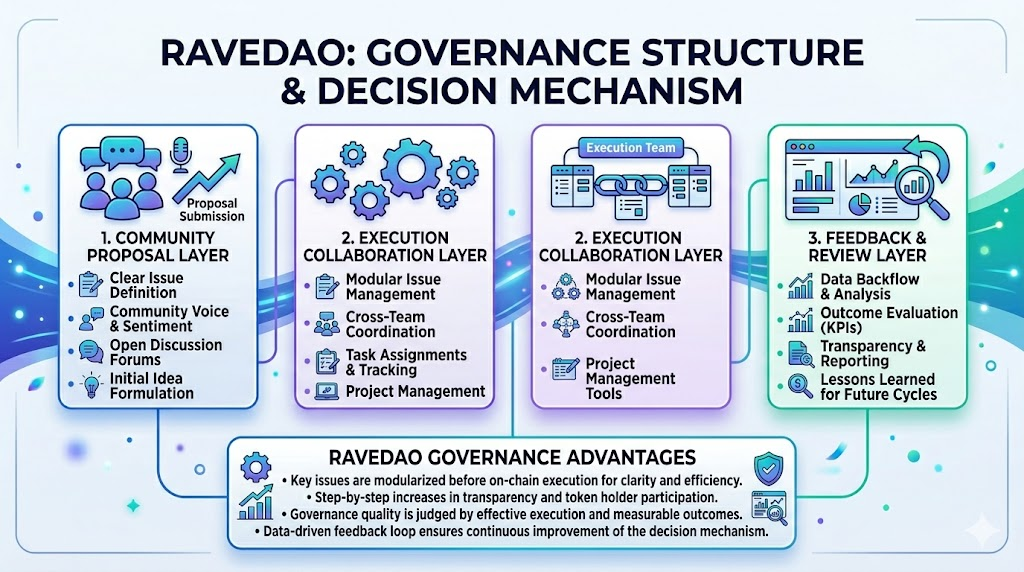
RaveDAO’s governance structure follows a three-tier model: community proposal layer, execution collaboration layer, and feedback review layer.
The core logic is not to put every decision on-chain immediately, but to first modularize key topics and then progressively enhance transparency and participation.
Typical governance topics include:
- Direction of activities and collaboration with city nodes
- Allocation of community resources and incentive priorities
- Partner onboarding and brand synergy strategies
- Optimization of community rules and long-term ecosystem roadmap
A robust decision-making mechanism generally requires four conditions:
- Clearly defined topics: proposals with clear boundaries and measurable goals
- Inclusive process: channels for holders and contributors to express views
- Actionable outcomes: voting results that translate into concrete actions
- Reviewable execution: feedback with data and conclusions post-implementation
For “activity-driven DAOs” like RaveDAO, governance quality is often measured by execution.
If proposal approval rates are high but implementation rates are low, governance quickly becomes superficial; if proposal volume is moderate and the execution loop is complete, trust in governance gradually strengthens.
The RAVE token plays a central role in governance by establishing credentials for participation and mapping incentives.
In essence, RAVE is not just a trading asset—it’s the gateway to governance, a record of contributions, and a tool for coordination.
Community members typically engage in governance through the following steps:
- Hold and manage RAVE assets to join the governance identity system
- Submit proposals or participate in discussions via governance channels
- Vote on proposals to signal community preferences
- Monitor execution results and participate in subsequent rounds of feedback
In practice, the quality of participation matters more than quantity. Key metrics include:
- The percentage of effective proposals, not just the total number submitted
- The ratio of repeat participant addresses, indicating core community stability
- Execution cycle post-voting, reflecting governance efficiency
- Satisfaction feedback after execution, demonstrating governance credibility
With recent market developments, RAVE’s liquidity and price volatility have surged, attracting new capital and users.
This presents a governance challenge: new holders focus on short-term market trends, while original contributors prioritize long-term development. Balancing “short-term traffic preferences” against “long-term governance objectives” remains a critical issue for RaveDAO.
Strengths and Challenges of Decentralized Governance
Decentralized governance offers clear advantages, but it also faces distinct challenges.
For RaveDAO, these opposing forces coexist and constantly interact.
- Enhanced user sense of ownership: participants have real influence on platform development, increasing retention
- Faster local responsiveness: different cities and groups can propose unique needs, supporting flexible expansion
- Improved brand collaboration: transparency in governance fosters trust with external partners
- Sustainable ecosystem narrative: shifting from “platform storytelling” to “community-led value creation”
Challenges: Why Governance Can Falter
- Participation barriers: new users unfamiliar with governance processes may be less inclined to engage
- Information asymmetry: complex issues require expertise, making it difficult for average users to judge
- Short-termism: market volatility can lead to trading goals overriding governance priorities
- Execution friction: approval does not guarantee successful implementation, and cross-team collaboration can be costly
For external analysts, assessing governance health requires a minimal checklist:
- Are proposals addressing real issues?
- Does voting reflect broad participation?
- Is execution proceeding as scheduled?
- Are outcomes delivering verifiable improvements?
If two out of four criteria are consistently missing, governance risks devolving into a mere communication tool rather than a decision-making infrastructure.
How to Foster Community Innovation and Participation?
The ceiling for community governance is set by the design of innovation mechanisms.
Without ongoing incentives, governance shifts from “co-creation” to “spectatorship”; if incentives are misaligned, it shifts from “collaboration” to “competition.”
Platforms like RaveDAO must build three systems to boost innovation density:
- Topic incubation: converting scattered ideas into structured proposals
- Contribution incentives: rewarding based on outcomes, not noise
- Execution support: providing resources for proposal initiators to ensure implementation
Practical steps can follow an orderly path:
- Establish themed governance tracks, such as activity innovation, community growth, and partnership expansion
- Use phased review mechanisms, starting with pilot projects and then scaling resources
- Create a public repository for high-completion proposals to enable knowledge reuse
- Bind contributions to equity, strengthening long-term participation
Innovation incentives should go beyond token rewards.
The most effective mix usually includes token rewards, reputation, project attribution, resource priority, and collaboration exposure.
When economic incentives, reputation, and development opportunities work together, community innovation becomes more sustainable.
Future Directions for RaveDAO Governance Structure
Based on current market trends and public information, RaveDAO’s governance structure is likely to evolve toward greater modularity, data-driven processes, and cross-scenario integration.
From Single-Layer to Multi-Layer Governance
As the community grows, a unified governance pool can become inefficient.
Layered governance by topic offers a more practical solution:
- Strategic layer: long-term roadmap and major resource decisions
- Operational layer: activity rhythm and partnership execution
- Community layer: local chapters and content collaboration proposals
This structure reduces governance noise and improves execution alignment.
From Experience-Based to Data-Driven Decision Making
Governance disputes often arise from incomplete information.
Transparent data dashboards can focus community discussions. Key metrics include:
- Proposal approval and execution completion rates
- Activity participation conversion and community retention trends
- Incentive spending versus outcome ratios
- Address structure and concentration of governance participants
The more comprehensive the data visualization, the greater the credibility of governance.
RaveDAO’s business naturally spans cities, brands, and platforms.
To support this growth, governance may need to adopt a collaborative structure—core community, partner interfaces, and local chapter nodes.
This approach maintains brand consistency while allowing for local innovation.
From Short-Term Consensus to Long-Term Institutionalization
RAVE’s recent market surge has brought in more new followers, increasing short-term governance noise.
Long-term stability depends on institutional development, such as:
- Clear standards for proposal admission and prioritization
- Formal disclosure schedules and review templates for key decisions
- Robust arbitration processes for contentious topics
- Community education systems to lower participation barriers
When institutional processes take precedence over sentiment, governance can withstand cyclical volatility.
Summary
RaveDAO’s decentralized governance is fundamentally about transforming high-liquidity market participants into high-quality community decision-makers.
The RAVE token enables participation, but governance outcomes depend on mechanism design, execution capability, and data transparency.
At present, RaveDAO has established the foundation for community-driven decision-making, including clear scenario entry points, an active token ecosystem, and a growing community network. However, short-term volatility, information asymmetry, and execution friction remain structural challenges.
A more definitive assessment framework can be summarized in three points:
- Does governance consistently generate actionable proposals?
- Does execution reliably deliver verifiable improvements?
- Does the community sustain a culture of long-term participation?







