Polymarket: The New Gateway to Decentralized Prediction Markets

Beginner
Quick Reads
Last Updated 2026-03-27 15:48:04
Reading Time: 1m
Polymarket is a decentralized prediction market platform on Polygon that enables rapid, gas-free transactions. The automated market maker (AMM) maintains liquidity, and smart contracts handle settlements. Users do not need to complete KYC. Non-custodial infrastructure ensures the safety of assets.

What Is Polymarket?


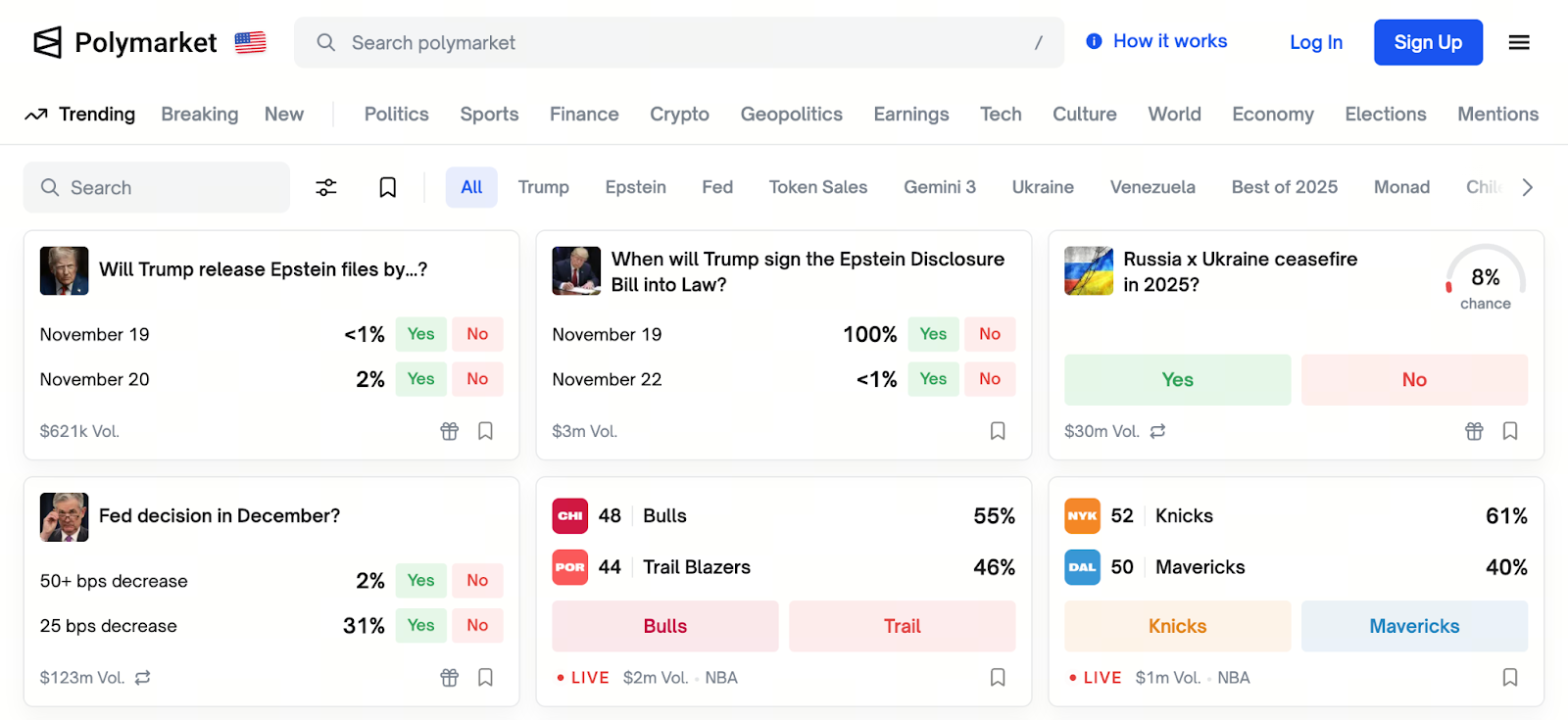
(Source: Polymarket)

Within the Web3 ecosystem, Polymarket offers a marketplace where event probabilities are transparently reflected in market prices. Unlike centralized betting sites or traditional gambling platforms, Polymarket is a prediction market built on blockchain technology. Anyone can buy or sell shares representing potential event outcomes using stablecoins such as USDC. Trading activity determines market prices, reflecting collective sentiment about future events.

Polymarket enables users to gauge the likelihood of outcomes for political elections, sporting events, technology breakthroughs, and global issues. All of this is reflected through its market prices. Leading media outlets, including The Wall Street Journal and Bloomberg, reference insights generated by this market mechanism.

Core Principles of Polymarket

Rather than stocks, Polymarket trades in shares that represent the probability of a specific event occurring. When an event appears more likely, the share price increases; if it seems less likely, the price decreases accordingly.

Examples include:

  • Will a particular candidate win an election?
  • Will a certain AI product launch by a specified date?
  • Will a project achieve a defined milestone?

Market prices reflect the collective judgment of participants.

Key Features of the Polymarket Platform

  1. Blockchain-Based Trust
    Every trade, settlement, and market rule is executed automatically by smart contracts—eliminating centralized intermediaries and removing the need for user trust in any operator.
  2. Stablecoin Trading Mitigates Volatility
    Polymarket uses USDC for all transactions, insulating market pricing from crypto price fluctuations.
  3. AMMs (Automated Market Makers) Ensure Liquidity
    Unlike traditional platforms that depend on counterparties, Polymarket relies on AMMs for automated, instant market operations.
  4. Straightforward Settlement
    Users can redeem each winning share for $1, so they know their potential returns.

Technical Foundation of Polymarket

Polymarket runs on the Polygon Layer 2 network, enabling high-volume transactions to be processed swiftly and at minimal cost, free from the high gas fees associated with Ethereum mainnet.

Smart contracts are responsible for:

  • Recording every transaction
  • Guaranteeing the immutability of market data
  • Automating settlement
  • Securing user funds

Users simply connect with a non-custodial wallet such as MetaMask to participate. No KYC is required, which fully embraces the decentralized ethos of Web3.

Polymarket Security

Polymarket’s security architecture includes:

  • Non-custodial structure: Users retain full control over their private keys; the platform cannot access user funds.
  • Cryptographic data protection: All transaction records are stored on-chain and cannot be altered.
  • Open-source smart contracts: All logic is transparent and verifiable, eliminating black box risk.

These design choices establish Polymarket as a trusted leader in decentralized prediction markets.

Polymarket Revenue Model

The platform operates on a straightforward business model:

  • Each share trade incurs a small USDC transaction fee
  • Fees are distributed to liquidity providers to keep markets active at all times
  • Higher trading volumes increase platform revenue

This approach avoids excessive fees and promotes active market engagement.

Why Is Polymarket So Essential in Web3?

Polymarket is pivotal in the Web3 landscape because it transforms crowd wisdom into tradable signals. It delivers real-time market insights that surpass the timeliness of polls or news reports. Leveraging decentralized technology, Polymarket ensures transparency and scalability across a diverse array of real-world events. The platform attracts users, media, and analysts as a data source, serving as an effective probability indicator. Polymarket provides a unique perspective and analytical tool for the Web3 community, empowering better understanding and forecasting of future events.

To learn more about Web3, register at: https://www.gate.com/

Conclusion

Traditionally, event forecasting has relied on experts, media, or historical data. In the Web3 era, Polymarket leverages market dynamics and blockchain technology to deliver transparent, real-time, and reliable signals about future outcomes. Polymarket not only creates opportunities for speculation, but also introduces a new paradigm for understanding the world. It transforms collective intelligence into actionable data and prices, serving as a vital tool for anticipating the future. As Web3 redefines finance, Polymarket is revolutionizing how future events are predicted.

Disclaimer
* The information is not intended to be and does not constitute financial advice or any other recommendation of any sort offered or endorsed by Gate.
* This article may not be reproduced, transmitted or copied without referencing Gate. Contravention is an infringement of Copyright Act and may be subject to legal action.

Related Articles

AI-Native Settlement Layers: How United Stables Is Building the Next Financial Rail
Beginner

AI-Native Settlement Layers: How United Stables Is Building the Next Financial Rail

Stablecoins were originally designed as dollar substitutes within exchanges, primarily used for asset pricing and trade settlement. As on-chain financial ecosystems have matured, their role has expanded beyond simple payments to include collateral assets, cross-chain liquidity mediums, and unified settlement units. In particular, as AI systems and automated agents begin to participate directly in economic activity, demand has risen sharply for programmable value units capable of instant settlement. This shift is pushing stablecoins toward the role of foundational financial infrastructure.
2026-03-25 03:16:17
DePIN Identity Network and Real World Applications: How Humanity Protocol Brings on-chain Identity Into the Physical World
Beginner

DePIN Identity Network and Real World Applications: How Humanity Protocol Brings on-chain Identity Into the Physical World

Most Web3 identity systems remain confined to on-chain environments and struggle to achieve meaningful adoption in real world settings. Through a DePIN architecture and physical verification hardware, Humanity Protocol aims to bring decentralized identity into access control systems, hospitality, public services, and offline events, allowing on-chain identity to function not just as a digital credential, but as foundational infrastructure for real world access.
2026-03-25 07:40:53
Gold Price Forecast for the Next Five Years: 2026–2030 Trend Outlook and Investment Implications, Could It Reach $6,000?
Beginner

Gold Price Forecast for the Next Five Years: 2026–2030 Trend Outlook and Investment Implications, Could It Reach $6,000?

Analyze current gold price trends alongside authoritative five-year forecasts, integrating an evaluation of market risks and opportunities. This gives investors insight into the potential trajectory of gold prices and the main drivers expected to shape the market over the next five years.
2026-03-25 18:13:30
Aster vs Hyperliquid: Which Perp DEX Will Prevail?
Beginner

Aster vs Hyperliquid: Which Perp DEX Will Prevail?

Aster and Hyperliquid are the two representative protocols of the "purpose-built L1 path" within the current decentralized perpetual exchange (Perp DEX) sector. As a pioneer in the field, Hyperliquid has built a deep liquidity moat through its highly mature order book architecture and strong community consensus. Conversely, Aster, as a rising challenger, seeks to leapfrog the competition in high-performance trading through more aggressive multi-chain aggregation logic, private transaction modules, and an underlying execution environment optimized for 2026 market demands.
2026-03-24 11:58:33
Aerodrome Tokenomics: How ve(3,3) Powers Base's Most Profitable DEX
Beginner

Aerodrome Tokenomics: How ve(3,3) Powers Base's Most Profitable DEX

AERO is the native token of Aerodrome Finance, a core decentralized exchange and liquidity protocol in the Base ecosystem. It is primarily used for liquidity incentives and ecosystem operations. veAERO is a governance NFT that users receive by locking AERO, representing both voting power and the right to share protocol revenue. Through a dual track structure of AERO as a utility token and veAERO as a governance credential, Aerodrome separates liquidity usage value from long term governance power, allowing participants to act as liquidity providers, governance decision makers, and revenue sharers within the same system.
2026-03-25 06:40:31
The ve(3,3) Flywheel Explained: How AERO Tokenomics Powers Aerodrome’s DeFi Economy
Beginner

The ve(3,3) Flywheel Explained: How AERO Tokenomics Powers Aerodrome’s DeFi Economy

In the competition for DeFi liquidity, high-inflation mining alone is no longer enough to build lasting advantages. Aerodrome applies the ve(3,3) economic model to redesign token emissions, voting mechanisms, and revenue distribution, creating a liquidity flywheel centered on governance and cash flow. This article examines AERO tokenomics, the veAERO locking mechanism, and protocol revenue models to explain how Aerodrome builds a sustainable DeFi economic system.
2026-03-25 06:41:58





