GUSD: Turning Stablecoins into Interest-Bearing On-Chain Notes

Beginner
Quick Reads
Last Updated 2026-03-28 05:41:36
Reading Time: 1m
GUSD is an innovative yield-bearing stablecoin that aims to overcome the limitations of traditional stablecoins, evolving them from mere value storage instruments into digital assets that proactively generate returns.

Transitioning from Value Preservation to Yield Generation
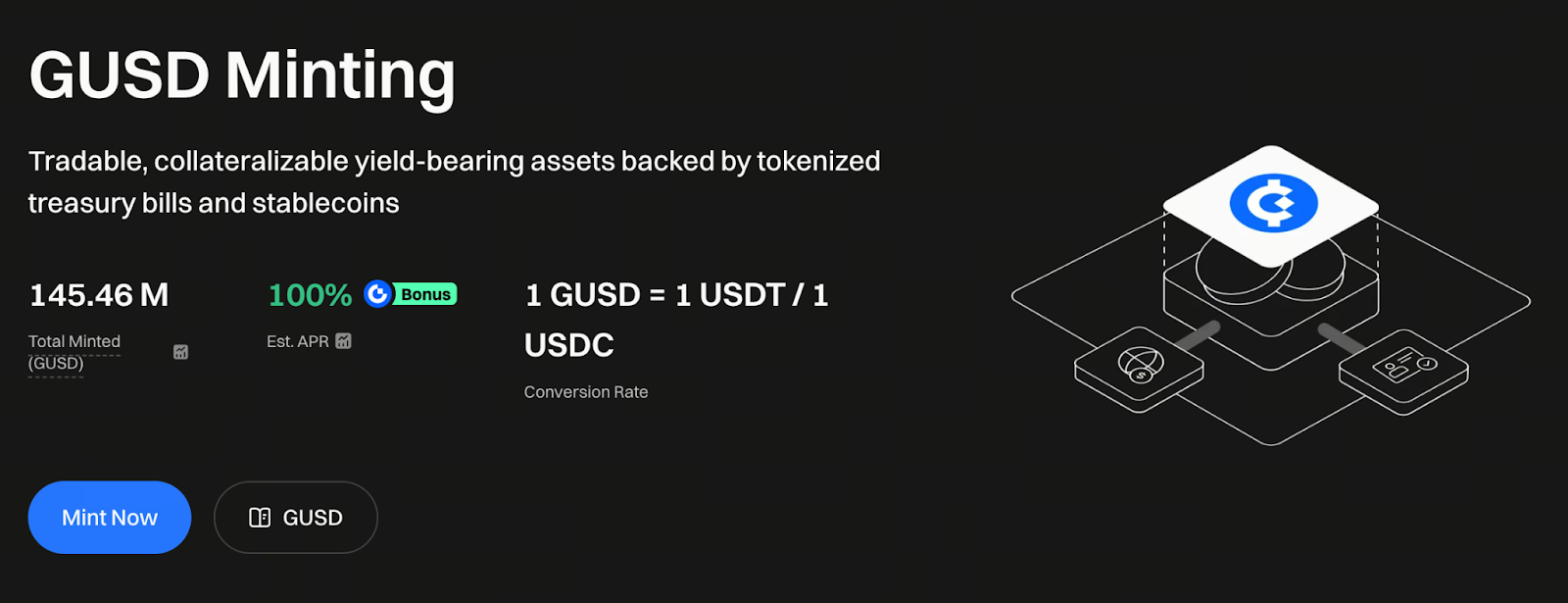
Stablecoins have traditionally been viewed as on-chain representations of the US dollar, serving purposes such as trading, risk hedging, or short-term value storage. GUSD is designed to move beyond this conventional role. While maintaining its dollar peg, GUSD transforms the holding experience into a cash flow-generating process, turning idle stablecoins into digital notes that accrue yield.

Real World Assets (RWA) as Yield Drivers

GUSD’s stability and yield are not solely supported by cash deposits. Instead, they are backed by traditional financial assets with cash flow, such as short-term US Treasury bonds. These assets generate interest income, forming the basis for the token’s value appreciation. GUSD effectively brings the yield mechanism of conventional bonds onto the blockchain, enabling the token to offer both price stability and yield.

Flexible Entry Options

Users have two primary options for acquiring GUSD, allowing them to choose according to their needs:

  • Direct purchase via trading platforms: Quickly acquire GUSD by exchanging USDT or other stablecoins on exchanges.
  • On-chain minting (1:1): If you hold USDT or USDC, you can mint GUSD on-chain at a 1:1 ratio, ideal for long-term holders seeking to accumulate yield.

Both approaches provide users with flexibility to manage liquidity and investment duration.

Mint GUSD now to earn daily annualized yield: https://www.gate.com/staking/GUSD?gt_disable_intercept_jump=1

Yield Model

GUSD does not distribute returns as daily micro-payments. Instead, it accrues interest cumulatively and settles at maturity. For example, if you mint 100 USDT and the underlying assets generate a 20% return during the holding period, you may redeem close to 120 USDC at maturity. This model mirrors the cumulative yield of holding a bond, rather than instant dividends, allowing GUSD’s value to grow over time.

Ecosystem Incentives and Expanded Applications

To broaden use cases and drive ecosystem engagement, GUSD is often paired with various incentives and integration strategies, including:

  • Staking rewards: Hold GUSD and participate in staking to earn additional yield;
  • Limited-time promotions or airdrops: Encourage early adoption and boost user retention;
  • Scenario integration: Gradually connect GUSD to lending, Launchpool, wealth management, and other Web3 applications to enhance utility.

These features enable GUSD to serve diverse functions across trading, wealth management, and liquidity provision.

Key Advantages of GUSD

  1. Time equals value: The longer you hold GUSD, the greater your potential yield, making it ideal for long-term allocation.
  2. Multiple entry and exit channels: Supports USDT, USDC, and other major stablecoins for minting, enabling seamless capital conversion.
  3. Versatility: GUSD can be used for trading margin, wealth management, or staking, maximizing asset utility.

Furthermore, maintaining transparent reserves and regular compliance audits helps build market trust.

Liquidity and Redemption Convenience

GUSD is engineered for high liquidity and low-friction redemption. Users can quickly redeem GUSD for USDC or USDT and trade across multiple channels. However, users should be aware of differences in fees and settlement times across platforms, especially since cross-chain transactions may introduce extra costs or delays.

Risk Disclosure

This material does not constitute an offer, solicitation, or investment advice. Please carefully evaluate risks and seek professional guidance before investing. Gate may restrict or prohibit service access from certain regions; refer to the user agreement for details.

User Agreement: https://www.gate.com/legal/user-agreement

Conclusion

GUSD aims to evolve stablecoins from simple value storage to dynamic value generation. By combining RWA backing with bond-like yield mechanisms, it offers on-chain capital a solution that bridges cash reserves and yield-generating products. As application scenarios expand and regulatory transparency improves, yield-generating stablecoins like GUSD are poised to become increasingly attractive within the on-chain wealth management and payment ecosystem.

Author: Allen
Disclaimer
* The information is not intended to be and does not constitute financial advice or any other recommendation of any sort offered or endorsed by Gate.
* This article may not be reproduced, transmitted or copied without referencing Gate. Contravention is an infringement of Copyright Act and may be subject to legal action.

Related Articles

Gold Price Forecast for the Next Five Years: 2026–2030 Trend Outlook and Investment Implications, Could It Reach $6,000?
Beginner

Gold Price Forecast for the Next Five Years: 2026–2030 Trend Outlook and Investment Implications, Could It Reach $6,000?

Analyze current gold price trends alongside authoritative five-year forecasts, integrating an evaluation of market risks and opportunities. This gives investors insight into the potential trajectory of gold prices and the main drivers expected to shape the market over the next five years.
2026-03-25 18:13:30
AI-Native Settlement Layers: How United Stables Is Building the Next Financial Rail
Beginner

AI-Native Settlement Layers: How United Stables Is Building the Next Financial Rail

Stablecoins were originally designed as dollar substitutes within exchanges, primarily used for asset pricing and trade settlement. As on-chain financial ecosystems have matured, their role has expanded beyond simple payments to include collateral assets, cross-chain liquidity mediums, and unified settlement units. In particular, as AI systems and automated agents begin to participate directly in economic activity, demand has risen sharply for programmable value units capable of instant settlement. This shift is pushing stablecoins toward the role of foundational financial infrastructure.
2026-03-25 03:16:17
Aster vs Hyperliquid: Which Perp DEX Will Prevail?
Beginner

Aster vs Hyperliquid: Which Perp DEX Will Prevail?

Aster and Hyperliquid are the two representative protocols of the "purpose-built L1 path" within the current decentralized perpetual exchange (Perp DEX) sector. As a pioneer in the field, Hyperliquid has built a deep liquidity moat through its highly mature order book architecture and strong community consensus. Conversely, Aster, as a rising challenger, seeks to leapfrog the competition in high-performance trading through more aggressive multi-chain aggregation logic, private transaction modules, and an underlying execution environment optimized for 2026 market demands.
2026-03-24 11:58:33
DePIN Identity Network and Real World Applications: How Humanity Protocol Brings on-chain Identity Into the Physical World
Beginner

DePIN Identity Network and Real World Applications: How Humanity Protocol Brings on-chain Identity Into the Physical World

Most Web3 identity systems remain confined to on-chain environments and struggle to achieve meaningful adoption in real world settings. Through a DePIN architecture and physical verification hardware, Humanity Protocol aims to bring decentralized identity into access control systems, hospitality, public services, and offline events, allowing on-chain identity to function not just as a digital credential, but as foundational infrastructure for real world access.
2026-03-25 07:40:53
Aerodrome Tokenomics: How ve(3,3) Powers Base's Most Profitable DEX
Beginner

Aerodrome Tokenomics: How ve(3,3) Powers Base's Most Profitable DEX

AERO is the native token of Aerodrome Finance, a core decentralized exchange and liquidity protocol in the Base ecosystem. It is primarily used for liquidity incentives and ecosystem operations. veAERO is a governance NFT that users receive by locking AERO, representing both voting power and the right to share protocol revenue. Through a dual track structure of AERO as a utility token and veAERO as a governance credential, Aerodrome separates liquidity usage value from long term governance power, allowing participants to act as liquidity providers, governance decision makers, and revenue sharers within the same system.
2026-03-25 06:40:31
How Does Kite Work? An In-Depth Look at Kite's Identity and Programmable Permission Architecture
Beginner

How Does Kite Work? An In-Depth Look at Kite's Identity and Programmable Permission Architecture

Kite is an EVM compatible Layer 1 blockchain network that runs on proof of stake. It is designed to give AI agents verifiable identity, programmable permissions, and real time settlement in an on-chain execution environment. In Kite's design, AI is no longer only a tool that follows instructions. It becomes an economic participant with independent on-chain identity and direct control over assets. Within secure and auditable infrastructure, an AI agent can complete payments, call services, and coordinate tasks autonomously, making Kite a foundational layer for the emerging agent economy.
2026-03-25 06:02:34