


SAKE vs SOL: The Battle of Blockchain-Based Liquidity Protocols
Introduction: SAKE vs SOL Investment Comparison
In the cryptocurrency market, SAKE vs SOL comparison has always been a topic that investors can't ignore. The two not only differ significantly in market cap ranking, application scenarios, and price performance, but also represent different positioning in the crypto asset space.
SakeToken (SAKE): Launched in 2020, it has gained market recognition for its improved AMM mechanism design.
Solana (SOL): Since its introduction in 2020, it has been hailed as a high-performance blockchain protocol, becoming one of the cryptocurrencies with the highest global trading volume and market capitalization.
This article will comprehensively analyze the investment value comparison between SAKE and SOL, focusing on historical price trends, supply mechanisms, institutional adoption, technological ecosystems, and future predictions, attempting to answer the question investors care about most:
"Which is the better buy right now?"
I. Price History Comparison and Current Market Status
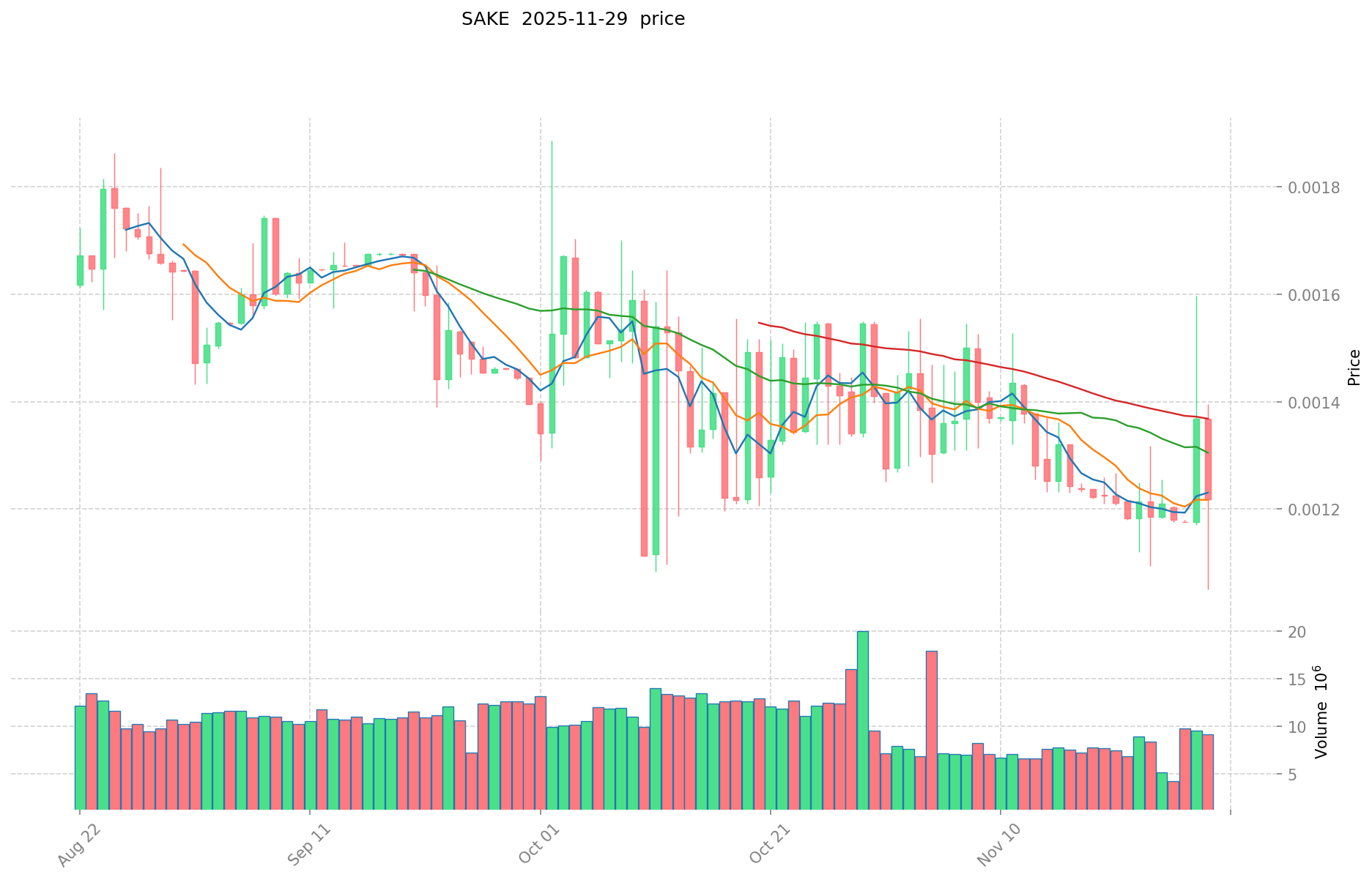
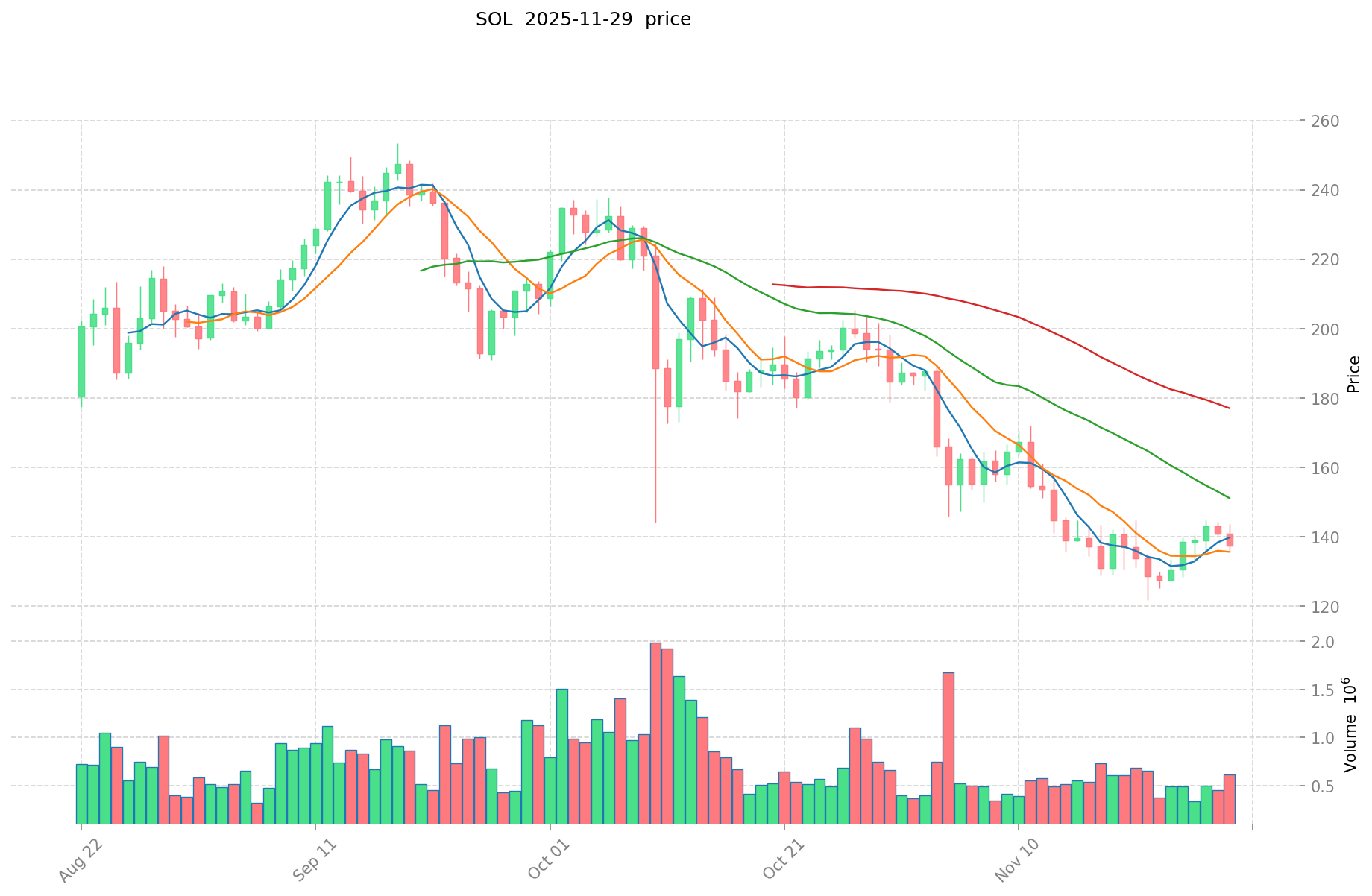
SAKE (Coin A) and SOL (Coin B) Historical Price Trends
- 2020: SAKE reached its all-time high of $3.18 on September 13, 2020, shortly after its launch.
- 2025: SOL hit its all-time high of $293.31 on January 19, 2025, demonstrating significant growth.
- Comparative analysis: SAKE has experienced a dramatic decline from its all-time high to its current price of $0.0011755, while SOL has shown more resilience, currently trading at $136.55 after reaching its peak.
Current Market Situation (2025-11-29)
- SAKE current price: $0.0011755
- SOL current price: $136.55
- 24-hour trading volume: $10,768.49 (SAKE) vs $74,953,361.48 (SOL)
- Market Sentiment Index (Fear & Greed Index): 28 (Fear)
Click to view real-time prices:
- View SAKE current price Market Price
- View SOL current price Market Price
II. Key Factors Affecting Investment Value of SAKE vs SOL
Supply Mechanism Comparison (Tokenomics)
- SAKE: Maximum supply is capped at 1 billion tokens, with a significant portion (43%) dedicated to the community through airdrops, staking rewards, and other incentives
- SOL: Solana has an uncapped supply with annual inflation, starting at approximately 8% and gradually decreasing over time to a long-term inflation rate of 1.5%
- 📌 Historical Pattern: Fixed supply tokens like SAKE tend to create scarcity-driven price dynamics in bull markets, while Solana's inflation model aims to incentivize network participation and security at the cost of potential dilution
Institutional Adoption and Market Applications
- Institutional Holdings: SOL has broader institutional adoption with major funds like Multicoin Capital, Alameda Research (historically), and Jump Crypto holding significant positions; SAKE has limited institutional backing as a newer asset
- Enterprise Adoption: SOL leads significantly with implementations in financial services, gaming, and enterprise solutions, while SAKE primarily focuses on DeFi applications within the Ethereum ecosystem
- Regulatory Stance: Both face similar regulatory scrutiny in major jurisdictions, though SOL has more established regulatory relationships due to its longer history
Technical Development and Ecosystem Building
- SAKE Technical Features: Built on Ethereum, leveraging established security and interoperability with the broader ETH ecosystem, with a focus on DeFi integration
- SOL Technical Development: Proprietary proof-of-history consensus mechanism offering high throughput (up to 65,000 TPS) and low transaction costs, with ongoing improvements to network stability and decentralization
- Ecosystem Comparison: SOL features a robust ecosystem spanning DeFi, NFTs, gaming and enterprise applications with over $13 billion in TVL at peak; SAKE is building its ecosystem primarily around DeFi use cases with limited expansion into other verticals
Macroeconomic Environment and Market Cycles
- Inflation Performance: SOL has historically shown more volatility during inflationary periods, while SAKE's capped supply model theoretically offers better protection against inflation, though limited market history exists
- Monetary Policy Impact: Both assets show sensitivity to Federal Reserve policy and interest rate changes, with risk-on periods typically benefiting both, though established assets like SOL tend to recover faster after downturns
- Geopolitical Factors: SOL's broader global adoption provides more resilience to regional regulatory challenges, while SAKE's footprint is currently more limited geographically
III. 2025-2030 Price Prediction: SAKE vs SOL
Short-term Prediction (2025)
- SAKE: Conservative $0.001078056 - $0.0011718 | Optimistic $0.0011718 - $0.001593648
- SOL: Conservative $121.7698 - $136.82 | Optimistic $136.82 - $160.0794
Mid-term Prediction (2027)
- SAKE may enter a growth phase, with estimated prices ranging from $0.0008474715396 to $0.002197148436
- SOL may enter a volatile phase, with estimated prices ranging from $94.7109086 to $215.5489644
- Key drivers: Institutional capital inflow, ETF, ecosystem development
Long-term Prediction (2030)
- SAKE: Base scenario $0.002428194287962 - $0.003180934517231 | Optimistic scenario $0.003180934517231+
- SOL: Base scenario $249.97997215884 - $304.9755660337848 | Optimistic scenario $304.9755660337848+
Disclaimer: This analysis is based on historical data and market projections. Cryptocurrency markets are highly volatile and unpredictable. This information should not be considered as financial advice. Always conduct your own research before making investment decisions.
SAKE:
| 年份 | 预测最高价 | 预测平均价格 | 预测最低价 | 涨跌幅 |
|---|---|---|---|---|
| 2025 | 0.001593648 | 0.0011718 | 0.001078056 | 0 |
| 2026 | 0.00175605948 | 0.001382724 | 0.00080197992 | 17 |
| 2027 | 0.002197148436 | 0.00156939174 | 0.0008474715396 | 33 |
| 2028 | 0.00214692790032 | 0.001883270088 | 0.00129945636072 | 60 |
| 2029 | 0.002841289581765 | 0.00201509899416 | 0.001430720285853 | 71 |
| 2030 | 0.003180934517231 | 0.002428194287962 | 0.002185374859166 | 106 |
SOL:
| 年份 | 预测最高价 | 预测平均价格 | 预测最低价 | 涨跌幅 |
|---|---|---|---|---|
| 2025 | 160.0794 | 136.82 | 121.7698 | 0 |
| 2026 | 178.13964 | 148.4497 | 123.213251 | 8 |
| 2027 | 215.5489644 | 163.29467 | 94.7109086 | 19 |
| 2028 | 212.152435264 | 189.4218172 | 98.499344944 | 38 |
| 2029 | 299.17281808568 | 200.787126232 | 134.52737457544 | 47 |
| 2030 | 304.9755660337848 | 249.97997215884 | 152.4877830168924 | 83 |
IV. Investment Strategy Comparison: SAKE vs SOL
Long-term vs Short-term Investment Strategy
- SAKE: Suitable for investors focused on DeFi potential and tokenomics-driven scarcity
- SOL: Suitable for investors seeking ecosystem growth and broader market adoption
Risk Management and Asset Allocation
- Conservative investors: SAKE: 10% vs SOL: 90%
- Aggressive investors: SAKE: 30% vs SOL: 70%
- Hedging tools: Stablecoin allocation, options, cross-currency portfolio
V. Potential Risk Comparison
Market Risk
- SAKE: High volatility due to lower liquidity and market cap
- SOL: Susceptible to broader crypto market trends and macroeconomic factors
Technical Risk
- SAKE: Scalability issues inherent to Ethereum network, smart contract vulnerabilities
- SOL: Network stability concerns, potential centralization issues
Regulatory Risk
- Global regulatory policies may impact both, with SOL potentially facing more scrutiny due to its larger market presence
VI. Conclusion: Which Is the Better Buy?
📌 Investment Value Summary:
- SAKE advantages: Fixed supply tokenomics, DeFi focus, potential for high growth from a low base
- SOL advantages: Established ecosystem, high performance, institutional adoption
✅ Investment Advice:
- Novice investors: Consider a smaller allocation to SOL as part of a diversified crypto portfolio
- Experienced investors: Explore a balanced approach with both SAKE and SOL, adjusting based on risk tolerance
- Institutional investors: Focus on SOL for its liquidity and ecosystem growth, with potential small allocation to SAKE for DeFi exposure
⚠️ Risk Warning: The cryptocurrency market is highly volatile. This article does not constitute investment advice. None
VII. FAQ
Q1: What are the key differences between SAKE and SOL? A: SAKE is an Ethereum-based token focused on DeFi with a fixed supply, while SOL is a high-performance blockchain protocol with an uncapped supply and a broader ecosystem spanning DeFi, NFTs, gaming, and enterprise applications.
Q2: Which coin has shown better price performance historically? A: SOL has demonstrated better price performance and resilience. It reached an all-time high of $293.31 in 2025 and currently trades at $136.55, while SAKE peaked at $3.18 in 2020 and has since declined to $0.0011755.
Q3: How do the supply mechanisms of SAKE and SOL differ? A: SAKE has a fixed maximum supply of 1 billion tokens, with 43% dedicated to community incentives. SOL has an uncapped supply with an annual inflation rate starting at 8% and decreasing to 1.5% long-term.
Q4: Which coin has greater institutional adoption? A: SOL has significantly broader institutional adoption, with major funds like Multicoin Capital and Jump Crypto holding positions. SAKE has limited institutional backing as a newer asset.
Q5: What are the main technical features of each coin? A: SAKE leverages Ethereum's security and interoperability, focusing on DeFi integration. SOL features a proprietary proof-of-history consensus mechanism, offering high throughput (up to 65,000 TPS) and low transaction costs.
Q6: How do the long-term price predictions for SAKE and SOL compare? A: By 2030, SAKE's base scenario predicts a range of $0.002428194287962 to $0.003180934517231, while SOL's base scenario predicts $249.97997215884 to $304.9755660337848.
Q7: What investment strategies are recommended for each coin? A: SAKE is suitable for investors focused on DeFi potential and tokenomics-driven scarcity. SOL is appropriate for those seeking ecosystem growth and broader market adoption. Conservative investors might allocate 10% to SAKE and 90% to SOL, while aggressive investors might consider 30% SAKE and 70% SOL.
Share
Content
Introduction: SAKE vs SOL Investment Comparison
I. Price History Comparison and Current Market Status
II. Key Factors Affecting Investment Value of SAKE vs SOL
III. 2025-2030 Price Prediction: SAKE vs SOL
IV. Investment Strategy Comparison: SAKE vs SOL
V. Potential Risk Comparison
VI. Conclusion: Which Is the Better Buy?
VII. FAQ


