Is Frax (FRAX) a good investment?: A Comprehensive Analysis of the Fractional-Algorithmic Stablecoin's Potential Returns and Risk Factors

Introduction: Frax (FRAX) Investment Position and Market Outlook
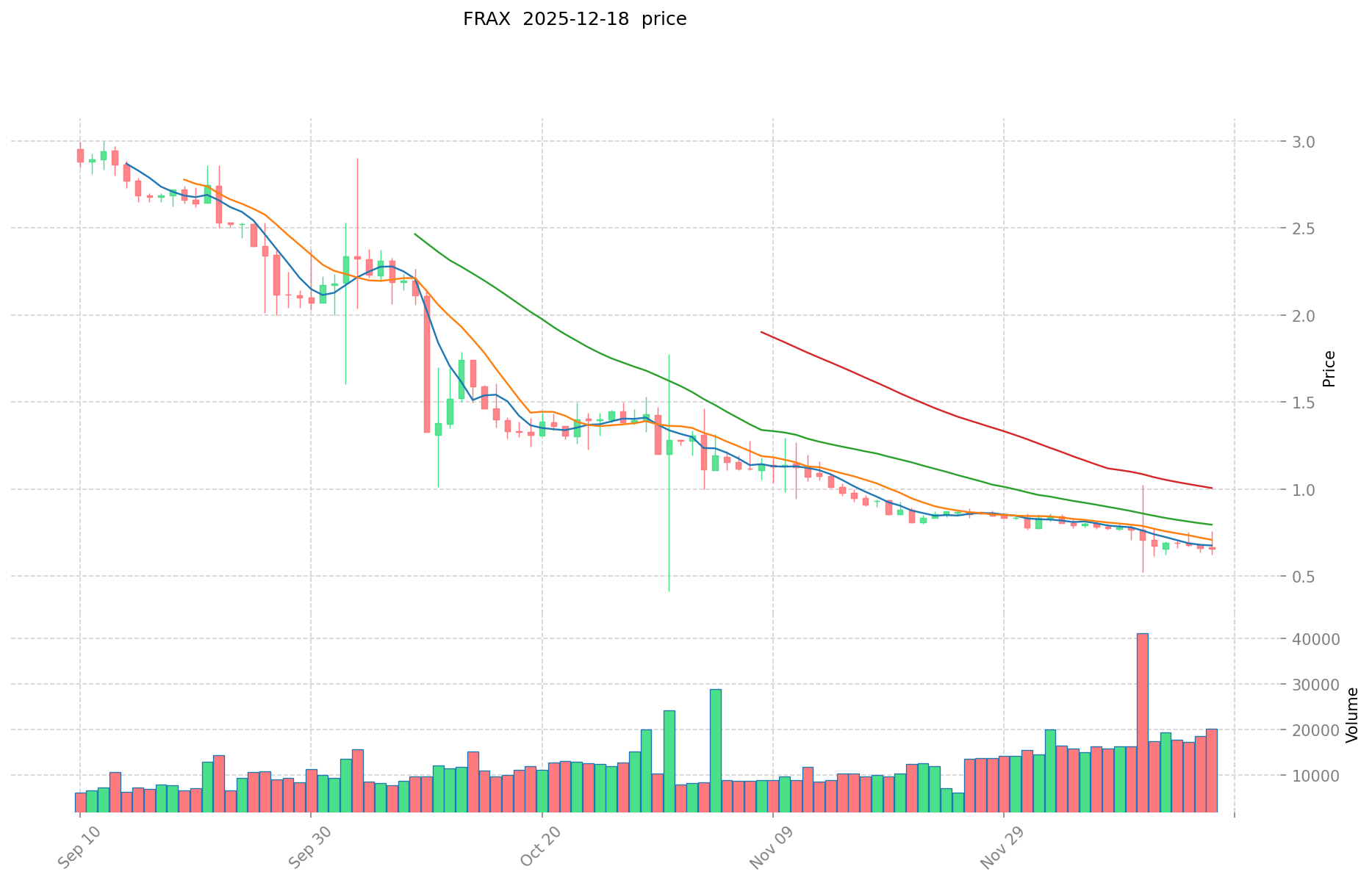
FRAX is an important asset in the cryptocurrency domain, serving as the native gas token for Fraxtal, a modular Layer 2 rollup blockchain built on the OP Stack. As of December 18, 2025, FRAX maintains a market capitalization of approximately $58.82 million with a fully diluted valuation of $91.83 million, with circulating supply of about 90.89 million tokens and fully diluted supply of 141.91 million tokens. The token is currently trading at $0.6471, down significantly from its all-time high of $1.14 reached on February 7, 2021.
Fraxtal distinguishes itself through several innovative features that position FRAX within the evolving Layer 2 ecosystem. The blockchain implements an EVM-equivalent rollup architecture comparable in speed, security, and cost efficiency to leading Ethereum rollups such as Optimism and Base. Notably, Fraxtal introduces the Flox blockspace incentive mechanism, which uniquely rewards both users and developers for network activity, enabling potential earnings to exceed actual gas consumption. The modular architecture further supports deployment of Layer 3 networks and interconnection with other chains through independently developed data availability modules.
With a current market ranking of 458 and market dominance of 0.0029%, FRAX has experienced notable price volatility, declining 79.71% over the past year. This article provides a comprehensive analysis of FRAX's investment value, historical price dynamics, future price projections, and associated investment risks to serve as a reference for prospective investors.
Frax (FRAX) Market Research Report
I. FRAX Price History Review and Current Investment Value Status
FRAX Historical Price Performance
Based on available data, FRAX has experienced significant price volatility:
- February 7, 2021: FRAX reached its all-time high of $1.14
- March 11, 2023: FRAX declined to its historical low of $0.874536
- 12-month performance: Declined by 79.71% from the previous year
- 30-day performance: Declined by 30.40%
- 7-day performance: Declined by 14.97%
Current FRAX Market Status (December 18, 2025)
- Current Price: $0.6471 USD
- 24-Hour Price Range: Low of $0.6249, High of $0.7602
- Market Sentiment Indicator: 1 (Neutral)
- 24-Hour Trading Volume: $13,139.50 USD
- Market Capitalization: $58,816,371.74 USD
- Fully Diluted Valuation: $91,829,429.08 USD
- Circulating Supply: 90,892,245 FRAX (64.05% of total supply)
- Total Supply: 141,909,178 FRAX
- Market Rank: 458
For real-time FRAX market prices, visit Gate FRAX Trading
II. Project Overview and Technical Architecture
Core Project Description
Fraxtal is a modular Rollup blockchain operating as a Layer 2 (L2) solution, featuring a "fractal scaling" roadmap with both established and innovative capabilities.
Technical Specifications
I. EVM Equivalency and OP Stack Implementation
Fraxtal functions as an EVM-equivalent Rollup utilizing the OP Stack as its smart contract platform and execution environment. The deployment of applications offers performance metrics comparable to leading Ethereum Rollups including Optimism and Base, with similar speed, security, and cost characteristics.
II. Modular Architecture
Fraxtal employs a modular Rollup structure containing multiple components and middleware designed for use, connection, and integration by other chains and networks. The platform supports Layer 3 (L3) deployment and development on its foundation. Currently, Fraxtal implements a dedicated data availability module developed by the Frax Core Team.
III. Blockspace Incentive Mechanism (Flox)
Fraxtal introduces a novel blockspace incentive structure that rewards both users and developers for network participation:
- Users earn rewards by consuming gas and interacting with smart contracts
- Developers earn FXTL points when their deployed contracts consume gas
- Reward earnings can exceed actual gas expenditure for users
- Developers may earn more than the gas costs generated by their dApps
- FXTL points are convertible into tokens in future periods
IV. Native Gas Token
The network's native gas token is FRAX, issued by Frax Finance.
III. Network Metrics and Holder Distribution
- Total Token Holders: 3,249
- Market Dominance: 0.0029%
- Market Cap to Fully Diluted Valuation Ratio: 64.05%
IV. Additional Resources
- Official Website: https://frax.com/
- Block Explorer: https://fraxscan.com
- Social Media: https://x.com/fraxfinance
- Exchange Availability: Listed on multiple cryptocurrency exchanges
Frax (FRAX) Investment Analysis Report
Report Date: December 18, 2025
I. Executive Summary
Frax (FRAX) is the native gas token of Fraxtal, a modular Layer 2 rollup blockchain built on the OP Stack. As of December 18, 2025, FRAX is trading at $0.6471 with a market capitalization of $58.82 million and a fully diluted valuation of $91.83 million. The token has experienced significant depreciation, declining 79.71% over the past year.
Key Metrics:
- Current Price: $0.6471
- 24-Hour Change: -1.65%
- 7-Day Change: -14.97%
- Market Cap Rank: 458
- Circulating Supply: 90,892,245 FRAX (64.05% of total supply)
- Total Supply: 141,909,178 FRAX
II. Core Factors Influencing FRAX Investment Viability
A. Supply Mechanism and Scarcity
FRAX operates as the native gas token for the Fraxtal network, issued by Frax Finance. With a maximum supply of 141,909,178 tokens and current circulation of 90,892,245 tokens (64.05% circulated), the token exhibits a structured supply model. The remaining ~51 million tokens represent future dilution potential, which could influence long-term price dynamics and investment returns.
The token distribution model directly affects network utility and fee economics on Fraxtal, impacting overall token demand.
B. Network Architecture and Technical Innovation
Fraxtal introduces several distinguishing technical features that support FRAX investment positioning:
1. EVM Equivalence and OP Stack Foundation Fraxtal utilizes the OP Stack as its smart contract platform and execution environment, achieving EVM equivalence. This architecture enables deployment speeds, security levels, and costs comparable to leading Ethereum rollups such as Optimism and Base, making it functionally competitive in the Layer 2 ecosystem.
2. Modular Rollup Design Fraxtal's modular architecture supports multiple components and middleware for external chains and networks. It currently employs a proprietary data availability module developed by the Frax Core Team, enabling the deployment of Layer 3 networks and customizable scaling solutions. This modularity enhances the platform's long-term extensibility.
3. Blockspace Incentive Mechanism (Flox) Fraxtal implements a novel blockspace incentive program called Flox that differentiates its value proposition:
- Users earn FXTL points by spending gas on the network and interacting with any smart contract
- Developers receive rewards when their deployed contracts consume gas
- Users can earn rewards exceeding their actual gas expenditure
- Developers can receive returns surpassing their dApps' gas consumption costs
- FXTL points are convertible into tokens in future periods
This mechanism aims to bootstrap network adoption and developer engagement through direct economic incentives, potentially driving sustained utility demand for FRAX as the native gas token.
C. Competitive Positioning in the Layer 2 Landscape
The Layer 2 rollup market includes established competitors (Optimism, Base, Arbitrum). Fraxtal's differentiation centers on:
- Modular architecture supporting Layer 3 deployment
- Native blockspace incentives (Flox) with potential user rewards exceeding gas costs
- Integration with the broader Frax Finance ecosystem
These features position FRAX as a utility token within a specialized scaling solution rather than a commodity gas token.
D. Market Sentiment and Price Performance
Recent Price Trends:
- 1-Hour: -0.033%
- 24-Hour: -1.65%
- 7-Day: -14.97%
- 30-Day: -30.40%
- 1-Year: -79.71%
Historical Price Range:
- All-Time High: $1.14 (February 7, 2021)
- All-Time Low: $0.874536 (March 11, 2023)
- Current 24-Hour Range: $0.6249 - $0.7602
The significant year-over-year depreciation reflects broader market conditions and potential headwinds specific to the token or platform. The token currently trades below its historical lows, indicating substantial value compression.
Trading Activity: 24-hour trading volume stands at $13,139.50, indicating moderate liquidity. The token maintains a market share of 0.0029% of total cryptocurrency market capitalization.
E. Ecosystem Integration and Utility
Gas Token Functionality: FRAX serves as the primary gas token on Fraxtal, creating baseline demand from network transaction fees. As Fraxtal network adoption increases, corresponding demand for FRAX for gas payments should follow.
Developer and User Engagement: The Flox incentive program creates secondary utility demand by rewarding network participants. The design intentionally encourages gas consumption, potentially strengthening the circular economy within the Fraxtal ecosystem.
III. Risk Factors and Considerations
Downside Risks:
- Extended bear market conditions affecting Layer 2 tokens
- Regulatory uncertainty in cryptocurrency markets
- Competition from established Layer 2 solutions
- Execution risk in achieving projected Fraxtal network adoption
- Potential supply inflation as remaining tokens enter circulation
Liquidity and Market Depth: With only 3,249 token holders and moderate 24-hour volumes, FRAX exhibits limited liquidity compared to major Layer 2 tokens, potentially creating slippage challenges for larger positions.
IV. Data Sources and References
- Official Website: https://frax.com/
- Block Explorer: https://fraxscan.com
- Official Twitter: https://x.com/fraxfinance
- Data Source: Gate, December 18, 2025
Disclaimer: This report is provided for informational purposes only and does not constitute investment advice. Cryptocurrency investments carry substantial risk, including potential loss of principal. Past performance does not guarantee future results. Readers should conduct independent research and consult with qualified financial advisors before making investment decisions.
III. FRAX Future Investment Prediction and Price Outlook (Is Frax (FRAX) Worth Investing in 2025-2030)
Short-term Investment Prediction (2025, Short-term FRAX Investment Outlook)
- Conservative forecast: $0.54 - $0.65
- Neutral forecast: $0.65 - $0.76
- Optimistic forecast: $0.76 - $0.99
Mid-term Investment Outlook (2026-2028, Mid-term Frax (FRAX) Investment Forecast)
- Market stage expectations: Fraxtal L2 ecosystem development phase with gradual protocol adoption and Flox incentive mechanism maturation driving network growth and user engagement expansion.
- Investment return predictions:
- 2026: $0.36 - $1.04
- 2027: $0.50 - $1.18
- 2028: $0.62 - $1.09
- Key catalysts: Fraxtal mainnet adoption acceleration, Flox rewards mechanism effectiveness, DeFi application ecosystem expansion on L2, Frax Finance protocol innovations, and market sentiment improvements towards Layer 2 solutions.
Long-term Investment Outlook (Is Frax a Good Long-term Investment?)
- Base case scenario: $0.94 - $1.60 by 2030 (assuming steady ecosystem adoption, stable gas token utility, and moderate market expansion)
- Optimistic scenario: $1.61 - $2.10 (assuming accelerated dApp deployment, successful L3 infrastructure development, and mainstream institutional adoption)
- Risk scenario: $0.48 - $0.75 (assuming market contraction, competitive pressures from other L2s, or reduced developer adoption)
Visit FRAX long-term investment and price prediction: Price Prediction
2025-12-18 to 2030-12-31 Long-term Outlook
- Base case: $0.94 - $1.21 USD (corresponding to steady ecosystem growth and stable protocol utility)
- Optimistic case: $1.22 - $1.60 USD (corresponding to mass adoption and favorable market conditions)
- Transformative case: $1.61 USD and above (if ecosystem achieves breakthrough progress and mainstream adoption)
- 2030-12-31 predicted high: $1.60 USD (based on optimistic development assumptions)
Disclaimer: This analysis is for informational purposes only and does not constitute investment advice. Cryptocurrency markets carry substantial risks including volatility, regulatory uncertainty, and technology risks. Past performance does not guarantee future results. Please conduct thorough research before making investment decisions.
| 年份 | 预测最高价 | 预测平均价格 | 预测最低价 | 涨跌幅 |
|---|---|---|---|---|
| 2025 | 0.755586 | 0.6458 | 0.542472 | 0 |
| 2026 | 1.03702564 | 0.700693 | 0.35735343 | 8 |
| 2027 | 1.1816486752 | 0.86885932 | 0.5039384056 | 34 |
| 2028 | 1.086769237456 | 1.0252539976 | 0.61515239856 | 58 |
| 2029 | 1.23553359250776 | 1.056011617528 | 0.77088848079544 | 63 |
| 2030 | 1.604081647025032 | 1.14577260501788 | 0.939533536114661 | 77 |
FRAX Investment Strategy and Risk Management Report
I. Investment Methodology (FRAX Investment Strategy)
Long-Term Holdings (HODL FRAX)
Long-term holding strategies are suitable for conservative investors who believe in the Fraxtal ecosystem's development potential. This approach involves:
- Accumulating FRAX tokens during market downturns
- Maintaining positions through market cycles
- Participating in Fraxtal's ecosystem growth through staking or network participation
Active Trading
Active trading strategies depend on technical analysis and wave-based operations:
- Utilizing price volatility (currently trading at $0.6471 with 24-hour fluctuations between $0.6249 and $0.7602)
- Monitoring the 7-day decline of -14.97% and 30-day decline of -30.40% for entry/exit signals
- Short-term traders should track real-time market sentiment and volume data (current 24-hour volume: $13,139.50)
II. Risk Management (Risk Management for FRAX Investment)
Asset Allocation Ratios
- Conservative Investors: 2-5% portfolio allocation to FRAX
- Aggressive Investors: 5-15% portfolio allocation, considering FRAX's market cap of $58.82 million and relatively low market dominance (0.0029%)
- Professional Investors: Strategic allocation based on ecosystem participation metrics and L2 rollup market positioning
Risk Hedging Solutions
- Multi-Asset Portfolio: Combine FRAX with other layer-2 solutions and stablecoins to diversify exposure
- Hedge Instruments: Consider futures contracts or options for downside protection given the one-year decline of -79.71%
- Stablecoin Reserves: Maintain USDC or other stablecoins for opportunistic purchases during market weakness
Secure Storage
- Cold Wallet Storage: For long-term holders, hardware wallets (Ledger, Trezor) are recommended given FRAX's market cap concentration among 3,249 token holders
- Hot wallet for Active Trading: Use reputable exchanges like Gate for active trading while maintaining cold storage for the majority of holdings
- Self-Custody Best Practices: Never share private keys; use hardware wallets for amounts exceeding $10,000
III. Investment Risks and Challenges (Risks of Investing in FRAX)
Market Risks
- High Volatility: FRAX exhibits significant price fluctuations (-79.71% over one year, from ATH of $1.14 to current price of $0.6471)
- Price Manipulation: Low trading volume relative to market cap may expose FRAX to liquidity and slippage risks
- Market Concentration: With only 3,249 token holders, the token shows high concentration risk
Regulatory Risks
- Policy Uncertainty: Regulatory frameworks for layer-2 solutions and associated tokens remain unclear across jurisdictions
- Ecosystem Dependency: FRAX's value is tied to Fraxtal's regulatory status and Frax Finance's compliance posture
- Stablecoin Regulation: Potential future regulations on stablecoin protocols could impact FRAX's utility
Technical Risks
- Smart Contract Vulnerabilities: As an OP Stack-based rollup, Fraxtal inherits operational and smart contract risks
- Data Availability Risks: The custom data availability module developed by the Frax Core Team requires continuous monitoring for security flaws
- Network Upgrade Failures: Future ecosystem upgrades, including L3 deployment and fractal scaling implementation, carry execution risks
IV. Conclusion: Is FRAX a Good Investment?
Investment Value Summary
FRAX presents a specialized investment opportunity within the layer-2 ecosystem. The token's utility as the native gas token on Fraxtal, combined with innovative incentive mechanisms like Flox, offers long-term potential for ecosystem participants. However, the -79.71% one-year decline and current market position (ranking #458, market cap $58.82 million) indicate significant recent underperformance.
Investor Recommendations
✅ Beginners:
- Implement dollar-cost averaging (DCA) strategies to accumulate FRAX over time
- Store holdings in secure hardware wallets
- Limit initial allocation to 2-3% of cryptocurrency portfolio
✅ Experienced Investors:
- Engage in wave-based trading using technical analysis
- Monitor Fraxtal network activity and development milestones
- Maintain diversified positions across multiple layer-2 solutions
✅ Institutional Investors:
- Consider strategic long-term positioning as Fraxtal ecosystem matures
- Monitor on-chain metrics (gas consumption, active addresses, developer activity)
- Evaluate ecosystem growth relative to competing L2 solutions
⚠️ Important Disclaimer: Cryptocurrency investments carry substantial risks, including total loss of principal. This report is provided for informational purposes only and does not constitute financial or investment advice. Conduct independent research and consult with qualified financial advisors before making investment decisions.
Report Date: December 18, 2025
Data Source: Gate Research
Current FRAX Price: $0.6471 | 24H Change: -1.65% | Market Cap: $58.82M
FAQ: Frax (FRAX) Investment Guide
Q1: What is Frax (FRAX) and what role does it play in the cryptocurrency ecosystem?
A: Frax (FRAX) is the native gas token of Fraxtal, a modular Layer 2 rollup blockchain built on the OP Stack. It serves multiple functions: as the primary token for paying transaction fees on the Fraxtal network, as a utility token within the Frax Finance ecosystem, and as a reward mechanism through the innovative Flox blockspace incentive program. As of December 18, 2025, FRAX is trading at $0.6471 with a market capitalization of approximately $58.82 million.
Q2: What are the key technical innovations that distinguish Fraxtal from other Layer 2 solutions?
A: Fraxtal differentiates itself through three core innovations: First, it implements an EVM-equivalent rollup architecture using the OP Stack, providing comparable speed, security, and cost efficiency to leading Layer 2s like Optimism and Base. Second, its modular architecture supports Layer 3 deployment and custom data availability modules. Third, the Flox blockspace incentive mechanism uniquely rewards both users and developers for network activity, with potential earnings exceeding actual gas consumption, creating a circular economic model that incentivizes adoption.
Q3: Is FRAX a good investment given its significant price decline?
A: FRAX presents a speculative opportunity rather than a conventional investment. The token has declined 79.71% over the past year from its all-time high of $1.14 to the current price of $0.6471. Long-term viability depends on successful Fraxtal ecosystem adoption, effective implementation of the Flox mechanism, and competitive positioning against established Layer 2 solutions. Investors should view this as a high-risk, high-reward opportunity suitable only for portfolios with substantial risk tolerance and proper diversification across multiple layer-2 assets.
Q4: What are the primary risks associated with investing in FRAX?
A: Key risks include: market risks from high volatility and low trading liquidity (24-hour volume of only $13,139.50 with 3,249 token holders); regulatory uncertainty surrounding layer-2 tokens and Frax Finance's compliance status; technical risks from smart contract vulnerabilities and the custom data availability module; and competitive pressures from established Layer 2 solutions like Optimism, Arbitrum, and Base. The concentration among a small holder base also creates potential manipulation risks.
Q5: What are the price projections for FRAX through 2030?
A: Conservative forecasts suggest FRAX could trade between $0.54-$0.65 in the near term. Mid-term projections (2026-2028) range from $0.36-$1.04 depending on ecosystem adoption rates. Long-term scenarios for 2030 include: base case of $0.94-$1.21 (steady ecosystem growth), optimistic case of $1.22-$1.60 (mass adoption), and transformative case exceeding $1.61 (breakthrough progress). These projections depend heavily on successful Fraxtal development and favorable market conditions.
Q6: What investment strategies are recommended for different investor profiles?
A: Conservative investors should allocate 2-5% of their cryptocurrency portfolio to FRAX using dollar-cost averaging during market downturns while maintaining positions in hardware wallets. Experienced investors can employ wave-based trading strategies using technical analysis of current price volatility, monitoring 7-day declines of -14.97% and 30-day declines of -30.40% for trading signals. Institutional investors should consider strategic long-term positioning while monitoring on-chain metrics such as network activity, developer engagement, and competitive performance relative to other Layer 2 solutions.
Q7: How does the Flox incentive mechanism support FRAX's long-term value proposition?
A: Flox represents a fundamental value driver for FRAX adoption. Users earn FXTL rewards points by consuming gas and interacting with smart contracts, with potential earnings exceeding actual gas expenditure. Developers receive rewards when deployed contracts consume gas, potentially generating returns surpassing their dApps' gas costs. These FXTL points convert into tokens in future periods, creating direct economic incentives for network participation. This mechanism aims to bootstrap adoption and developer activity, potentially driving sustained demand for FRAX as the network's native gas token and creating a self-reinforcing adoption cycle.
Q8: What indicators should investors monitor to evaluate FRAX's investment potential?
A: Key metrics include: on-chain network activity (total value locked, daily active addresses, transaction volume on Fraxtal); developer ecosystem metrics (deployed dApps, Layer 3 implementations); Flox program effectiveness (reward distribution rates, user and developer participation levels); competitive positioning (relative performance versus Optimism, Base, Arbitrum); market liquidity and trading volume improvements; regulatory developments affecting layer-2 tokens and Frax Finance; and milestone achievement rates in Fraxtal's fractal scaling roadmap. Monitoring these indicators helps assess whether ecosystem development aligns with price recovery assumptions.
Share
Content
I. FRAX Price History Review and Current Investment Value Status
II. Project Overview and Technical Architecture
III. Network Metrics and Holder Distribution
IV. Additional Resources
I. Executive Summary
II. Core Factors Influencing FRAX Investment Viability
III. Risk Factors and Considerations
IV. Data Sources and References
Short-term Investment Prediction (2025, Short-term FRAX Investment Outlook)
Mid-term Investment Outlook (2026-2028, Mid-term Frax (FRAX) Investment Forecast)
Long-term Investment Outlook (Is Frax a Good Long-term Investment?)
2025-12-18 to 2030-12-31 Long-term Outlook
I. Investment Methodology (FRAX Investment Strategy)
II. Risk Management (Risk Management for FRAX Investment)
III. Investment Risks and Challenges (Risks of Investing in FRAX)
IV. Conclusion: Is FRAX a Good Investment?
How to Buy Cryptocurrency


Trending Cryptocurrencies



XZXX: A Comprehensive Guide to the BRC-20 Meme Token in 2025

Bitcoin Fear and Greed Index: Market Sentiment Analysis for 2025

Top Crypto ETFs to Watch in 2025: Navigating the Digital Asset Boom
5 ways to get Bitcoin for free in 2025: Newbie Guide

Bitcoin Market Cap in 2025: Analysis and Trends for Investors
2025 Bitcoin Price Prediction: Trump's Tariffs' Impact on BTC

Adding Polygon Network to Your Web3 Wallet: A Step-by-Step Guide

Guide to Adding Arbitrum to Your Crypto Wallet
Maximize Your Solana Investments with Cutting-Edge Yield Platforms

2024's Most Anticipated NFT Innovations
Secure and User-Friendly Digital Wallet for Tezos Blockchain