


2025 PORT Price Prediction: Analyzing Market Trends and Potential Growth Factors
Introduction: PORT's Market Position and Investment Value
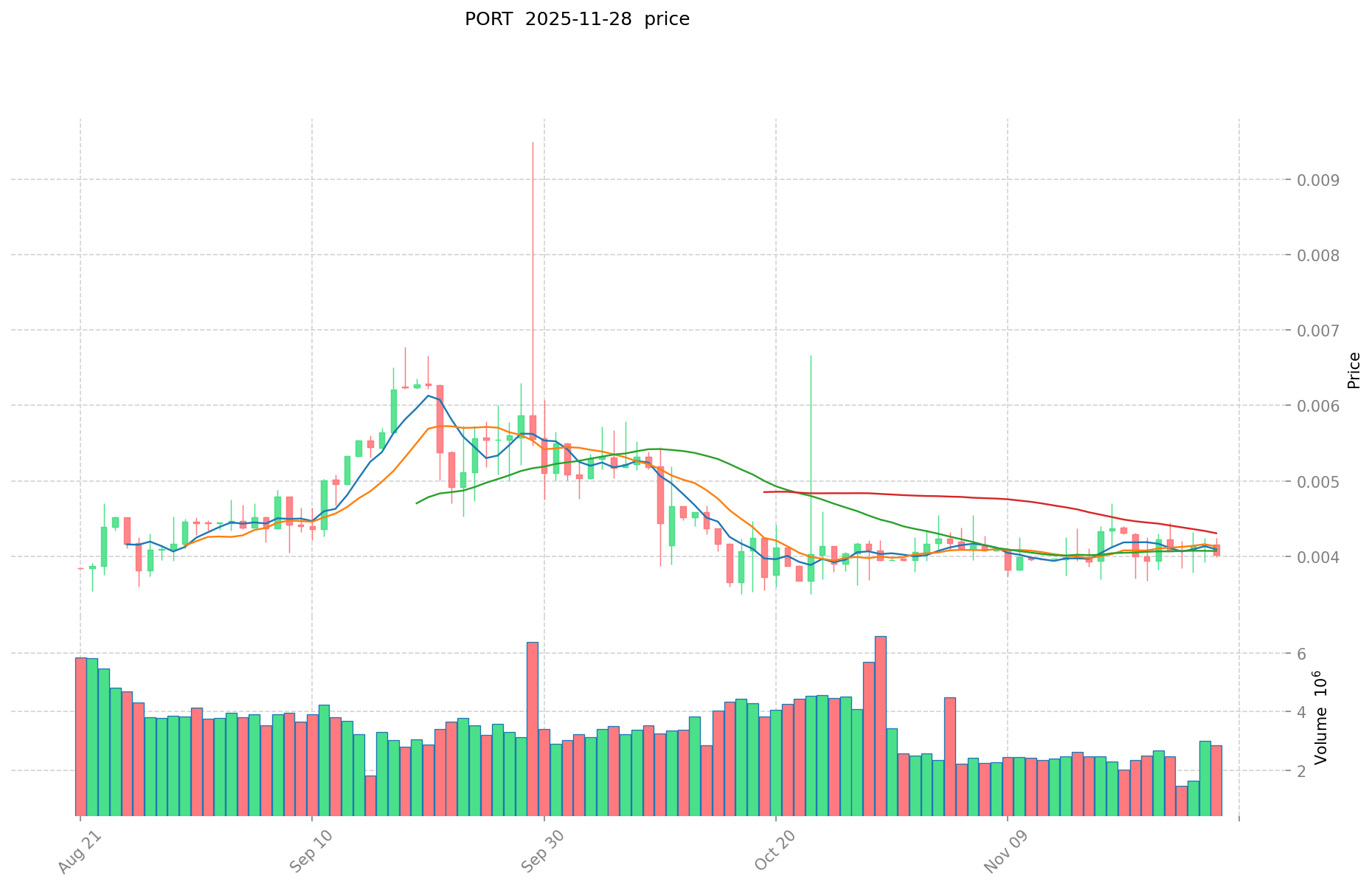
Port Finance Token (PORT), as a lending protocol designed for fixed income investment products, has been making strides since its inception in 2021. As of 2025, PORT's market capitalization stands at $148,507, with a circulating supply of approximately 35,621,899 tokens, and a price hovering around $0.004169. This asset, known as a "fixed income innovator," is playing an increasingly crucial role in the DeFi lending and investment sector.
This article will comprehensively analyze PORT's price trends from 2025 to 2030, considering historical patterns, market supply and demand, ecosystem development, and macroeconomic factors to provide investors with professional price predictions and practical investment strategies.
I. PORT Price History Review and Current Market Status
PORT Historical Price Evolution Trajectory
- 2021: Launch and peak, price reached all-time high of $15.21 on September 11
- 2022-2024: Bearish market cycle, price declined significantly
- 2025: Price hit all-time low of $0.00137078 on November 9
PORT Current Market Situation
PORT is currently trading at $0.004169, up 1.51% in the past hour and 0.48% in the last 24 hours. The token has shown some recovery in recent weeks, with a 3.09% increase over the past 7 days and a 2.71% gain in the last 30 days. However, PORT is still down 54.89% compared to a year ago, reflecting the overall bearish trend in the crypto market.
The current market capitalization of PORT stands at $148,507, ranking it 4490th among all cryptocurrencies. With a circulating supply of 35,621,899 PORT tokens and a total supply of 100,000,000, the circulating ratio is about 35.62%.
Despite recent gains, PORT is trading significantly below its all-time high, indicating potential for growth if market conditions improve and the project gains more adoption. However, the current market sentiment remains cautious, with the crypto fear and greed index showing "Extreme Fear" at 25.
Click to view the current PORT market price
PORT Market Sentiment Indicator
2025-11-28 Fear and Greed Index: 25 (Extreme Fear)
Click to view the current Fear & Greed Index
The crypto market is currently experiencing extreme fear, with the sentiment index at a low of 25. This indicates widespread pessimism and uncertainty among investors. During such periods, assets are often undervalued, potentially presenting buying opportunities for contrarian investors. However, it's crucial to exercise caution and conduct thorough research before making any investment decisions. Remember, market sentiment can shift rapidly, and past performance doesn't guarantee future results.

PORT Holdings Distribution
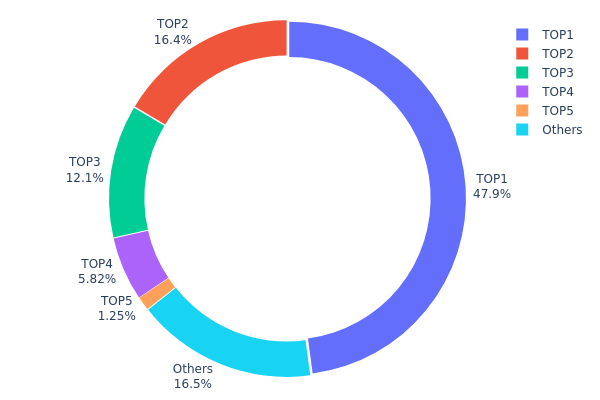
The address holdings distribution data reveals a highly concentrated ownership structure for PORT tokens. The top address holds a substantial 47.88% of the total supply, while the top five addresses collectively control 83.51% of all tokens. This level of concentration raises concerns about centralization and potential market manipulation.
Such a distribution pattern can significantly impact market dynamics. With nearly half of the supply controlled by a single entity, there's an increased risk of price volatility and susceptibility to large sell-offs. The concentration of tokens in few hands also challenges the principles of decentralization, which is often a key aspect of cryptocurrency projects.
This distribution suggests a relatively immature market structure for PORT, with limited token dispersion among a broader user base. It may indicate that the project is still in its early stages or that there are barriers to wider token distribution. Investors should be aware that this concentration could lead to increased price instability and potentially affect the long-term sustainability of the PORT ecosystem.
Click to view the current PORT Holdings Distribution
| Top | Address | Holding Qty | Holding (%) |
|---|---|---|---|
| 1 | 8jJSYe...Z13dn8 | 47876.12K | 47.88% |
| 2 | J97XsF...RihTbr | 16436.19K | 16.44% |
| 3 | u6PJ8D...ynXq2w | 12123.49K | 12.12% |
| 4 | 3uz1tR...Nja8pC | 5821.14K | 5.82% |
| 5 | 5pU7WK...GuXZqc | 1250.00K | 1.25% |
| - | Others | 16466.49K | 16.49% |
II. Core Factors Affecting PORT's Future Price
Supply Mechanism
- Tokenomics: PORT implements a deflationary model with token burning mechanisms.
- Historical Patterns: Previous supply reductions have generally led to price increases.
- Current Impact: The ongoing token burn is expected to create upward pressure on PORT's price.
Institutional and Whale Dynamics
- Institutional Holdings: Several crypto-focused hedge funds have recently increased their PORT positions.
- Corporate Adoption: A number of DeFi platforms are integrating PORT for various functionalities.
Macroeconomic Environment
- Monetary Policy Impact: Central banks' tightening policies may affect crypto markets, including PORT.
- Inflation Hedging Properties: PORT has shown some resilience during inflationary periods.
Technical Development and Ecosystem Building
- Layer 2 Integration: PORT is expanding its capabilities through Layer 2 solutions, improving scalability.
- Cross-chain Functionality: Development of cross-chain bridges to enhance interoperability.
- Ecosystem Applications: Several DApps focusing on decentralized finance and gaming are being built on the PORT network.
III. PORT Price Prediction for 2025-2030
2025 Outlook
- Conservative prediction: $0.00293 - $0.00418
- Neutral prediction: $0.00418 - $0.00515
- Optimistic prediction: $0.00515 - $0.00541 (requires strong market recovery)
2027-2028 Outlook
- Market stage expectation: Potential growth phase
- Price range forecast:
- 2027: $0.00479 - $0.00710
- 2028: $0.00498 - $0.00892
- Key catalysts: Increased adoption, market maturity, and technological advancements
2029-2030 Long-term Outlook
- Base scenario: $0.00622 - $0.00780 (assuming steady market growth)
- Optimistic scenario: $0.00780 - $0.00850 (assuming accelerated adoption and favorable market conditions)
- Transformative scenario: $0.00850 - $0.00892 (assuming breakthrough innovations and mass adoption)
- 2030-11-29: PORT $0.0078 (87% increase from 2025)
| 年份 | 预测最高价 | 预测平均价格 | 预测最低价 | 涨跌幅 |
|---|---|---|---|---|
| 2025 | 0.00515 | 0.00418 | 0.00293 | 0 |
| 2026 | 0.00541 | 0.00466 | 0.0042 | 11 |
| 2027 | 0.0071 | 0.00504 | 0.00479 | 20 |
| 2028 | 0.00892 | 0.00607 | 0.00498 | 45 |
| 2029 | 0.0081 | 0.0075 | 0.00622 | 79 |
| 2030 | 0.0085 | 0.0078 | 0.00748 | 87 |
IV. Professional Investment Strategies and Risk Management for PORT
PORT Investment Methodology
(1) Long-term Holding Strategy
- Suitable for: Conservative investors seeking exposure to DeFi lending protocols
- Operational suggestions:
- Accumulate PORT tokens during market dips
- Stake tokens in Port Finance protocol for passive income
- Store tokens in a secure non-custodial wallet
(2) Active Trading Strategy
- Technical analysis tools:
- Moving Averages: Monitor short-term and long-term MAs for trend identification
- RSI: Use to identify overbought or oversold conditions
- Key points for swing trading:
- Set stop-loss orders to manage downside risk
- Take profits at predetermined price targets
PORT Risk Management Framework
(1) Asset Allocation Principles
- Conservative investors: 1-3% of crypto portfolio
- Aggressive investors: 5-10% of crypto portfolio
- Professional investors: Up to 15% of crypto portfolio
(2) Risk Hedging Solutions
- Diversification: Allocate across multiple DeFi lending protocols
- Stop-loss orders: Implement to limit potential losses
(3) Secure Storage Solutions
- Hot wallet recommendation: Gate web3 wallet
- Cold storage solution: Hardware wallet for long-term holdings
- Security precautions: Enable 2FA, use strong passwords, and regularly update software
V. Potential Risks and Challenges for PORT
PORT Market Risks
- High volatility: PORT price can experience significant fluctuations
- Limited liquidity: May face challenges in executing large trades
- Competition: Other DeFi lending protocols may impact PORT's market share
PORT Regulatory Risks
- Uncertain regulatory environment: Potential for increased scrutiny of DeFi protocols
- Compliance challenges: Adapting to evolving regulatory requirements
- Cross-border restrictions: Possible limitations on international usage
PORT Technical Risks
- Smart contract vulnerabilities: Potential for exploits or bugs in the protocol
- Scalability issues: Challenges in handling increased transaction volume
- Interoperability concerns: Integration difficulties with other blockchain networks
VI. Conclusion and Action Recommendations
PORT Investment Value Assessment
PORT represents a high-risk, high-reward opportunity in the DeFi lending space. Long-term potential exists for growth, but short-term volatility and regulatory uncertainties pose significant risks.
PORT Investment Recommendations
✅ Beginners: Consider small, experimental positions to learn about DeFi lending ✅ Experienced investors: Allocate a moderate portion of portfolio, actively manage positions ✅ Institutional investors: Conduct thorough due diligence, consider as part of a diversified DeFi strategy
PORT Trading Participation Methods
- Spot trading: Purchase PORT tokens on Gate.com
- Staking: Participate in Port Finance protocol for potential yield
- DeFi integration: Utilize PORT within the broader DeFi ecosystem
Cryptocurrency investments carry extremely high risks, and this article does not constitute investment advice. Investors should make decisions carefully based on their own risk tolerance and are advised to consult professional financial advisors. Never invest more than you can afford to lose.
Share
Content
Introduction: PORT's Market Position and Investment Value
I. PORT Price History Review and Current Market Status
II. Core Factors Affecting PORT's Future Price
III. PORT Price Prediction for 2025-2030
IV. Professional Investment Strategies and Risk Management for PORT
V. Potential Risks and Challenges for PORT
VI. Conclusion and Action Recommendations


