What Is the Native Cryptocurrency of Polkadot?

Beginner
Quick Reads
Last Updated 2026-03-29 06:49:43
Reading Time: 1m
Dr. Gavin Wood, co-founder of Ethereum, introduced Polkadot as a cross-chain protocol. It was developed to address the isolation of traditional public blockchains and achieve interoperability across multiple blockchain networks.

Polkadot Overview

Dr. Gavin Wood, co-founder of Ethereum, developed Polkadot as a cross-chain protocol. Its core vision is to enable seamless communication and data sharing across different blockchains. This architecture resolves the isolation issue inherent in traditional public blockchains, making true interoperability possible in the Web3 world. Polkadot’s structure is comprised of three main components:

  • Relay Chain: The central backbone of the network, responsible for consensus, security, and coordinating cross-chain operations.
  • Parachains: Customizable blockchains designed for specific applications or functionalities.
  • Bridges: Connect Polkadot with external public blockchains like Ethereum and Bitcoin to enable cross-chain transactions.

Within this framework, DOT drives network operation and incentivizes participants.

Polkadot’s Native Digital Asset: DOT

DOT serves as Polkadot’s native cryptocurrency. It is more than just an investment vehicle; it acts as the engine and governance instrument of the entire ecosystem. Its primary functions include:

  • Governance: DOT holders propose and vote on network upgrades, protocol changes, and policy adjustments.
  • Staking: By staking DOT, participants secure the network via the Nominated Proof of Stake (NPoS) consensus model and receive rewards.
  • Bonding: New parachains joining the Polkadot ecosystem must bond DOT to obtain a slot, ensuring equitable resource allocation.

These core functions establish DOT as the foundational economic pillar of Polkadot.

DOT’s Three Core Functions

1. Governance

Polkadot prioritizes decentralized governance, much like other leading public blockchains. DOT holders initiate proposals and vote on key network decisions, including upgrades, protocol parameters, and treasury management. DOT is not only an investment asset but also a governance token.

2. Network Security

Polkadot uses the NPoS consensus mechanism. DOT staking underpins network security. Validators stake DOT to earn block production rights, while nominators select and support validators to share in the rewards. This system makes DOT the core of Polkadot’s security model.

3. Parachain Slot Auctions

One of Polkadot’s signature innovations is the Parachain Slot Auction. Projects that want to deploy parachains on Polkadot must bond DOT to bid for a slot. This mechanism drives demand for DOT and ensures fair, efficient allocation of network resources.

DOT’s Economic Model

DOT does not have a capped supply like Bitcoin. It follows an inflationary model that continuously incentivizes validators and network participants. Currently, DOT’s annual inflation rate stands at approximately 10%. Some newly minted DOT is distributed as staking rewards, with the remainder allocated to the treasury for ecosystem development.

This model encourages holders to participate actively in network governance and security.

DOT: Challenges and Future Outlook

DOT is central to the Polkadot ecosystem, but several challenges remain:

  • Ecosystem Growth: Parachain development needs more robust, real-world applications.
  • Market Competition: Competing blockchain architectures such as Cosmos and Ethereum are advancing cross-chain and multi-chain solutions.
  • Regulatory Risks: Government policy changes worldwide could impact DOT’s trajectory.

With additional parachain projects launching and the Web3 ecosystem expanding, DOT is expected to become a vital asset in blockchain infrastructure.

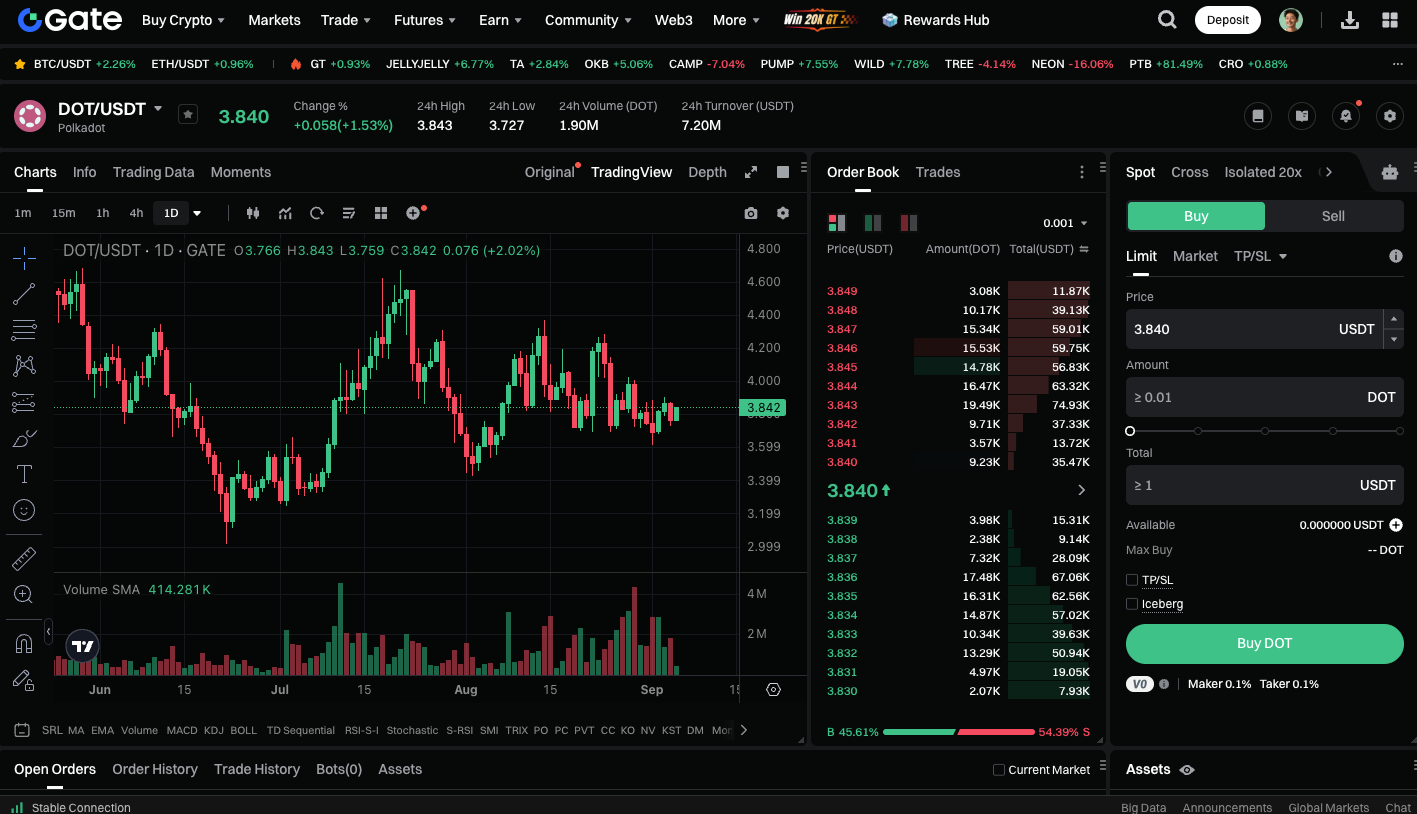
Begin trading DOT spot: https://www.gate.com/trade/DOT_USDT

Conclusion

DOT is far more than Polkadot’s native cryptocurrency. It is the beating heart of the cross-chain ecosystem, supporting governance, network security, and parachain slot auctions. As Web3 adoption accelerates, DOT’s significance will continue to grow. For investors seeking deeper insight into Polkadot or engagement with its ecosystem, understanding DOT’s functionality and value is essential for unlocking the full potential of Polkadot.

Author: Allen
Disclaimer
* The information is not intended to be and does not constitute financial advice or any other recommendation of any sort offered or endorsed by Gate.
* This article may not be reproduced, transmitted or copied without referencing Gate. Contravention is an infringement of Copyright Act and may be subject to legal action.

Related Articles

AI-Native Settlement Layers: How United Stables Is Building the Next Financial Rail
Beginner

AI-Native Settlement Layers: How United Stables Is Building the Next Financial Rail

Stablecoins were originally designed as dollar substitutes within exchanges, primarily used for asset pricing and trade settlement. As on-chain financial ecosystems have matured, their role has expanded beyond simple payments to include collateral assets, cross-chain liquidity mediums, and unified settlement units. In particular, as AI systems and automated agents begin to participate directly in economic activity, demand has risen sharply for programmable value units capable of instant settlement. This shift is pushing stablecoins toward the role of foundational financial infrastructure.
2026-03-25 03:16:17
DePIN Identity Network and Real World Applications: How Humanity Protocol Brings on-chain Identity Into the Physical World
Beginner

DePIN Identity Network and Real World Applications: How Humanity Protocol Brings on-chain Identity Into the Physical World

Most Web3 identity systems remain confined to on-chain environments and struggle to achieve meaningful adoption in real world settings. Through a DePIN architecture and physical verification hardware, Humanity Protocol aims to bring decentralized identity into access control systems, hospitality, public services, and offline events, allowing on-chain identity to function not just as a digital credential, but as foundational infrastructure for real world access.
2026-03-25 07:40:53
Gold Price Forecast for the Next Five Years: 2026–2030 Trend Outlook and Investment Implications, Could It Reach $6,000?
Beginner

Gold Price Forecast for the Next Five Years: 2026–2030 Trend Outlook and Investment Implications, Could It Reach $6,000?

Analyze current gold price trends alongside authoritative five-year forecasts, integrating an evaluation of market risks and opportunities. This gives investors insight into the potential trajectory of gold prices and the main drivers expected to shape the market over the next five years.
2026-03-25 18:13:30
Aster vs Hyperliquid: Which Perp DEX Will Prevail?
Beginner

Aster vs Hyperliquid: Which Perp DEX Will Prevail?

Aster and Hyperliquid are the two representative protocols of the "purpose-built L1 path" within the current decentralized perpetual exchange (Perp DEX) sector. As a pioneer in the field, Hyperliquid has built a deep liquidity moat through its highly mature order book architecture and strong community consensus. Conversely, Aster, as a rising challenger, seeks to leapfrog the competition in high-performance trading through more aggressive multi-chain aggregation logic, private transaction modules, and an underlying execution environment optimized for 2026 market demands.
2026-03-24 11:58:33
Aerodrome Tokenomics: How ve(3,3) Powers Base's Most Profitable DEX
Beginner

Aerodrome Tokenomics: How ve(3,3) Powers Base's Most Profitable DEX

AERO is the native token of Aerodrome Finance, a core decentralized exchange and liquidity protocol in the Base ecosystem. It is primarily used for liquidity incentives and ecosystem operations. veAERO is a governance NFT that users receive by locking AERO, representing both voting power and the right to share protocol revenue. Through a dual track structure of AERO as a utility token and veAERO as a governance credential, Aerodrome separates liquidity usage value from long term governance power, allowing participants to act as liquidity providers, governance decision makers, and revenue sharers within the same system.
2026-03-25 06:40:31
The ve(3,3) Flywheel Explained: How AERO Tokenomics Powers Aerodrome’s DeFi Economy
Beginner

The ve(3,3) Flywheel Explained: How AERO Tokenomics Powers Aerodrome’s DeFi Economy

In the competition for DeFi liquidity, high-inflation mining alone is no longer enough to build lasting advantages. Aerodrome applies the ve(3,3) economic model to redesign token emissions, voting mechanisms, and revenue distribution, creating a liquidity flywheel centered on governance and cash flow. This article examines AERO tokenomics, the veAERO locking mechanism, and protocol revenue models to explain how Aerodrome builds a sustainable DeFi economic system.
2026-03-25 06:41:58