As Web3 applications grow more complex, the limitations of traditional blockchains in data processing—such as unverifiable data, insufficient availability, and lack of direct computational participation—are increasingly evident. Irys was developed to address these fundamental bottlenecks, empowering on-chain applications to handle larger-scale data.
Broadly speaking, Irys marks an evolution from “storage blockchain” to “data-driven blockchain,” transforming data from a passive record to a core resource that can be verified, accessed, and actively executed.
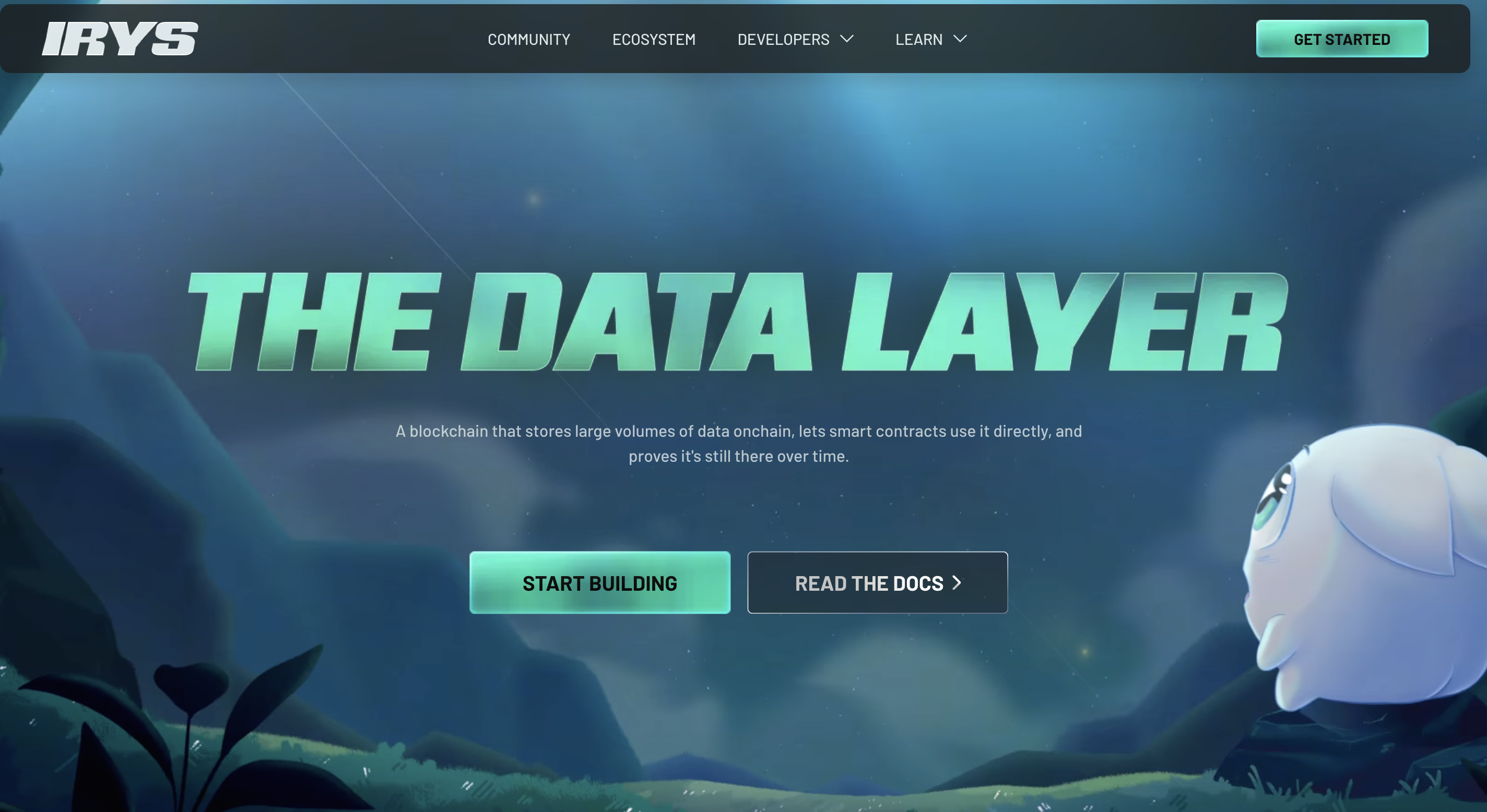
Source: irys.xyz
What Is Irys (IRYS)
Irys is a decentralized data network built on the “Datachain” concept—a blockchain system designed for both data storage and execution. Unlike traditional chains that only record transaction states, Irys integrates data itself into the consensus and verification process.
In legacy storage blockchains, data is treated as static payload, with no unified mechanism among nodes to prove its existence or continued availability. Irys introduces a verifiable data mechanism, allowing every dataset to be collectively proven and validated across the network.
This architecture elevates Irys beyond a mere “storage layer”—it becomes a programmable data environment. Developers can build data-dependent applications directly on Irys without relying on external data services.
Irys’ Core Role: Web3 Verifiable Data Layer
Irys is positioned as the “verifiable data layer” in Web3, bridging the structural gap between data and execution. Traditionally, data storage and Smart Contract execution are separated, limiting application capabilities.
In Web3 environments, data must be stored, verified, accessible, and usable for computation. Without these capabilities, on-chain applications cannot process complex data logic.
Irys embeds data proofs (Proof of Storage / Availability) directly into the consensus, making data part of the trusted on-chain environment. Nodes can confirm data status without relying on external assumptions.
Architecturally, Irys represents a Data Layer / Data Availability solution, with its core value in connecting “data” and “execution.”
How Irys Works: Data Storage, Verification, and Invocation
Irys operates around the data lifecycle—upload, verification, and invocation. Users submit data to the network, which is sharded and integrated into the blockchain structure.
For verification, Irys innovates by ensuring each block records not only transaction order but also encrypted sampling proofs for data partitions. This guarantees data exists and remains accessible.
The network uses a unified verification mechanism, preventing fragmented, node-specific validation. All nodes confirm data status based on common rules, enhancing consistency.
At the invocation layer, Irys enables data to participate directly in on-chain execution logic, making it “programmable data.”
Irys Network Structure: Nodes, Storage, and Data Distribution Logic
The Irys network comprises multiple nodes responsible for data storage, verification, and distribution. Nodes follow consensus mechanisms to maintain network integrity.
For data distribution, Irys employs partitioning and replication, ensuring data is stored across the network. This enhances availability and mitigates single-point failures.
Crucially, nodes must prove they are “actively storing data” via cryptographic proofs and sampling verification, making storage a verifiable process. Network operation relies on incentives, including storage rewards and verification returns.
IRYS Token Functions: Incentives, Payments, and Network Security
The IRYS token is the network’s core economic instrument, used for storage payments, node incentives, and network security.
Users pay IRYS tokens to store data—similar to the Gas model, but fees are tied to actual data resource consumption, making storage quantifiable.
Nodes earn rewards for providing storage and verification, creating a decentralized supply of resources and ensuring continuous network operation.
Additionally, IRYS tokens may be used for staking and security measures to prevent malicious activity. Together, IRYS Tokenomics forms the economic foundation of the network.
Irys Use Cases: From Data Storage to Web3 Infrastructure
Irys is used for Web3 data storage—NFT metadata, on-chain content, and long-term data archiving—where data must be accessible and tamper-proof.
In DeFi and on-chain applications, data availability is a critical requirement. Irys enables complex data to be utilized directly in blockchain logic.
As AI and data marketplaces expand, verifiable data becomes increasingly important. Irys provides foundational infrastructure for data trading and computation.
Overall, Irys is evolving from a “storage tool” to a full “infrastructure layer.”
Irys vs. Other Storage Protocols (Arweave, Filecoin)
While Irys, Arweave, and Filecoin all address Web3 data storage, their positioning and design differ significantly.
Arweave emphasizes permanent storage (one-time payment for lifetime preservation), Filecoin offers a storage marketplace for on-demand storage. Irys aims to build a verifiable data layer, focusing on data proof, accessibility, and direct invocation by on-chain logic.
Irys integrates “data verification + execution logic” within the same system, allowing data to be both stored and actively participate in blockchain computations. This “data as state, executable” design aligns Irys more closely with a data-driven computation layer than a simple storage network.
Irys Advantages, Limitations, and Common Misconceptions
Irys’ primary advantage is its unified “data + execution” architecture, enabling data to directly participate in blockchain logic—essential for complex applications.
The verifiable data mechanism increases trust, allowing developers to build decentralized applications without external dependencies.
Limitations include high system complexity, an evolving ecosystem, and a cost model that requires long-term validation.
A common misconception is equating Irys with traditional cloud storage. In reality, it is an on-chain data infrastructure, not a simple storage replacement.
Summary
Irys introduces a verifiable data layer that unifies storage, verification, and execution, advancing blockchains from “state recording systems” to “data-driven systems.”
Its core value is transforming data into a trusted on-chain resource, enabling more complex and authentic Web3 applications. This architecture not only changes storage methods but also redefines data’s role in blockchain.
FAQ
1. What is Irys?
Irys is a decentralized data storage and verifiable data layer protocol, designed to support on-chain data storage and executable computation.
2. How does Irys differ from Arweave?
Irys emphasizes data verifiability and executability, while Arweave focuses on permanent storage. Irys expands on Arweave by adding data verification and execution features.
3. What is the purpose of the IRYS token?
The IRYS token is the core economic asset of the Irys network, used for data storage payments, incentivizing node operation, and maintaining network security and consensus.
4. Which layer does Irys belong to?
Irys is generally considered the Web3 Data Layer or Data Availability layer, providing verifiable data infrastructure for blockchains and applications.
5. Can Irys replace traditional cloud storage?
Not entirely. Irys is focused on blockchain data infrastructure, with advantages in decentralization, verifiability, and permanence. However, it differs from traditional cloud storage (like AWS or Alibaba Cloud) in performance, cost, and large-scale general storage capabilities.







