TANSSI: The Rising Token Powering the Next-Gen Appchain Deployment Platform

Beginner
Quick Reads
Last Updated 2026-03-30 04:20:04
Reading Time: 1m
TANSSI is the native Token of the Tanssi Network, used for paying network fees, incentivizing validators, and participating in governance. This article analyzes the functions, distribution mechanism, and investment prospects of TANSSI.

What is TANSSI? Which ecosystem does it belong to?


Figure:https://www.tanssi.network/

TANSSI is the native utility Token of the Tanssi Network, primarily used for network fee payments, staking rewards, and on-chain governance participation.

Tanssi Network is a decentralized infrastructure platform that allows developers to deploy independent Appchains in minutes. Similar to AWS for Web3, Tanssi achieves elastic scaling and customizable runtime environments for application chains through a modular architecture.

In this system, the role of TANSSI is equivalent to “fuel + proof of stake + participation certificate.”

The main use of TANSSI

TANSSI plays the following key roles in the Tanssi network:

  • Gas fee payment: Users need to use TANSSI to pay network fees when deploying and running Appchain.
  • Staking Incentives: Validators and nodes need to stake TANSSI to participate in block consensus and earn block rewards.
  • On-chain governance: Holders can vote on governance proposals such as network upgrades and parameter adjustments.
  • Ecological Incentives: Project parties and users can contribute to the TANSSI incentive ecosystem through activities such as tool development, content creation, testing, etc.

Total Token Supply and Distribution Mechanism

The total issuance of TANSSI is 100 million tokens, with the distribution as follows:

  • 35% for ecosystem development and incentives (such as airdrops, development subsidies, etc.)
  • 20% allocated to the team and advisors, set for 12-24 months linear unlocking.
  • 25% allocated to early investors
  • 10% for the foundation’s long-term reserves
  • 10% allocated to community governance and partner support

This design ensures ample incentives during the initial launch phase of the network, while also providing sustainability for long-term governance and development.


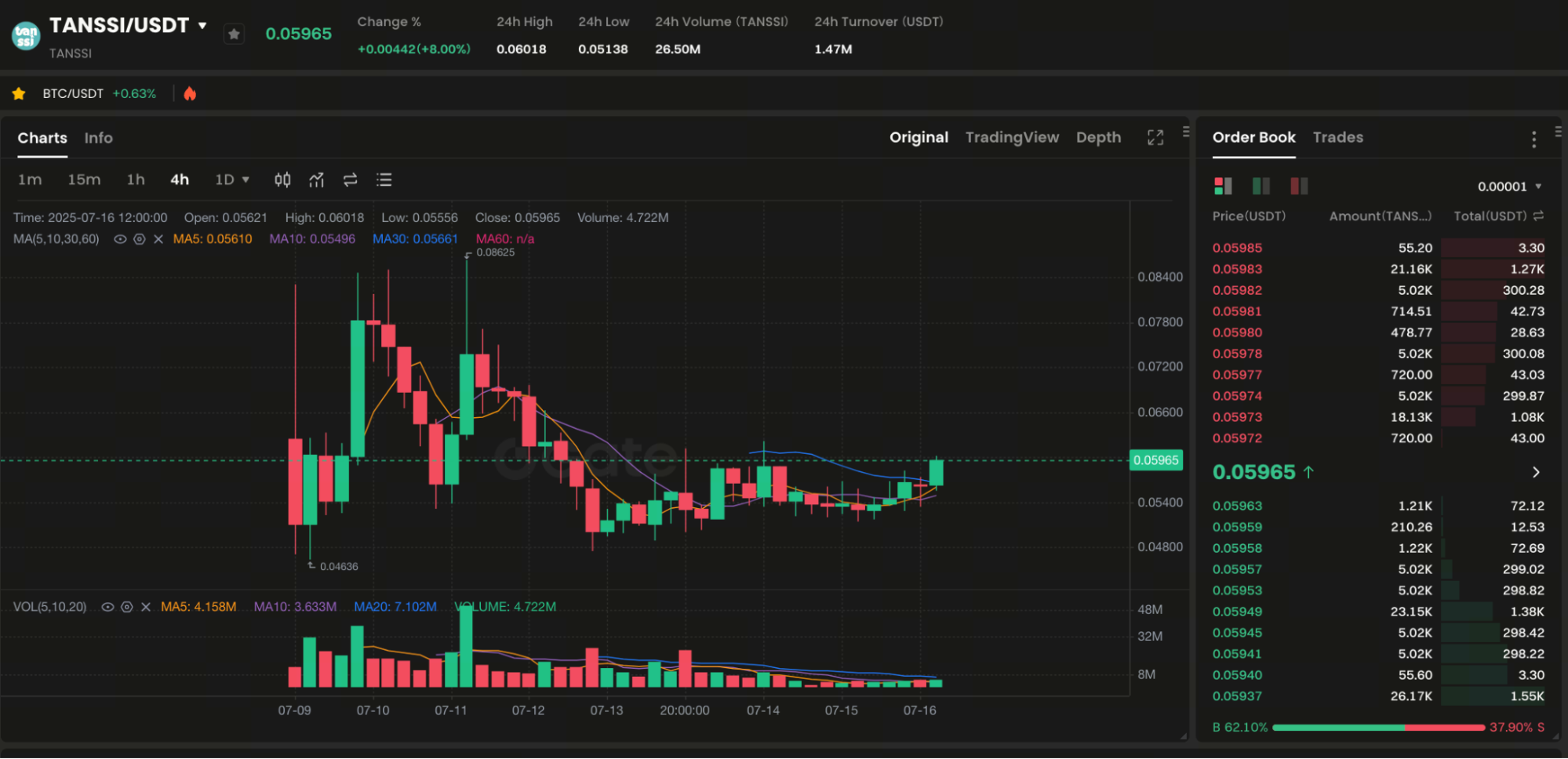
Image:https://www.gate.com/trade/TANSSI_USDT

TANSSI has been listed on the Gate spot platform, with a price of approximately 0.059 USD as of July 16, 2025.

Airdrop plan and acquisition methods

The TANSSI airdrop event is in progress, themed “Journey to Mainnet,” and is being distributed to all community participants.

The current ways to obtain the TANSSI airdrop mainly include:

  • Galxe Task: Complete on-chain interactions, Twitter, Telegram, and other social tasks
  • Discord Activity Reward: Join the Tanssi community, participate in discussions and earn roles.
  • Content creation plan: Writing articles, recording videos, translating white papers, etc. can all earn Coco Gems.
  • Forkie Tickets Exchange: Collect Forkie Tickets during community events to exchange for TANSSI.

Through these methods, even ordinary users have the opportunity to obtain TANSSI at zero cost.

Market Prospects and Risk Analysis

As one of the first native Tokens in the Appchain field, TANSSI’s market prospects depend on the following points:

  • The mainnet launch speed of Tanssi Network
  • Growth of ecological cooperation projects (such as Lumia, Web3 games)
  • Token circulation rate and practical use implementation
  • The acceptance of the development trend of Appchain by the macro environment

Risks cannot be ignored:

  • A high market valuation may bring selling pressure.
  • The delay in the mainnet or slow product rollout may affect the Token value.
  • The project’s degree of decentralization is still gradually progressing.

Investors should comprehensively consider their own risk preferences.

Summary: Is TANSSI worth paying attention to?

TANSSI is a new type of Token that is “born from infrastructure and thrives on ecological explosion”. If you are optimistic about the Appchain modularity trend and wish to participate in the new round of dividend distribution for Web3 infrastructure, then TANSSI is definitely worth your in-depth attention and layout.

Author: Max
Disclaimer
* The information is not intended to be and does not constitute financial advice or any other recommendation of any sort offered or endorsed by Gate.
* This article may not be reproduced, transmitted or copied without referencing Gate. Contravention is an infringement of Copyright Act and may be subject to legal action.

Related Articles

What is Fartcoin? All You Need to Know About FARTCOIN
Intermediate

What is Fartcoin? All You Need to Know About FARTCOIN

Fartcoin (FARTCOIN) is a representative meme coin within the Solana ecosystem based on an AI-driven narrative. Its core concept originated from an experiment aimed at exploring the "boundaries between AI Agents and humor." More than just a digital asset with social attributes, the project deeply couples absurd humor culture with on-chain financial logic by integrating autonomous AI interaction models.
2026-04-04 22:01:19
Gold Price Forecast for the Next Five Years: 2026–2030 Trend Outlook and Investment Implications, Could It Reach $6,000?
Beginner

Gold Price Forecast for the Next Five Years: 2026–2030 Trend Outlook and Investment Implications, Could It Reach $6,000?

Analyze current gold price trends alongside authoritative five-year forecasts, integrating an evaluation of market risks and opportunities. This gives investors insight into the potential trajectory of gold prices and the main drivers expected to shape the market over the next five years.
2026-03-25 18:13:30
Aster vs Hyperliquid: Which Perp DEX Will Prevail?
Beginner

Aster vs Hyperliquid: Which Perp DEX Will Prevail?

Aster and Hyperliquid are the two representative protocols of the "purpose-built L1 path" within the current decentralized perpetual exchange (Perp DEX) sector. As a pioneer in the field, Hyperliquid has built a deep liquidity moat through its highly mature order book architecture and strong community consensus. Conversely, Aster, as a rising challenger, seeks to leapfrog the competition in high-performance trading through more aggressive multi-chain aggregation logic, private transaction modules, and an underlying execution environment optimized for 2026 market demands.
2026-03-24 11:58:33
AI-Native Settlement Layers: How United Stables Is Building the Next Financial Rail
Beginner

AI-Native Settlement Layers: How United Stables Is Building the Next Financial Rail

Stablecoins were originally designed as dollar substitutes within exchanges, primarily used for asset pricing and trade settlement. As on-chain financial ecosystems have matured, their role has expanded beyond simple payments to include collateral assets, cross-chain liquidity mediums, and unified settlement units. In particular, as AI systems and automated agents begin to participate directly in economic activity, demand has risen sharply for programmable value units capable of instant settlement. This shift is pushing stablecoins toward the role of foundational financial infrastructure.
2026-03-25 03:16:17
Aerodrome Tokenomics: How ve(3,3) Powers Base's Most Profitable DEX
Beginner

Aerodrome Tokenomics: How ve(3,3) Powers Base's Most Profitable DEX

AERO is the native token of Aerodrome Finance, a core decentralized exchange and liquidity protocol in the Base ecosystem. It is primarily used for liquidity incentives and ecosystem operations. veAERO is a governance NFT that users receive by locking AERO, representing both voting power and the right to share protocol revenue. Through a dual track structure of AERO as a utility token and veAERO as a governance credential, Aerodrome separates liquidity usage value from long term governance power, allowing participants to act as liquidity providers, governance decision makers, and revenue sharers within the same system.
2026-03-25 06:40:31
Hybrid Collateral Stablecoins: Inside United Stables' Stability and Yield Architecture
Beginner

Hybrid Collateral Stablecoins: Inside United Stables' Stability and Yield Architecture

In the early stages of the crypto market, traditional stablecoins mainly relied on single-reserve or single-collateral models. Their primary focus was price stability and payment convenience, which allowed them to become foundational tools for on-chain trading and capital flows. As the market has entered a more mature financial phase, however, this structure has begun to reveal limitations, including high concentration risk and the difficulty of balancing liquidity with yield. These constraints have driven the evolution toward multi-layer collateral and portfolio-based designs, such as the dual-layer hybrid collateral architecture proposed by United Stables, which seeks to redefine the underlying logic of stable assets.
2026-03-25 03:17:39