When users search for Stellar vs Ripple, they're usually trying to understand why these two platforms are frequently compared. Both focus on global capital flows, low-cost transactions, and payment efficiency, yet they differ significantly in terms of target users, network architecture, and asset control.
This question typically involves comparing network positioning, architectural design, consensus mechanisms, incentive models, asset issuance, and use cases.
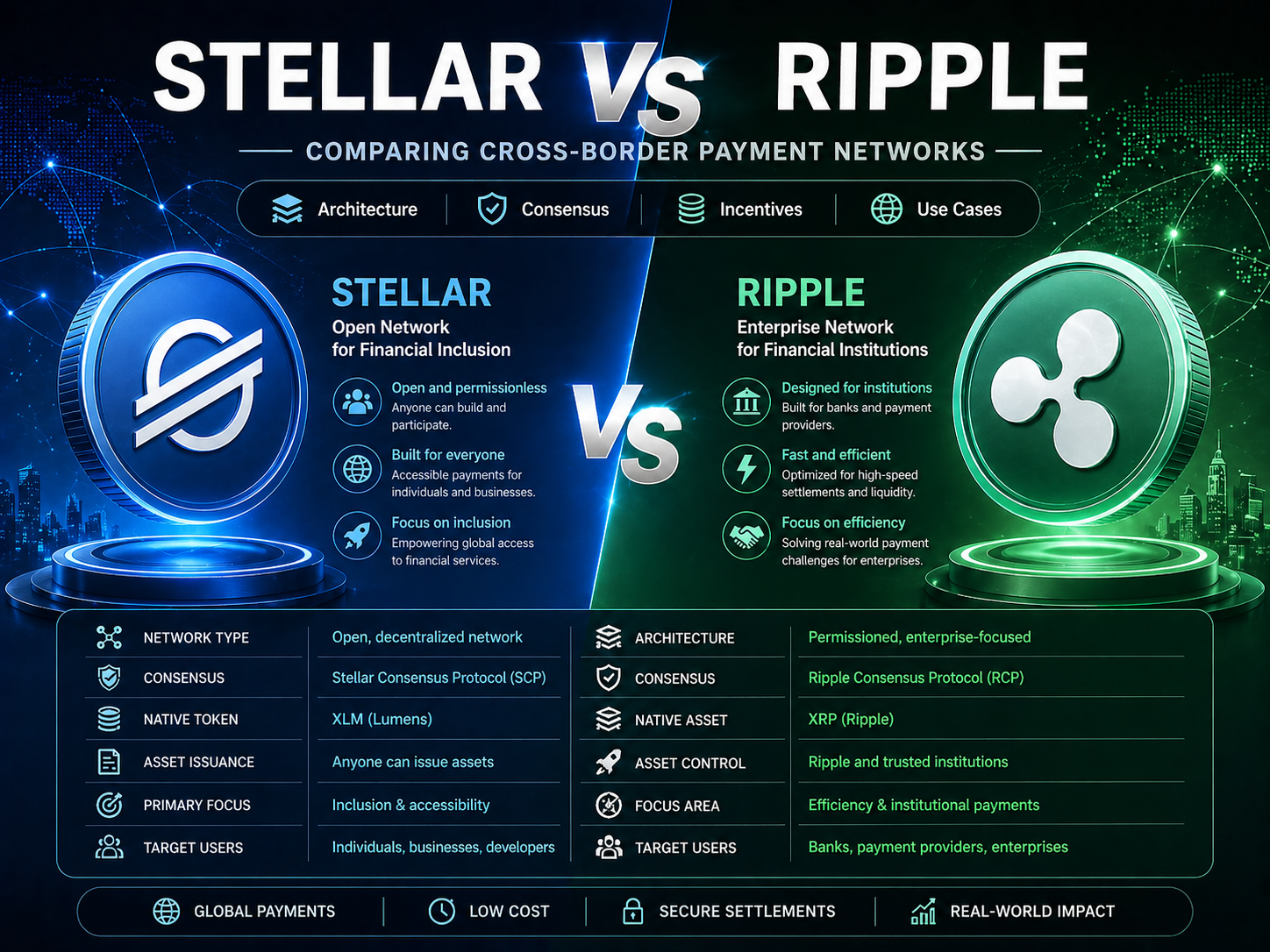
What Is Stellar?
Stellar is an open cross-border payment network designed for low-cost transfers, asset issuance, and the circulation of multiple currencies.
Stellar enables users, developers, and institutions to issue assets within the network and process transfers and settlements via a distributed ledger. Its core purpose goes beyond XLM transactions—it's about enabling the movement of various fiat currencies, stablecoins, and digital assets on a unified platform.
Stellar transactions are confirmed using the Stellar Consensus Protocol, and the network supports path payments. When senders and recipients use different assets, Stellar can automatically find exchange routes, making cross-asset payments seamless.
This open design positions Stellar as an open financial network, making it ideal for micro-payments, cross-border remittances, and financial inclusion.
What Is Ripple?
Ripple refers to the cross-border payment system built around the XRP Ledger and Ripple’s payment solutions, with a primary focus on serving financial institutions and payment companies.
Ripple is architected as institutional-grade payment infrastructure. Its goal is to improve fund settlement efficiency among banks, payment processors, and financial service providers, reducing the intermediary and time costs associated with traditional cross-border payments.
The XRP Ledger uses a consensus mechanism to confirm transactions and allows XRP to serve as a liquidity tool in specific scenarios. Ripple’s products are institutionally focused, emphasizing payment channels, liquidity management, and settlement speed.
This makes Ripple more suitable for banks and financial institutions rather than as an open system for general users.
Architectural Differences: Stellar vs Ripple
Stellar and Ripple differ primarily in openness and their intended audience.
Stellar is built as an open network—any user or institution can issue assets, create wallets, or develop payment applications. Ripple is structured as an institutional payment network, serving the settlement needs of banks, payment companies, and financial institutions.
| Comparison |
Stellar |
Ripple |
| Network Positioning |
Open Payment Network |
Institutional Payment Network |
| Target Users |
Users, Developers, Institutions |
Banks, Payment Institutions |
| Asset Issuance |
Supports Open Issuance |
Focuses on XRP System & Institutional Services |
| Application Focus |
Cross-Border Transfers, Financial Inclusion |
Bank Settlement, Liquidity Management |
| Ecosystem Direction |
Open Financial Applications |
Institutional Financial Infrastructure |
Stellar resembles an open payment layer, while Ripple functions as an institutional settlement network. Both seek to improve cross-border payments, but their user bases and ecosystem strategies differ.
Consensus Mechanism Differences
Neither Stellar nor Ripple uses traditional mining, but their consensus models are distinct.
Stellar employs the Stellar Consensus Protocol, based on the Federated Byzantine Agreement. Nodes select their own trusted sets, and consensus is reached via overlapping trust relationships, fostering open participation and distributed trust.
Ripple uses the XRP Ledger consensus, where validator nodes confirm transactions. This model prioritizes rapid agreement through trusted validators, boosting transaction speed.
In short, Stellar emphasizes open trust selection, while Ripple prioritizes efficient confirmations through a validator framework. Both aim for fast settlements, but their decentralization and governance approaches differ.
These consensus differences directly impact each network’s openness, governance, and adaptability.
Incentive Mechanism Comparison
Stellar and Ripple diverge from PoW or PoS networks and do not offer traditional mining rewards.
On Stellar, XLM is mainly used for transaction fees, minimum account balances, and anti-abuse measures. Minimal fees discourage spam, and balance requirements prevent unnecessary accounts and resource consumption.
On Ripple, XRP serves as a transaction fee and a liquidity instrument. Fees are burned to prevent spam, and XRP helps enhance liquidity efficiency in cross-border payments.
Neither network relies on ongoing block rewards for miners or validators; both sustain operations via low fees, network rules, and ecosystem demand.
This makes them well-suited for payments, where low costs, fast confirmation, and reliable user experiences are essential.
Asset Control and Issuance Mechanisms
Stellar and Ripple differ notably in asset issuance and control.
Stellar allows users and institutions to issue custom assets—such as stablecoins, fiat-pegged tokens, or other digital certificates. Issuers set asset rules, and users accept them via trustlines.
Ripple centers on the XRP Ledger and XRP liquidity. While the XRP Ledger does support asset issuance and payments, Ripple’s business focus remains on institutional payments and liquidity.
Stellar is geared toward open asset issuance for diverse payments and financial inclusion; Ripple prioritizes efficient fund flows for institutional users.
As a result, Stellar is better for open asset ecosystems, while Ripple excels in institutional liquidity and settlement services.
Use Cases and Ecosystem Focus
Both Stellar and Ripple target cross-border payments but have different priorities.
Stellar is ideal for micro cross-border remittances, stablecoin issuance, financial inclusion, and multi-asset transactions. Its open framework enables developers and financial service providers to build payment solutions atop the network.
Ripple is most applicable for interbank settlements, payment processor clearing, and cross-border liquidity management. Its ecosystem is institutionally driven, emphasizing speed and capital efficiency.
In summary, Stellar supports open financial infrastructure, whereas Ripple powers institutional-grade payment solutions. They are not direct substitutes, but rather networks serving distinct users and use cases.
Summary
Stellar and Ripple both strive to enhance cross-border payments, but they take different approaches. Stellar focuses on open networks, asset issuance, and financial inclusion—best for multi-asset payments and micro-remittances. Ripple emphasizes institutional settlement, liquidity management, and bank-level infrastructure. The main distinction lies in open versus institutional payment networks.
FAQ
What’s the biggest difference between Stellar and Ripple?
Stellar is focused on open payments and financial inclusion, while Ripple is dedicated to settlement solutions for banks and payment institutions. Both address cross-border payments, but serve different users.
Do both Stellar and Ripple support cross-border payments?
Yes, both enable cross-border payments. Stellar caters to open user and developer environments; Ripple is tailored to institutional fund settlements.
How do Stellar’s XLM and Ripple’s XRP differ?
XLM mainly covers Stellar network fees, minimum account balances, and asset conversions; XRP is used for XRP Ledger transaction fees and institutional liquidity.
Are Stellar and Ripple’s consensus mechanisms the same?
No. Stellar leverages the SCP Federated Byzantine Agreement, while Ripple uses the XRP Ledger consensus mechanism. Both deliver fast confirmations but employ different trust models.
Which is best for financial inclusion?
Stellar is better suited for financial inclusion and open payments because its design enables open asset issuance, low-cost transfers, and active developer participation.







