Meteora Founder Faces Class Action As MET Token Launches on Solana

Beginner
Quick Reads
Last Updated 2026-03-28 08:11:43
Reading Time: 1m
Meteora is a next-generation DeFi protocol offering efficient, composable, and sustainable liquidity infrastructure. Recently, Meteora’s founder Benjamin Chow faces a class-action lawsuit for using celebrity endorsements to promote scam tokens. He is also accused of market manipulation.

Class Action Lawsuit Targets Meteora Founder

Decrypt reports that Meteora founder Benjamin Chow is facing a class action lawsuit accusing him of orchestrating a cryptocurrency scam and illicitly using the likenesses of former U.S. First Lady Melania Trump and Argentine President Javier Milei to market the so-called “scam tokens” MELANIA and LIBRA. After launch, these tokens saw prices spike rapidly before plunging sharply. Court documents allege Chow worked with Hayden Davis and Kelsier Ventures to manipulate the markets for at least 15 different tokens. The court has already unfrozen $57.6 million in USDC linked to the LIBRA token, while remaining cautious about the lawsuit’s prospects.

Meteora Project Overview

Meteora is a next-generation DeFi protocol backed by YZi Labs and IDG Capital, designed to deliver efficient, composable, and sustainable liquidity infrastructure on the Solana blockchain. After rebranding from Mercurial Finance to Meteora in 2023, the project quickly became a core liquidity provider for major Solana aggregators like Jupiter Swap, driving dynamic capital movement throughout the ecosystem.

Tokenomics

Meteora uses a distinctive Liquidity Allocation mechanism instead of a traditional airdrop. Recipients are granted liquidity positions in the MET/SOL pool rather than direct token allocations, allowing them to earn trading fees while reducing sell pressure. Total supply: 1,000,000,000 MET; initial circulating supply: 48% (480,000,000), allocated as follows:

Immediate Circulation (48%)

  • Legacy stakeholders: 20%
  • User and liquidity provider rewards: 15%
  • Jupiter ecosystem stakers: 3%
  • Launchpad & Launchpool: 3%
  • Advisors and off-chain contributors: 2%
  • M3M3 participants: 2%
  • Centralized Exchange (CEX) liquidity and market-making support: 3%

Long-Term Lockup (52%, Six-Year Linear Release)

  • Core team: 18%
  • Treasury and reserves: 34%

This structure underscores long-term commitment and community focus. Extended lockups for team and investor tokens ensure ongoing development and alignment with community interests.

Token Utility

MET is the primary token of the Meteora ecosystem, serving several key functions:

  • Governance: Holders can participate in protocol governance, setting protocol fees, and product proposals.
  • Liquidity incentives: Providing liquidity or joining Vaults earns MET rewards.
  • Fee distribution: Part of protocol revenue is used to buy back MET and distribute it to stakers.
  • Ecosystem support: Facilitates new project launches and partner incentive programs.

MET Listing Schedule


(Source: MeteoraAG)

Official Meteora announcement:

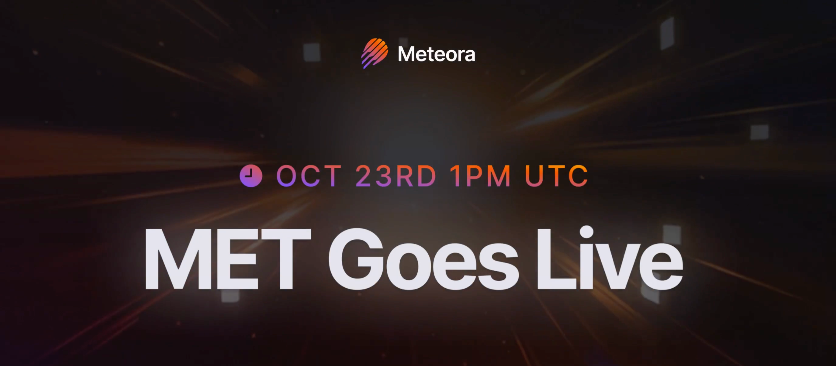
  • Token Generation Event (TGE): October 23, 2025, 1:00 PM UTC
  • Trading, claiming, and fee earnings: All begin simultaneously
  • Exchange listing: One hour after TGE (2:00 PM UTC)
  • Liquidity Distributor NFT holders can begin receiving fee earnings immediately, without having to claim tokens first.

For more information about Web3, register at: https://www.gate.com/

Summary

As a flagship DeFi infrastructure project on Solana, Meteora demonstrates a long-term, community-focused strategy in liquidity design, tokenomics, and ecosystem development. The recent class action against founder Benjamin Chow reminds investors that, despite technological advancement and ecosystem activity, legal and market risks remain. For participants, understanding the token distribution, liquidity mechanisms, and operating model—and exercising sound judgment—is vital to protecting their interests. With the MET token listing approaching, heightened market interest and trading activity may present opportunities, but also carry significant volatility risks.

Author: Allen
Disclaimer
* The information is not intended to be and does not constitute financial advice or any other recommendation of any sort offered or endorsed by Gate.
* This article may not be reproduced, transmitted or copied without referencing Gate. Contravention is an infringement of Copyright Act and may be subject to legal action.

Related Articles

Gold Price Forecast for the Next Five Years: 2026–2030 Trend Outlook and Investment Implications, Could It Reach $6,000?
Beginner

Gold Price Forecast for the Next Five Years: 2026–2030 Trend Outlook and Investment Implications, Could It Reach $6,000?

Analyze current gold price trends alongside authoritative five-year forecasts, integrating an evaluation of market risks and opportunities. This gives investors insight into the potential trajectory of gold prices and the main drivers expected to shape the market over the next five years.
2026-03-25 18:13:30
AI-Native Settlement Layers: How United Stables Is Building the Next Financial Rail
Beginner

AI-Native Settlement Layers: How United Stables Is Building the Next Financial Rail

Stablecoins were originally designed as dollar substitutes within exchanges, primarily used for asset pricing and trade settlement. As on-chain financial ecosystems have matured, their role has expanded beyond simple payments to include collateral assets, cross-chain liquidity mediums, and unified settlement units. In particular, as AI systems and automated agents begin to participate directly in economic activity, demand has risen sharply for programmable value units capable of instant settlement. This shift is pushing stablecoins toward the role of foundational financial infrastructure.
2026-03-25 03:16:17
Aster vs Hyperliquid: Which Perp DEX Will Prevail?
Beginner

Aster vs Hyperliquid: Which Perp DEX Will Prevail?

Aster and Hyperliquid are the two representative protocols of the "purpose-built L1 path" within the current decentralized perpetual exchange (Perp DEX) sector. As a pioneer in the field, Hyperliquid has built a deep liquidity moat through its highly mature order book architecture and strong community consensus. Conversely, Aster, as a rising challenger, seeks to leapfrog the competition in high-performance trading through more aggressive multi-chain aggregation logic, private transaction modules, and an underlying execution environment optimized for 2026 market demands.
2026-03-24 11:58:33
DePIN Identity Network and Real World Applications: How Humanity Protocol Brings on-chain Identity Into the Physical World
Beginner

DePIN Identity Network and Real World Applications: How Humanity Protocol Brings on-chain Identity Into the Physical World

Most Web3 identity systems remain confined to on-chain environments and struggle to achieve meaningful adoption in real world settings. Through a DePIN architecture and physical verification hardware, Humanity Protocol aims to bring decentralized identity into access control systems, hospitality, public services, and offline events, allowing on-chain identity to function not just as a digital credential, but as foundational infrastructure for real world access.
2026-03-25 07:40:53
Aerodrome Tokenomics: How ve(3,3) Powers Base's Most Profitable DEX
Beginner

Aerodrome Tokenomics: How ve(3,3) Powers Base's Most Profitable DEX

AERO is the native token of Aerodrome Finance, a core decentralized exchange and liquidity protocol in the Base ecosystem. It is primarily used for liquidity incentives and ecosystem operations. veAERO is a governance NFT that users receive by locking AERO, representing both voting power and the right to share protocol revenue. Through a dual track structure of AERO as a utility token and veAERO as a governance credential, Aerodrome separates liquidity usage value from long term governance power, allowing participants to act as liquidity providers, governance decision makers, and revenue sharers within the same system.
2026-03-25 06:40:31
How Does Kite Work? An In-Depth Look at Kite's Identity and Programmable Permission Architecture
Beginner

How Does Kite Work? An In-Depth Look at Kite's Identity and Programmable Permission Architecture

Kite is an EVM compatible Layer 1 blockchain network that runs on proof of stake. It is designed to give AI agents verifiable identity, programmable permissions, and real time settlement in an on-chain execution environment. In Kite's design, AI is no longer only a tool that follows instructions. It becomes an economic participant with independent on-chain identity and direct control over assets. Within secure and auditable infrastructure, an AI agent can complete payments, call services, and coordinate tasks autonomously, making Kite a foundational layer for the emerging agent economy.
2026-03-25 06:02:34