Blockchain technology was initially used mainly for digital asset transfers and decentralized payments. As enterprises began placing greater importance on data reliability and process transparency, however, blockchain started to move into broader scenarios such as supply chain management, product tracking, and business collaboration. In these settings, data authenticity and immutability directly affect supply chain efficiency, while traditional systems often suffer from information silos, limited transparency, and inefficient tracking.
VeChain emerged as an enterprise blockchain project against this backdrop. Through its dual token model, scalable on chain architecture, and enterprise focused tool services, it provides blockchain infrastructure for supply chain management and asset tracking. Compared with platforms that emphasize open finance or decentralized applications, VeChain focuses more on traceability and collaboration needs in real world industries, giving it an important position in the enterprise blockchain solutions market.
What Is VeChain (VET)?
As a public blockchain platform designed specifically for enterprise applications, VeChain aims to use blockchain technology to improve transparency and trust in supply chain and asset management processes. Its core goal is to allow companies to record the movement of goods, verify product authenticity, and share trusted data among different participants.
The native token of the VeChain network is VET, which is used for value transfer and network governance. The system also introduces VTHO as the transaction fee token, used to pay for on chain operation costs. This dual token structure gives enterprises more stable cost expectations when using blockchain services.
How Did VeChain Develop?
VeChain was originally founded in 2015 with the goal of solving information opacity in the supply chain industry. As enterprise demand for traceability increased, VeChain gradually evolved from an initial proof of concept into an independent blockchain network known as VeChainThor.
After the launch of the VeChainThor mainnet, VeChain began offering enterprises complete infrastructure for data recording, smart contract execution, and supply chain tracking. VeChain also lowered the entry barrier for companies through its ToolChain platform, allowing non blockchain enterprises to deploy on chain solutions more easily.
How Does VeChain’s Dual Token Mechanism Work?
VeChain uses a VET + VTHO dual token mechanism:
VET is the main value carrier in the network. It is used for transfers, staking, and participation in governance. VTHO is the network’s energy token, used to pay for on chain transactions and smart contract execution fees.
This design separates value storage from transaction fee payments, reducing the risk that enterprises face from transaction cost volatility caused by market fluctuations. Holding VET continuously generates VTHO, which provides resource support for network usage.
The core advantage of the dual token model is cost stability. For enterprises that need to record data on chain frequently, this mechanism can prevent transaction fees from fluctuating in direct sync with the main token price, improving predictability.
How Does the VeChainThor Blockchain Work?
VeChainThor is VeChain’s underlying blockchain network, and its core operating mechanism is based on Proof of Authority, or PoA, consensus.
Under the PoA model, certified Authority Masternode nodes are responsible for validating transactions and producing blocks. This mechanism reduces computational competition among nodes, enabling the network to achieve higher throughput and lower transaction costs.
Compared with PoW, PoA is more energy efficient. Compared with PoS, PoA can provide higher efficiency and more stable performance in enterprise application scenarios. This design is better suited to supply chain and enterprise use cases that require large volumes of data to be written on chain.
What Are VeChain’s Applications in Supply Chain Management?
VeChain’s main applications are concentrated in supply chain tracking and trusted data recording.
In product traceability scenarios, companies can write information about production, transportation, warehousing, and sales to the blockchain, making data from each stage transparent and verifiable. Consumers can scan a code to view a product’s origin and movement records, which helps increase trust.
In anti counterfeiting verification scenarios, VeChain can create a unique digital identity for each product, helping companies identify counterfeit goods. In addition, VeChain can improve data reliability and process efficiency through on chain records in areas such as carbon emissions management, cold chain logistics, and asset tracking.
What Core Components Does the VeChain Ecosystem Include?
VeChain’s ecosystem consists of the underlying blockchain network, enterprise service tools, and a partner network.
VeChainThor provides the base on chain infrastructure. ToolChain offers enterprise onboarding services, helping companies quickly implement product tracking and data management. The partner network supports VeChain’s real world application in supply chain and sustainability scenarios.
This ecosystem structure makes VeChain not only a blockchain network, but also a complete enterprise oriented solution.
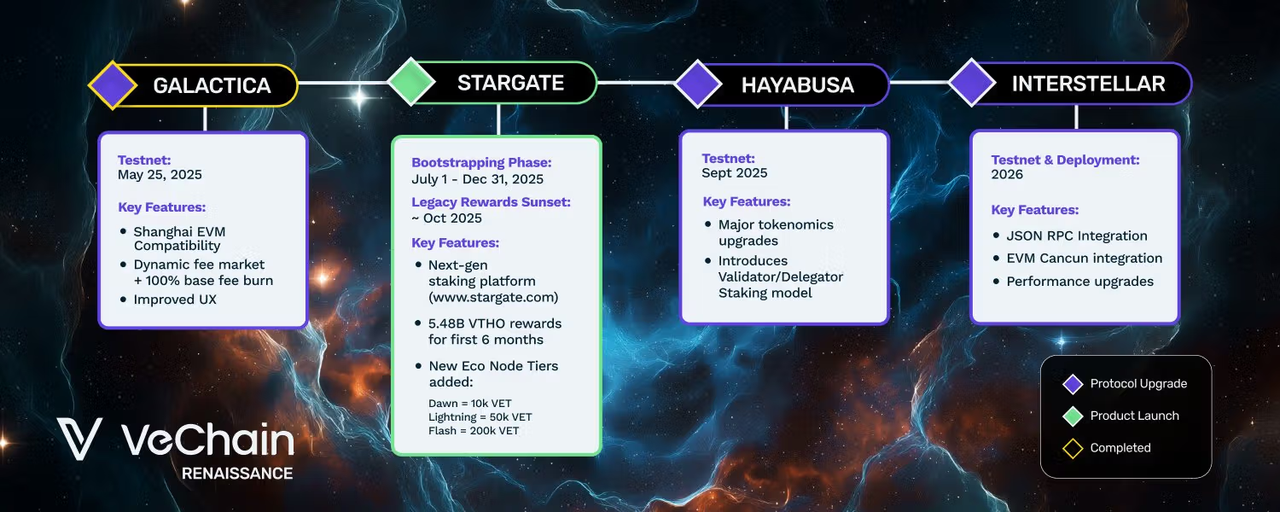
VeChain StarGate upgrade announcement and roadmap, source: VeChain
What Are VeChain’s Advantages and Limitations?
VeChain’s strengths lie in its enterprise oriented design. Its dual token mechanism provides a stable cost structure, PoA consensus improves performance, and ToolChain lowers the barrier for enterprises to use blockchain. Together, these features make VeChain highly applicable to supply chain scenarios.
Its limitations are also clear. Although the PoA model is efficient, it has a relatively small number of validator nodes, so its degree of decentralization is weaker than that of open public blockchains. At the same time, enterprise blockchain adoption cycles are usually long, and ecosystem expansion is often slower than that of general purpose public blockchains aimed at developers.
Conclusion
As a blockchain platform focused on enterprise applications and supply chain management, VeChain provides efficient and stable on chain services through its VET + VTHO dual token mechanism and PoA consensus model. Its core value lies in improving supply chain transparency and data reliability, allowing enterprises to use blockchain technology in areas such as product tracking, anti counterfeiting verification, and carbon management.
As enterprise demand for trusted data and traceability continues to grow, VeChain has established a distinct position in the enterprise blockchain solutions market and has become one of the important infrastructure projects connecting blockchain technology with real world industries.
FAQs
What Is VeChain (VET) Mainly Used For?
VeChain is mainly used for supply chain tracking, product traceability, anti counterfeiting verification, and enterprise data management, helping companies improve transparency and trust.
What Is the Difference Between VET and VTHO?
VET is the value token, used for transfers and governance. VTHO is the transaction fee token, used to pay for on chain transactions and smart contract execution costs.
What Consensus Mechanism Does VeChain Use?
VeChain uses the Proof of Authority, or PoA, consensus mechanism, where certified nodes are responsible for validating transactions and producing blocks.
Why Is VeChain Suitable for Supply Chain Management?
VeChain is suitable for supply chain management because it provides low cost, high efficiency data recording capabilities and helps ensure that supply chain information is transparent and tamper resistant.
How Is VeChain Different from Traditional Supply Chain Systems?
In traditional supply chain systems, data is often scattered across multiple centralized systems. VeChain uses blockchain to enable data sharing and trusted tracking across different participants.







