As Web3 applications become more complex, the limitations of traditional blockchains in data processing have become increasingly clear. These include data that cannot be verified, insufficient availability, and the inability of data to participate directly in computation. Irys was created to address these core bottlenecks, enabling on-chain applications to handle data at a much larger scale.
More broadly, Irys represents an evolution from a “storage blockchain” toward a “data-driven blockchain,” where data is not merely something recorded, but a core resource that can be verified, called, and used in execution.
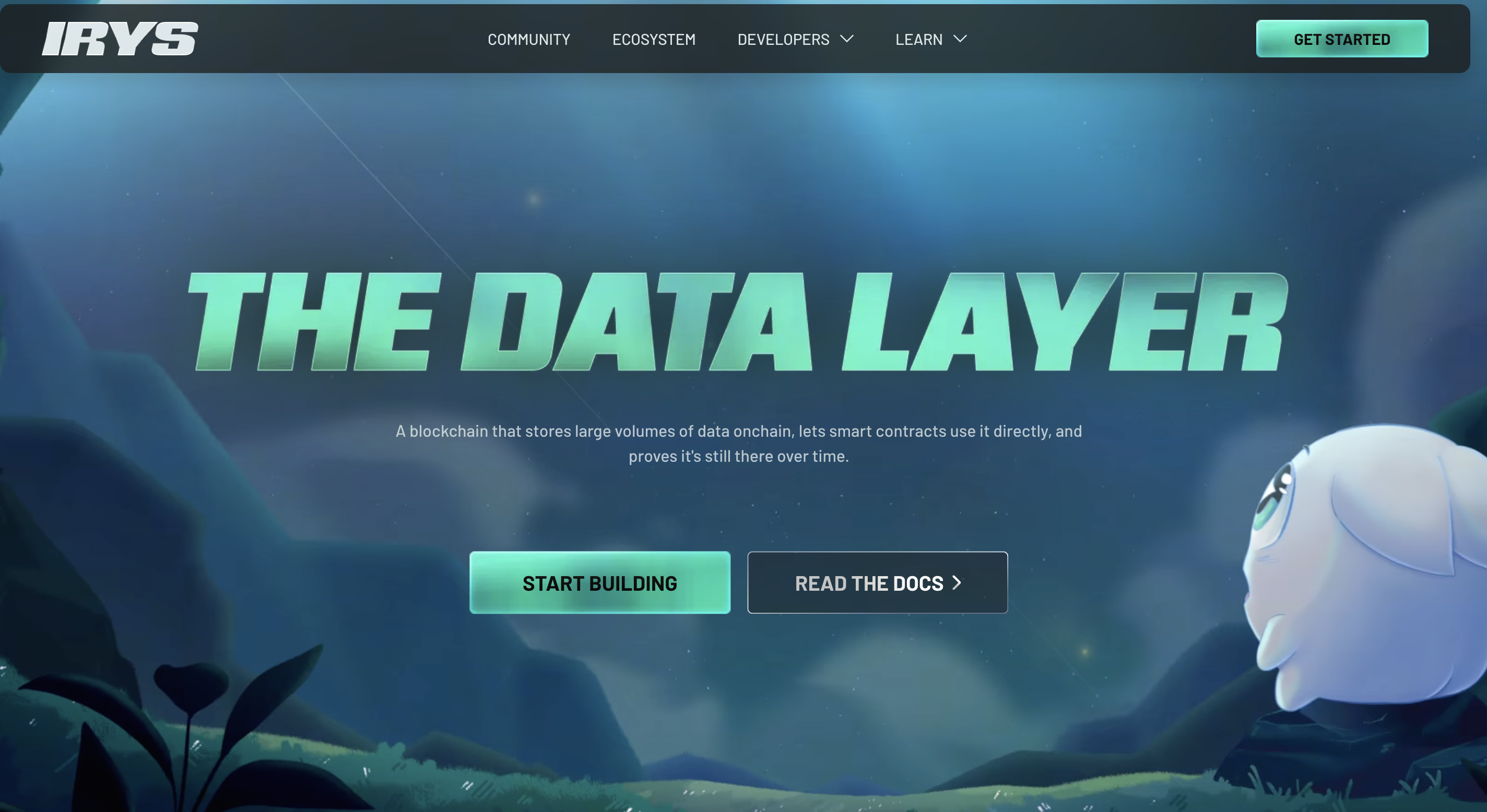
Source: irys.xyz
What Is Irys (IRYS)
Irys is a decentralized data network built around the concept of a “Datachain.” At its core, it is a blockchain system that supports both data storage and execution. Unlike traditional chains that only record transaction states, Irys brings data itself into the consensus and verification process.
In traditional storage-focused blockchains, data is usually treated as a static payload, and there is no unified mechanism across nodes to prove whether the data truly exists or remains continuously available. Irys introduces a verifiable data mechanism, allowing every piece of data to be proven and verified by the network as a whole.
This structure means Irys is no longer just a “storage layer,” but a programmable data environment. Developers can build data-dependent applications on top of it without relying on external data services.
Irys’s Core Positioning: The Web3 Verifiable Data Layer
Irys’s core positioning is to build the “verifiable data layer” for Web3, filling the structural gap between data and execution. In traditional architectures, data storage and smart contract execution are usually separated, which limits what applications can do.
In Web3, data not only needs to be stored, it must also meet three conditions: it must be verifiable, accessible, and usable for computation. Without these capabilities, on-chain applications struggle to process complex data logic.
Irys embeds data proofs, such as Proof of Storage and Proof of Availability, directly into the consensus process, making data part of the trusted on-chain environment. This means nodes can confirm the state of data without depending on external assumptions.
From an architectural perspective, Irys can be seen as one implementation path for the Data Layer or Data Availability layer. Its core value lies in connecting “data” with “execution.”
How Irys Works: How Data Is Stored, Verified, and Called
The way Irys works revolves around the data lifecycle, covering three key stages: upload, verification, and calling. First, users submit data to the network, where the data is sharded and incorporated into the on-chain structure.
In data verification, Irys’s innovation lies in the fact that each block records not only transaction ordering, but also cryptographic sampling proofs for data partitions. This ensures that data not only exists, but can also remain continuously accessible.
In addition, the network uses a unified verification mechanism to avoid the fragmentation that comes from each node verifying data independently. All nodes can confirm data status based on the same rules, improving overall consistency.
At the data calling level, Irys allows data to participate directly in on-chain execution logic, turning it into “programmable data.”
Irys’s Network Structure: Nodes, Storage, and Data Distribution Logic
The Irys network consists of multiple nodes responsible for data storage, verification, and distribution. Similar to traditional blockchains, nodes must follow a consensus mechanism to maintain network consistency.
For data distribution, Irys uses partitioning and replication mechanisms to store data across the network. This structure improves data availability while reducing the risk of single points of failure.
More importantly, nodes do not merely store data. They also need to prove that they are “actively storing data.” This mechanism is implemented through cryptographic proofs and sampling verification, turning data storage into a verifiable action. Network operation depends on incentive mechanisms, including storage rewards and verification earnings.
The Function and Role of the IRYS Token: Incentives, Payments, and Network Security
The IRYS token is the core economic tool that supports network operation. Its main roles include paying storage fees, incentivizing nodes, and maintaining network security.
At the usage level, users need to pay tokens to store data. This is similar to a Gas model, but its fee structure is more closely tied to data resource consumption. This mechanism makes data storage a measurable and priceable activity.
At the incentive level, nodes earn rewards by providing storage and verification services, creating a decentralized supply of resources. This design helps ensure the network can continue operating over time.
In addition, the token may also be used in staking and security mechanisms to help prevent malicious behavior. Overall, IRYS tokenomics forms the economic foundation of the network.
Irys Use Cases: From Data Storage to Web3 Infrastructure
Irys’s use cases first appear in Web3 data storage, including NFT metadata, on-chain content, and long-term data archiving. These scenarios require data to remain accessible over the long term and resistant to tampering.
In DeFi and on-chain applications, data availability is a critical requirement. The data layer capabilities provided by Irys allow complex data to be used directly by on-chain logic.
As AI and data markets continue to develop, the importance of verifiable data becomes even greater. Irys can provide infrastructure support for data trading and computation.
Overall, Irys is evolving from a “storage tool” into an “infrastructure layer.”
How Irys Differs from Other Storage Protocols, Including Arweave and Filecoin
Although Irys, Arweave, and Filecoin all aim to solve Web3 data storage challenges, they differ clearly in positioning and design.
Arweave focuses on permanent storage, using a one-time payment model for long-term preservation. Filecoin, by contrast, builds a storage market for on-demand storage. Irys’s core goal is not only storage, but the construction of a Verifiable Data Layer, with a focus on whether data can be proven to exist, remain accessible, and be called directly by on-chain logic.
In terms of the relationship between data and computation, Irys integrates “data verification + execution logic” into the same system, allowing data not only to be stored, but also to participate directly in on-chain computation. This “data as state, data as executable” design makes Irys closer to a data-driven computation layer than a simple storage network.
Irys’s Strengths, Limitations, and Common Misconceptions
Irys’s main strength lies in its integrated “data + execution” design, which allows data to participate directly in on-chain logic. This structure provides a foundation for more complex applications.
In addition, the verifiable data mechanism improves data trustworthiness, allowing developers to avoid reliance on external services. This is highly important for building decentralized applications.
However, its limitations are also fairly clear. These include higher system complexity, an ecosystem that is still developing, and a cost model that requires long-term validation.
A common misconception is to equate Irys with traditional cloud storage. In reality, it is closer to an on-chain data infrastructure layer than a simple storage replacement.
Summary
By introducing a verifiable data layer, Irys integrates data storage, verification, and execution into a unified architecture, helping blockchain evolve from a “state recording system” into a “data-driven system.”
Its core value lies in making data a trusted on-chain resource, thereby supporting more complex and more practical Web3 applications. This structure not only changes how data is stored, but also redefines the role of data within blockchain systems.
FAQ
1. What Is Irys**?**
Irys is a decentralized data storage and verifiable data layer protocol, mainly used to support on-chain data storage and executable computation.
2.How Is Irys Different from Arweave?
Irys places greater emphasis on data verifiability and executability, while Arweave focuses more on permanent storage. Building on Arweave, Irys adds data verification and execution capabilities.
3.What Is the IRYS Token Used For?
The IRYS token is the core economic asset of the Irys network. It is mainly used to pay data storage fees, incentivize network node operation, and maintain network security and consensus.
4.Which Layer Does Irys Belong To?
Irys is generally viewed as part of the Web3 Data Layer or Data Availability layer, providing verifiable data infrastructure for blockchains and applications.
5.Can Irys Replace Traditional Cloud Storage?
Not completely. Irys focuses more on blockchain data infrastructure. Its strengths are decentralization, verifiability, and permanence, but it still differs from traditional cloud storage, such as AWS and Alibaba Cloud, in performance, cost, and large-scale general-purpose storage.







